Indian-made Renault Duster headed for SA
The Duster forms part of Renault’s product expansion of its Chennai plant and will go on sale later this year.
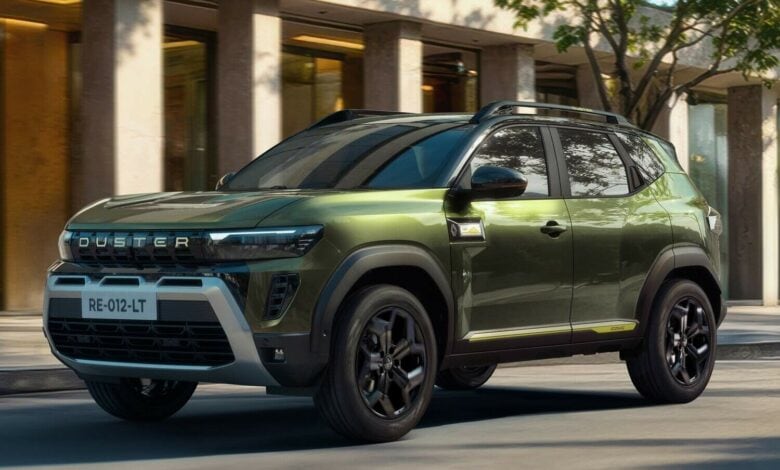
Unveiled globally three years ago as a Dacia, Renault has removed the wraps from the Indian-made third generation Duster confirmed to arrive in South Africa later this year, reports The Citizen.
Rebadged as a Renault in select European markets where the Dacia brand isn’t marketed, the Indian assembled model comes via the brand’s Chennai plant, and differs subtly from the variant made in both Romania and Turkey.
Europe vs India
These include the dropping of the Dacia signature Y-shaped LED headlight graphics, the introduction of a new front bumper with an integrated imitation skidplate and nudge bar, block letter Duster instead of Renault lettering on the grille and wider inlets on the flanks of the bumper itself.
Mounted on 17 or 18-inch alloy wheels, the aesthetic differences go further as the upwards shoulder line underneath the D-pillar has changed, while still retaining the door handles concealed within the C-pillar.

At the rear, the Dacia-inspired light cluster remain, but connected via an LED light bar running below the window line.
Additional differences is a blackened numberplate cavity and a restyled bumper with an integrated satin silver imitation skidplate.
Dimensions
Dimensionally, the Duster differs only in width and height from the European version, with the former 1813mm versus 1921mm, and the latter 1669mm compared to 1661mm.
The 4343mm overall length and 2657mm long wheelbase measurements are therefore the same, however, ground clearance is slightly higher at 212mm compared to 209mm.
Claimed boot space is 518-litres or 1789-litres with the rear seats folded flat. By comparison, the European Duster has between 472 and 1 609-litres of packing space.
New inside
Inside, the interior has been completely reworked, with the final design and layout leaning more towards to the new Clio and all-electric 5 E-Tech than a Dacia.
The biggest is the dashboard, which gains a pair of dual displays; the infotainment system still measuring 10.1-inches, but the instrument cluster available in either seven or 10.25-inches.
Also gone are the Dacia Y-shaped air vents replaced by more conventional ones, reportedly improved materials admit much criticism against the ones in the current European-made model, a new central hangdown section below the infotainment system, and restyled centre console.
Depending on the trim level, notable features include a panoramic sunroof, ambient lighting, type-C USB ports, electric and ventilated front seats, dual-zone climate control, an electric tailgate and an Arkamys sound system.
Taking care of safety are front and rear parking sensors, a 360° camera system, a minimum of six airbags, lane keep assist, blind spot monitoring, traffic sign recognition, automatic emergency braking, driver attention alert, auto high beam assist and lane departure warning.
Still no diesel, 4WD also gone
Up front, the Duster comes with a choice of three engines, one being a hybrid difference to that of the Europe.
Called TCe 100, the base 1.0-litre three-cylinder turbo-petrol produces 100 PS or 74kW/160Nm. A six-speed manual is the only transmission option available.
Familiar to South Africans, the TCe 160 uses the Daimler co-developed 1.3-litre turbo-petrol rated at 160 PS or 118kW/280Nm.
Transmissions are either a six-speed manual or a six-speed dual-clutch EDC as opposed to the current Duster’s seven.
Finally, the hybrid combines a normally aspirated 1.8-litre petrol with a 1.4-kWh battery pack powering a pair of electric motors.
The result is 80kW/172Nm connected to a four-speed automatic gearbox, which becomes a six-speed when taking into the account the single ratios provided by each of the electric motors.
In the biggest departure from the European Duster, the Indian-market version is solely offered with front-wheel drive with no four-wheel drive option being available or planned.
Coming to South Africa
Going on-sale later this year, the Duster forms part of Renault’s product expansion of its Chennai plant, which will later include a market specific version of the Boreal spun-off of the Dacia Bigster.
As is well-known by now, the Duster will also spawn a rebadged version called the Nisan Tekton, which has been confirmed for South Africa alongside an incoming Nissan version of the Boreal.
Teased towards the end of 2024 on local soil before its eventual market release last year, the confirmation then of the Duster being sourced from Romania was only temporary as primary production in India had already been planned.
As such, expect pricing to possibly drop once the Indian-made models finally go on-sale later this year.
Only then will pricing be announced, though, expect the likely end of the four-wheel drive model as well as the mild-hybrid 1.2-litre turbocharged engine that powers it.
Breaking news at your fingertips… Follow Caxton Network News on Facebook and join our WhatsApp channel.
Nuus wat saakmaak. Volg Caxton Netwerk-nuus op Facebook en sluit aan by ons WhatsApp-kanaal.