
2021 Local Election Factsheet: Housing in South Africa
What share of South Africans live in formal houses? How many houses has the government built? Ahead of the local government elections on Monday (November 1), our factsheet answers voters’ questions.
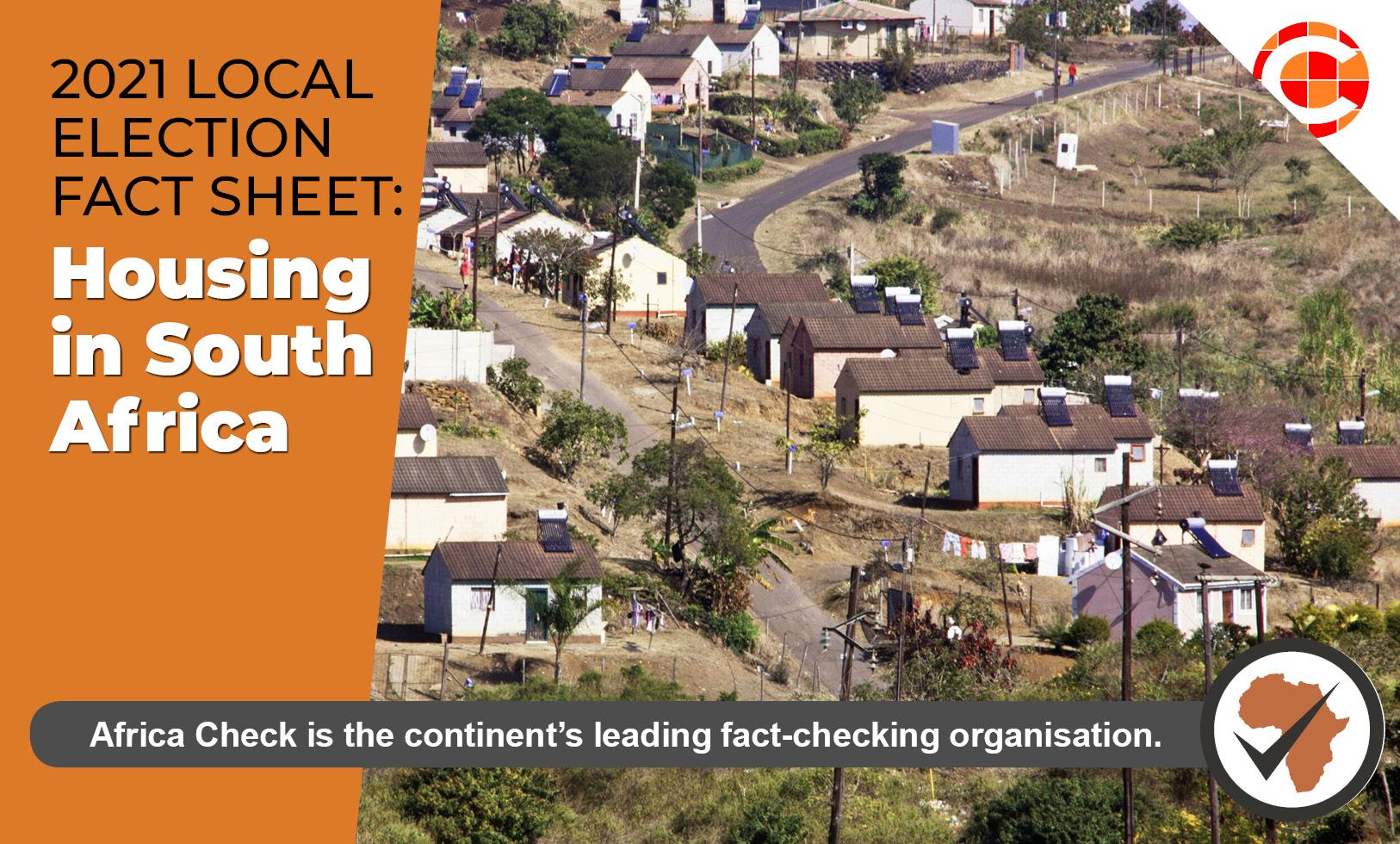
Next week, South Africans head to the polls to elect representatives for district, metropolitan and local municipal councils across the country.
In its election manifesto, the EFF lists ‘free quality’ housing as one of its cardinal pillars. The ANC boasts that it has increased access to housing, and the DA promises to ‘increase the scale of housing’ delivered through private initiatives.
What percentage of South Africans have access to housing? How many houses has the government built? We answer these questions and more.
What percentage of South Africans have access to housing?
Statistics South Africa records housing data in its annual general household survey. The latest survey is for 2019, with the Covid-delayed 2020 survey due to be released on Thursday (October 28), according to Stats SA’s service delivery statistics manager Niël Roux.
In 2019, almost 82% of South African households lived in formal housing. A formal dwelling is a ‘structure built according to approved plans’. This is in contrast to traditional dwellings (built from traditional materials) and informal dwellings.
How big is the housing backlog?
South Africa’s housing backlog was estimated at 1.5 million units in 1995. It was expected to increase by 178 000 units a year due to population growth. By 2018, the human settlements minister reported that the housing backlog had increased to 2.1 million units.
The 2019 general household survey estimated that 12.7% of households lived in informal dwellings. This means about 2.2 million households are in informal dwellings, based on Stats SA’s estimate that the country has just over 17.1 million households.
Informal dwellings include ‘makeshift structures not erected according to approved architectural plans’. These include shacks or shanties built in informal settlements or in backyards. Stats SA suggested that ‘rapid household growth and population relocation’ has made it difficult to address the housing backlog.
How many houses has the government built?
The human settlements department’s 2019/20 annual report says it has provided ‘about 4.8 million’ housing opportunities since 1994. But this doesn’t mean 4.8 million new houses were built.
As of 2019, government had provided just over 3.3 million housing units and just over 1.1 million serviced sites. A serviced site is a piece of land that is connected to water, sanitation, and electricity. Recipients have to build their own houses.
What problems do people experience with state housing?
The share of households that received government housing subsidies grew from 5.6% in 2002 to 18.7% in 2019. Stats SA includes questions in its general household survey on the quality of this housing ‘as a result of the concerns raised by community groups’.
This was done to ‘facilitate an analysis of the extent of problems experienced by households with the construction of these dwellings’. In 2019, 10.9% of households in state-subsidised houses reported weak or very weak walls and 10.8% said the same of their roofs.
These problems were most common in the Northern Cape. Gauteng had the lowest levels of reported weak walls and roofs.
Percentage of households that said their ‘RDP’ or state-subsidised house had ‘weak or very weak’ walls or a ‘weak or very weak’ roof. 
Also see: 2021 Local Election Factsheet: Sanitation in South Africa
Also see: 2021 Local Election Factsheet: Poverty in South Africa
Also see: 2021 Local Election Factsheet: Jobs in South Africa
Also see: 2021 Local Election Factsheet: Electricity in South Africa
Also see: 2021 Local Election Factsheet: Water in South Africa
This article was written by Africa Check, a non-partisan fact-checking organisation.


Read original story on witbanknews.co.za

