
Covid-19 rules “bid to stop virus, not curb freedom” – government
Those responsible for ensuring masks were worn by individuals on their premises or when using public transport were faced with a fine or imprisonment for a period not exceeding six months or both.
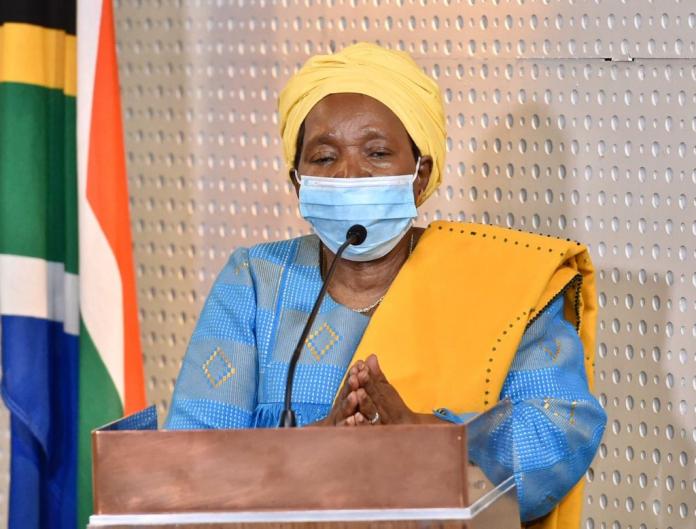
Fines and criminal records were in the offering for those responsible for ensuring anyone on their premises were indeed wearing masks.
New Covid-19 lockdown regulations announced on Monday, meant any employer, manager or owner of a building, used by the public to obtain goods or services, would be responsible if any person enters and remains at their premises without wearing a mask.
The same goes for any driver, owner or operator of public transport.
Failing to ensure that the now mandatory mask requirement was adhered to could see such persons facing a fine or imprisonment for a period not exceeding six months or to both a fine and imprisonment.
Following a declaration by president Cyril Ramaphosa during a televised address to the nation on Sunday night, ministers responsible for the proclamation regulations on Monday explained that, while the onus to ensure masks were worn fell on employers, business owners and transport operators, fines and criminal records for individuals were not in the regulations at this stage.
During Monday morning’s briefing, local government minister Dr Nkosazana Dlamini-Zuma said the wearing of masks was a mandatory measure in curbing the spread of the virus.
“It is mandatory to wear a face mask to protect ourselves and those around us. You cannot enter any form of public transport without a mask. Not just in transport but in any public place, you must wear a mask.”
The measures were not meant to limit the nation’s freedom but to limit Covid-19, Dlamini-Zuma explained.
The government made an exception for those undertaking vigorous exercises in public places as long as they maintained a distance of at least three metres from any other person.
“We are approaching the eye of the storm. We are burying mothers, fathers, sisters and grandchildren, as the spread grows. This means we must all work together and protect one another. No one is safe until we are all safe.”
Dlamini-Zuma said the surge in the number of Covid-19 cases was mainly due to the reopening of the economy and government needed to reinstate the levels to curb the fast-growing cases.
“We were forced to ease the lockdown regulations due to responsibility to balance the economy and the health crisis.”
She said approaching the anticipated Covid-19 peak, every citizen needed to take responsibility in playing their part in curbing the spread.
Dlamini-Zuma said the wearing of masks was the responsibility of every citizen.
Under the strengthened measures, social distancing would remain in place and social gathering remain outlawed.
The tobacco ban alongside many other level three regulations were unchanged as the country battled an increasing number of Covid-19 cases with the peak season fast approaching.
On the reinstated alcohol ban, she said alcohol contributed to people not adhering to lockdown regulations which led to many flooding hospitals thus overwhelming the system.
“When people are drinking in groups they let their guard down, they let the masks go and social distancing is not adhered to.
“When people have taken liquor they get drunk and indulge in irresponsible behaviour, start fighting and killing each other and drive while under the influence of alcohol.”
She said alcohol usage led to emergency cases that overwhelmed health facilities.
The sale of tobacco, tobacco products and e-cigarettes also remains prohibited.
“The virus does not move but it is spread by people. To limit the spread we have to limit movement. It is for that reason that the curfew from 21:00 to 04:00 has been brought back. An exception is for those who are working. Such people will need a permit.”
Taxis will be allowed 100% load capacity for a short distance and 70% for long-distance but visiting a family member was still not allowed under reinforced lockdown level three regulations.
“The young ones may carry the virus without knowing it and then pass it to their grandparents, we have seen this happening.”
Inter-provincial travel was also still not allowed unless one was embarking on a business trip or critical trips.
“People over 60 must remain at home as far as possible as the mortality rate rises daily in the age group,” she said.
Hotels, lodges, bed and breakfasts, timeshare facilities, resorts and guest houses are still not allowed for leisure stays, they are allowed to operate for quarantine or business trip purposes only.
Public parks were now open for exercising but not for social gatherings, while auctions would be allowed under strict conditions.
The regulations are applicable as of Monday.
Other cabinet ministers were scheduled to elaborate on other regulations.
Notice: Coronavirus reporting at Caxton Local Media aims to combat fake news
Dear reader,
As your local news provider, we have the duty of keeping you factually informed on Covid-19 developments. As you may have noticed, mis- and disinformation (also known as “fake news”) is circulating online. Caxton Local Media is determined to filter through the masses of information doing the rounds and to separate truth from untruth in order to keep you adequately informed. Local newsrooms follow a strict pre-publication fact-checking protocol. A national task team has been established to assist in bringing you credible news reports on Covid-19.
Readers with any comments or queries may contact National Group Editor Irma Green (irma@caxton.co.za) or Legal Adviser Helene Eloff (helene@caxton.co.za).
Read original story on rekordcenturion.co.za

