
Dinosaur eggshells provide a new way to date fossils
Researchers at Stellenbosch University have found a new technique that uses dinosaur eggshells to more accurately determine the age of fossil sites around the world.
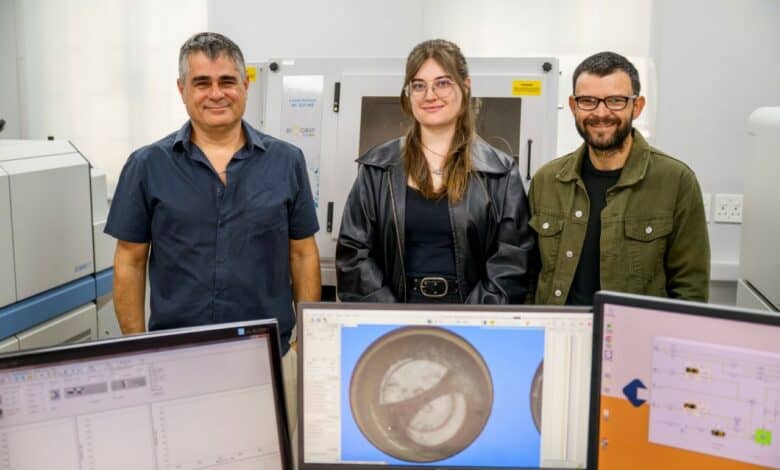
An international team of geologists and palaeontologists is pioneering a groundbreaking methodology to reliably determine the age of fossil-bearing rocks by directly dating fossilised dinosaur eggshells.
The study, led by Dr Ryan Tucker from Stellenbosch University’s (SU) Department of Earth Sciences, was published in Communications Earth & Environment.
According to a statement by SU, many fossil sites around the world are only coarsely dated.
“Without precise information on the geologic age of fossils, palaeontologists struggle to understand how different species and ecosystems relate across time and space,” the statement reads.
Researchers typically date fossils indirectly, using minerals like zircon or apatite found nearby. However, these minerals aren’t always present, and dating the fossils themselves – bones or teeth – often yields uncertain results.
Tucker’s team, consisting of MSc student Kira Venter and Prof Cristiano Lana from the Elemental and Isotope Analysis Laboratory at SU’s Central Analytical Facilities, took a different approach.
Natural clock
They used advanced uranium–lead dating and elemental mapping to measure trace amounts of uranium and lead housed inside the calcite of fossilised dinosaur eggshells. These isotopes function like a natural clock, enabling scientists to determine when the eggs were buried.
This team from SU developed a novel method to age-date fossilised dinosaur eggs, using a Neoma Multi-Collector, Inductively Coupled Plasma, Mass Spectrometer instrument, hosted in the Elemental and Isotope Analysis Laboratory in SU’s Department of Earth Sciences.
Tests on dinosaur eggs from Utah (USA) and the Gobi Desert (Mongolia) showed that the eggshells record ages with an accuracy of about 5% relative to precise volcanic-ash dates. In Mongolia, the team determined the first-ever direct age, around 75 million years old, for a historic locality preserving dinosaur eggs and nests.
“Eggshell calcite is remarkably versatile,” says Tucker. “It gives us a new way to date fossil sites where volcanic layers are missing, a challenge that has limited palaeontology for decades.”
The project involved researchers from institutions in the US, Mongolia and Brazil, including the North Carolina Museum of Natural Sciences and North Carolina State University. Fieldwork in Mongolia was conducted through the Mongolian Alliance for Dinosaur Exploration (MADEx) and supported by the National Geographic Society and the National Science Foundation.
By showing that dinosaur eggshells can reliably record the passage of geologic time, the study links biology and Earth science in a new way, offering researchers a powerful tool to date fossil sites around the globe.
“Direct dating of fossils is a palaeontologist’s dream,” says study co-author Lindsay Zanno, associate research professor at North Carolina State University and head of palaeontology at the North Carolina Museum of Natural Sciences. “Armed with this new technique, we can unravel mysteries about dinosaur evolution that used to be insurmountable.”
Breaking news at your fingertips… Follow Caxton Network News on Facebook and join our WhatsApp channel.
Nuus wat saakmaak. Volg Caxton Netwerk-nuus op Facebook en sluit aan by ons WhatsApp-kanaal.
Read original story on www.citizen.co.za

