
Durban University of Technology manufactures its own hand sanitisers
The Durban University of Technology (DUT) has produced 1000 litres of hand sanitiser: FastSan 80, which will be distributed for free to staff and students when the university re-opens.
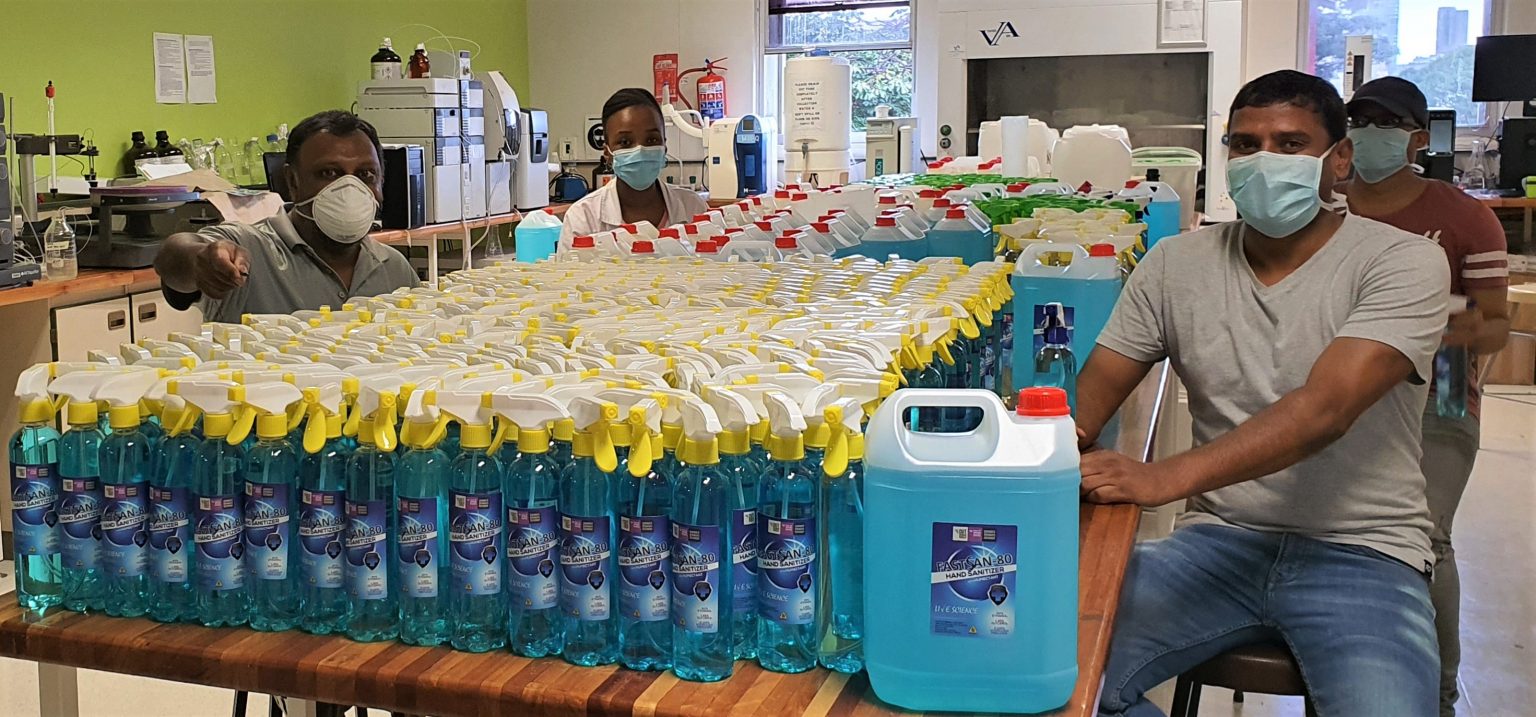
This project is part of the university’s initiatives driven by the vice-chancellor, Prof Thandwa Mthembu, to curb the spread of COVID-19 among the DUT community.
Prof Suren Singh, the executive dean of the Faculty of Applied Sciences, stated that the faculty has a wide array of expertise that could play a significant role in the fight against Covid-19.
Singh further explained that it was only fitting that this project be spearheaded by Prof Kugen Permaul, one of the universities leading molecular biologists, and director of the BRICS consortium on Biomass Utilization (one of only three globally), to spearhead this project.
Prof Permaul drove this project with a highly technical skilled team from the Department of Biotechnology and Food Technology at DUT comprising of three staff members, Dr Adarsh Puri, Mr Gaositwe Makalomakwa and Mrs Siphiwengesihle Mbamali. Their passion for using science to make a difference led to the evolution of a unique product.
“The first batch of 1000 litres of hand sanitiser was produced, bottled, and labelled in four days. A competition was held within the department to come up with a name for the hand sanitiser. FastSan was proposed by the Head of Department, Prof Feroz Swalaha, and chosen as it includes the faculty name and the ‘80’ designates the alcohol concentration,” said Permaul.
He further stated that the hand sanitiser was formed accordingly to the World Health Organization (WHO) specifications.
Elaborating on its effectiveness, Permaul shared that the FastSan 80 hand sanitiser uses 80 percent ethanol as opposed to most of the sanitisers that use 70 percent or lower ethanol.
“While 70 percent of ethanol is an effective concentration for inactivating coronaviruses and other micro-organisms, 80 percent ethanol is more effective. Besides the active ingredient, alcohol, a humectant has been added to moisturize hands and prevent drying out with frequent use. Hydrogen peroxide is added to sterilize the bottles and sanitiser,” explained Permaul.
The first batch of 500ml spray bottles and 5 litres containers have been collected by DUT’s Covid-19 Task Team and will be distributed when the institution re-opens.
The team is considering making smaller sizes for more portability.
The project is currently for internal use at DUT but future plans may include distribution to the community and other organisations.
Notice: Coronavirus reporting at Caxton Local Media aims to combat fake news
Dear reader,
As your local news provider, we have the duty of keeping you factually informed on Covid-19 developments. As you may have noticed, mis- and disinformation (also known as “fake news”) is circulating online. Caxton Local Media is determined to filter through the masses of information doing the rounds and to separate truth from untruth in order to keep you adequately informed. Local newsrooms follow a strict pre-publication fact-checking protocol. A national task team has been established to assist in bringing you credible news reports on Covid-19.
Readers with any comments or queries may contact National Group Editor Irma Green (irma@caxton.co.za) or Legal Adviser Helene Eloff (helene@caxton.co.za).
Read original story on risingsunoverport.co.za

