
Government tightens the screws as Covid-19 cases soar
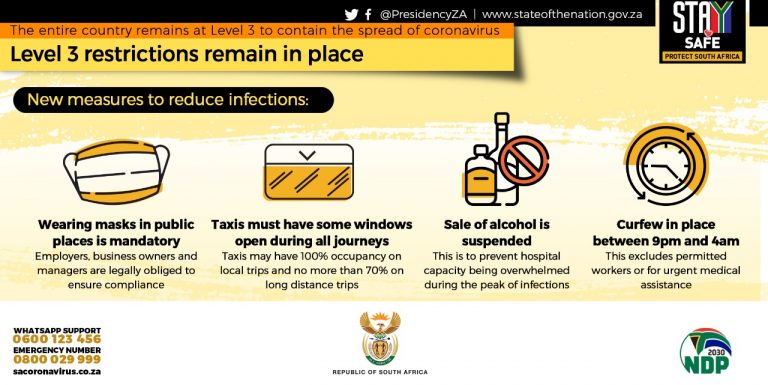
The strengthening of regulations would include the reinstating of a curfew from Monday evening between 21:00 and 04:00, the suspension of family visits and other social events as well as a ban on the sale and distribution of alcohol with immediate effect.
With cases of Covid-19 showing an alarming upward trend, the government has moved to strengthen enforcement of regulations.
The country would remain on alert level three, but with some curbs last seen in level four or five.
In a televised address to the nation on Sunday, President Cyril Ramphosa said following consultations cabinet, the national coronavirus command council as well as various experts, strengthened regulations would include the reinstating of the curfew from between 21:00 – 04:00 every day, the suspension of family visits and other social events as well as a ban against the sale and distribution of alcohol with immediate effect.
“Cabinet has approved the extension of the national state of disaster to the 15th of August 2020,” he said.
Ramaphosa said the decision to ban the sale and distribution of alcohol came as a result of a strain on the health care system burdened by an increase in emergency trauma cases in hospitals.
He said bed capacity in hospitals was overwhelmed by preventable alcohol-related casualties.
“We have therefore decided that in order to conserve hospital capacity, the sale, dispensing and distribution of alcohol will be suspended with immediate effect,” he said.
“There is now clear evidence that the resumption of alcohol sales has resulted in substantial pressure being put on hospitals, including trauma and ICU units, due to motor vehicle accidents, violence and related trauma.”
Parks will be open only for exercise but not any other form of gathering.
Masks
Ramaphosa said institutions had a legal obligation to ensure that anyone in their organisations wore masks.
“Employers, shop owners and managers, public transport operators and managers and owners of any other public building are now legally obliged to ensure that anyone entering their premises or vehicle must be wearing a mask.
“All workplaces and all institutions need to ensure that there is a designated coronavirus official responsible for making sure that all regulations and all precautions are strictly adhered to,” Ramaphosa said.
Taxis
Taxis undertaking local trips would now be permitted to increase their capacity to 100%, while long-distance taxis would not be allowed to exceed 70% of passenger capacity, on condition that masks were worn, vehicles sanitised and windows opened.
Hospitals
Ramaphosa said ward capacity was being freed up in a number of hospitals by delaying non-urgent care.
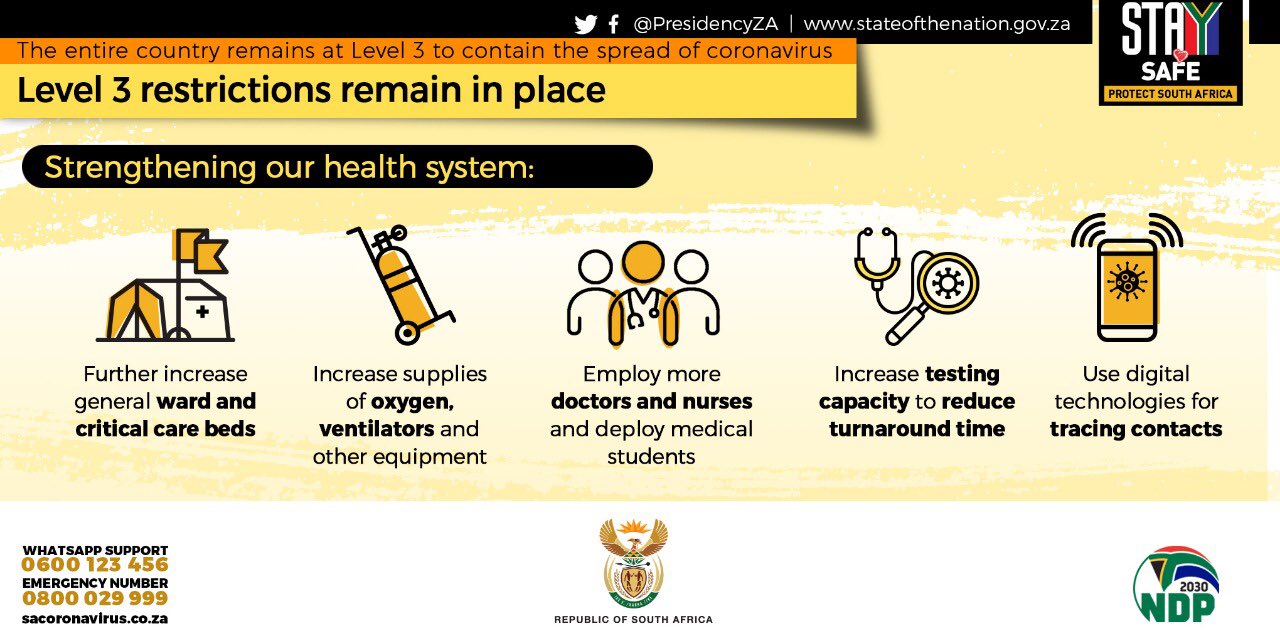
“We are working to increase supplies of oxygen, ventilators and other equipment for those who will need critical care, including by diverting the supply of oxygen from other purposes.
“Due to the lack of critical care facilities in rural areas, measures are being put in place to refer patients to better-equipped urban centres.
“To deal with shortages of health personnel in some areas, government will employ more doctors and nurses and is negotiating with health science faculties to deploy volunteers to provide medical, nursing, physiotherapy, pharmacy and general patient support. Almost 28,000 hospital beds for Covid-19 patients have been made available,” the president said.
More than 37 000 quarantine beds in private and public facilities across the country have been prepared to isolate those who cannot do so at home and 1 700 additional ventilators have been secured.
Testing
Ramaphosa said they were working to reduce the turnaround time for testing to no more than 48 hours.
Anti-body testing for community-based surveillance would be introduced to estimate the population that has been infected with this virus.
“We have conducted more than two million coronavirus tests and community health workers have done more than 20 million screenings,” he said.
“We have procured and delivered millions of items of personal protective equipment to hospitals, clinics and schools across the country to protect our frontline workers.”
Gauteng being the epicenter of the virus was said to be approaching 100 000 confirmed cases.
The Eastern Cape has passed 50 000 cases and the Western Cape was nearing 80 000 cases.
More than 134 000 South Africans have recovered from the coronavirus.
“According to current projections, each of our provinces will reach the peak of infections at different times between the end of July and late September,” Ramaphosa said.
A total of 276 242 cases have been reported in the country to date, with over 12 00 cases reported every day.
Notice: Coronavirus reporting at Caxton Local Media aims to combat fake news
Dear reader,
As your local news provider, we have the duty of keeping you factually informed on Covid-19 developments. As you may have noticed, mis- and disinformation (also known as “fake news”) is circulating online. Caxton Local Media is determined to filter through the masses of information doing the rounds and to separate truth from untruth in order to keep you adequately informed. Local newsrooms follow a strict pre-publication fact-checking protocol. A national task team has been established to assist in bringing you credible news reports on Covid-19.
Readers with any comments or queries may contact National Group Editor Irma Green (irma@caxton.co.za) or Legal Adviser Helene Eloff (helene@caxton.co.za).
Read original story on rekordeast.co.za

