
Inside South Africa’s booming delivery industry
Motorbike delivery riders in South Africa’s fast-growing delivery sector say they face long hours and safety risks, while retailers point to existing safety and compliance measures.
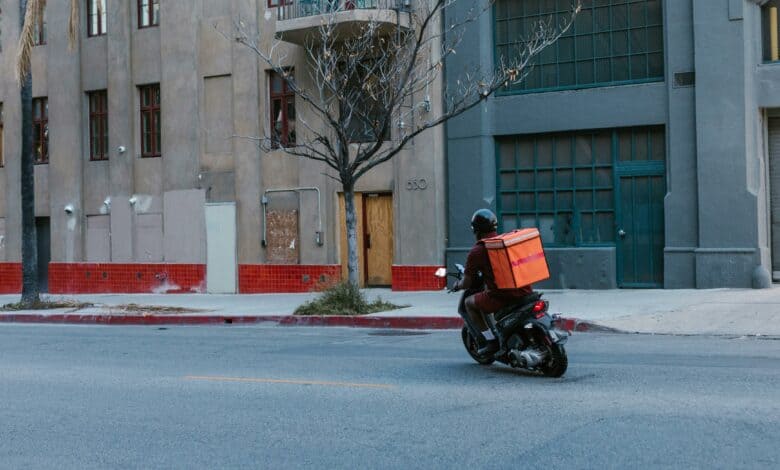
While the motorbike delivery industry has brought convenience to consumers’ doorsteps, stakeholders say it faces several challenges that require formal regulation.
Motorbike delivery riders, who wished to remain anonymous, say their jobs are a daily struggle.
A 36-year-old driver said he works from 07:30 to 22:00 each day.
“We face a lot of challenges, including the risk of being hijacked and the aggressive behaviour of other motorists on the road. We fear for our lives and our safety. Motorists act as though we are imposing on them by using the roads. They stop us, park in front of us and sometimes even try to knock us down,” he adds.
The driver says that they also work under poor conditions.
“It does not matter if the weather is bad or the roads are slippery; if a delivery needs to go out, we have to do it. The long shifts have also left us constantly tired because, from the time we wake up, we are working,” he adds
Long hours and low earnings
He says that they only get one day off a week.
“The pay is also not good. Companies pay us per order, and on average, we make R22 for each delivery. So, if we complete 10 orders in a day, we earn R220. I pay R850 a week to hire my bike. I have to pay for my own petrol and ensure the bike is serviced at least twice a month, depending on the kilometres travelled.”
He explains the service costs about R500.
“Each week, I have to make over R3 500 to cover these costs and still have enough money to live. If I make less than R3 000, then I know I am in financial trouble,” he says.
The driver claims that the industry comprises 70% foreign nationals.
“Many of them are not registered, while others borrow each other’s accounts to work. The industry needs some form of regulation,” he alleges.
Unemployment
Another driver agreed that the industry needs to be better regulated.
“It is difficult for us to get other jobs and, although this work enables us to provide for our families, we are being unfairly treated by big companies that are making millions from our labour,” he adds.
He works from 08:00 to 22:00 and is paid only on commission.
“Many of us have become victims of crime. People place orders and, once you arrive at the delivery location, you are robbed of your money, cellphone and vehicle. If we are injured on the job, we have to take ourselves to hospital. Nobody checks up on us or pays the medical bills – everything comes out of our own pockets,” the driver claims.
Another driver says he started doing delivery work after losing his job as a security guard.
“It is a lot of hard work, and we only get paid on commission. We need the industry to be regulated because we are expected to work like regular employees, but we do not have any of the benefits. We at least need a set salary,” he says.
Retailer delivery models and pay structures
Two major retailers with established delivery services operating at scale across the country provided insight into their delivery models and rider conditions.
In a statement, Woolworths said that it contracts a third-party company to manage the majority of operations, including the contracting of Dash riders.
“Driver earnings are determined by the number of hours worked, as well as the number of kilometres travelled,” the statement said.
It further stated that customers commonly tip riders and that the full amount is transferred directly to the rider.
Woolworth said regular reviews are also conducted, taking prevailing conditions into account, including the impact of fuel increases and fluctuating transport costs.
“According to our data, the average Dash driver earns between R14 000 and R15 000 per month, while their costs are roughly R4 000 to R5 000 per month, depending on their circumstances. Thus, the average driver’s net monthly earnings are in the region of R9 000 to R10 000,” the statement said.
It also said that riders are rewarded and incentivised
“For example, they receive protective uniforms and equipment at no cost to themselves and have access to significantly discounted Woolworths food, a benefit enjoyed by all Woolworths employees,” it explained.
Insurance and rider protection
The riders are required to have insurance in place in the event of road accidents to ensure cover for injury to the driver, injury or damage to customers and third parties, damage to the motorbike and loss of income.
Woolworths added that while driver relationships are managed by the independent service provider, it maintains close oversight of the employment conditions of riders to ensure compliance with the Woolworths Code of Business Principles.
The statement added that all riders are required to possess all necessary documentation, including a valid driver’s licence, identification documents and the legal right to work in South Africa.
Driver safety and training
In a statement, Shoprite Holdings said that since its inception in 2019, Sixty60 has created 18 181 jobs. This figure includes the almost 10 000 delivery riders contracted to Pingo, a last-mile logistics and delivery platform.
The statement described safety as central to Pingo’s operating model.
“All riders hold valid driver’s licences and complete comprehensive onboarding, which includes safety protocols and accident procedures, defensive and anti-hijacking driving techniques and annual refresher training.”
Shoprite Holdings further explained that all riders complete K53 training and annual defensive riding assessments conducted by a Motorcycle Safety Institute-accredited instructor, supported by ongoing safety awareness programmes.
The riders, it said, were equipped with subsidised encounter helmets, protective jackets, rain suits and other essential riding apparel.
The statement added that the delivery radius is carefully designed so riders can comfortably deliver within 60 minutes.
“The average distance per Sixty60 delivery is only 3.6km, ensuring the one-hour delivery promise is comfortably fulfilled by riders. Riders are not incentivised to meet fixed delivery deadlines nor penalised for late deliveries.”
It said driver behaviour is continuously monitored using telematics.
Shoprite Holdings added that riders receive ongoing operational support through field teams, regional workshops and a central support unit.
The unit also assists with technical issues, safety checks and regular vehicle maintenance, including mandatory inspections and weekly on-site checks.
Insurance cover
According to the statement, every driver has group personal accident cover with Discovery, and Pingo maintains third-party liability insurance through OUTsurance, which protects riders against claims for damage to third-party property arising from incidents that occur while performing deliveries.
Remuneration
While Shoprite Holdings did not provide details on the salaries of riders, it did explain that riders retained 100% of all customer tips.
Riders also do not subsidise their own fuel.
“A fuel fee is paid per delivery, according to specific kilometre bands, and it is adjusted monthly in line with the fuel price – so riders are fairly compensated for delivery mileage,” it said.
The retailer described their contractor vetting process as ‘rigorous’.
It said Pingo checks criminal records, valid motorcycle licence verification, vehicle roadworthiness assessments, banking and identity checks and compliance with all legal and permit requirements.
Debate over enforcement and foreign riders
Despite these assurances from major industry players regarding safety, training and compliance frameworks, questions over enforcement and consistency in the broader sector remain.
The South African Motorbike Delivery Association (Samda) is calling on government to more strictly enforce existing road regulations, including verifying that delivery riders hold a South African Code A or A1 motorbike licence. A Code A1 licence permits the holder to ride motorcycles of up to 125cc, while a Code A licence is required for motorcycles exceeding 125cc.
The organisation confirmed that many riders are foreign nationals and claimed that some are unfamiliar with South African road rules and regulations.
Samda also alleged that many delivery platforms fail to properly verify documentation during the recruitment process. It said that while riders may be required to produce valid licences, companies and platforms often do not check whether they have outstanding traffic fines. The association further raised concerns about the use of foreign licences in the industry, saying some cannot be fully verified.
“A Samda member has a membership certificate which confirms verification of all documents,” the organisation added.
Turning to road safety, the association said most delivery platforms provide third-party insurance to cover damages when riders are at fault.
However, it expressed concern over riders using cellphones while driving, saying this is in direct violation of road laws.
“The law stipulates that no person should drive and use a cellphone, which is blatantly ignored,” the association said.
Samda added that motorcycles should be fitted with cellphone cradles for navigation, instead of riders placing phones inside their helmets.
The association also questioned the lack of visible company identification on delivery motorcycles, saying many bikes are privately owned and are not clearly marked.
“We believe it is done deliberately. Platforms don’t want to take responsibility,” the association claimed.
While some companies require annual roadworthy assessments or certificates, Samda claimed that fraudulent certificates remain a concern.
The organisation also alleged that monitoring in the delivery industry is inadequate, with possible under-reporting of accidents.
Breaking news at your fingertips… Follow Caxton Network News on Facebook and join our WhatsApp channel.
Nuus wat saakmaak. Volg Caxton Netwerk-nuus op Facebook en sluit aan by ons WhatsApp-kanaal.
Read original story on www.citizen.co.za

