
NICD explains Covid-19 test data anomalies, gives updated figures
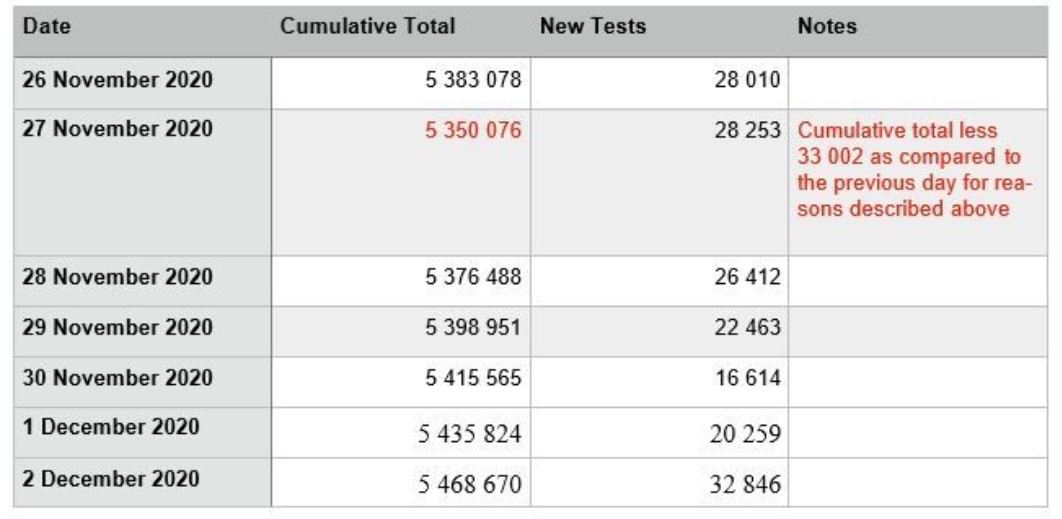
Here are the updated testing figures from 26 November to 2 December.
After coming under fire for not making South Africa’s Covid-19 tests data public for a number of days, the National Institute for Communicable Diseases (NICD) on Wednesday evening explained in a statement why it had been doing what is was doing, The Citizen reports.
From time to time, epidemiological centres undertake audits at various intervals to interrogate the efficiency of the data, clean up the data where necessary and implement improved systems for data collation, the NICD said.
“This vital process ensures that one maintains an accurate epidemiological picture, particularly when the situation is rapidly evolving as with Covid-19.
“On 27 November 2020, the National Institute for Communicable Diseases (NICD) reported the total cumulative number of tests conducted as 5 350 076. This was 33 002 tests less than what was reported the previous day,” the statement read.
It is important to note that this change is related to testing numbers and does not affect the daily positive case numbers reported by the health minister, the NICD said.
“The NICD has, after consultation with the Incidence Management Team yesterday [Tuesday], submitted a report today [Wednesday] outlining the factors that led to this reduction in cumulative tests: The data source for testing data was changed to the Notifiable Medical Conditions Surveillance System (NMCSS) on 27 November 2020.
“The reasons for this change were:
- To align the reporting of test data with the source of case data
- To prepare for the inclusion of antigen-based tests, which will be reported into the NMCSS
- To enable reporting of district-level test data once the implementation of geocoding for test data was completed in the NMCSS.
“As part of data quality control, the following process ensued, which resulted in the reduction of testing numbers:
- Improvement in the process for identifying and removing duplications of the same test from the same patient
- Removal of samples that were collected outside of the country but tested in South Africa. This guarantees that the testing numbers only reflect South African samples (this ensures an accurate epidemiological picture in relation to the South African context).
“The following table reflects the cumulative number of tests reported and the daily new tests that have been recorded on the database since we last reported on the testing data on 26 November 2020,” the statement concluded.
Notice: Coronavirus reporting at Caxton Local Media aims to combat fake news
Dear reader,
As your local news provider, we have the duty of keeping you factually informed on Covid-19 developments. As you may have noticed, mis- and disinformation (also known as “fake news”) is circulating online. Caxton Local Media is determined to filter through the masses of information doing the rounds and to separate truth from untruth in order to keep you adequately informed. Local newsrooms follow a strict pre-publication fact-checking protocol. A national task team has been established to assist in bringing you credible news reports on Covid-19.
Readers with any comments or queries may contact National Group Editor Irma Green (irma@caxton.co.za) or Legal Adviser Helene Eloff (helene@caxton.co.za).
Read original story on citizen.co.za

