
Rise in CIT robberies due to police failure to monitor routes, says expert
Robberies on a stretch of the N4 in Pretoria have been ongoing for several years where armed suspects intercept CIT vehicles, before gaining access to them by using explosives and darting off with large amounts of money.
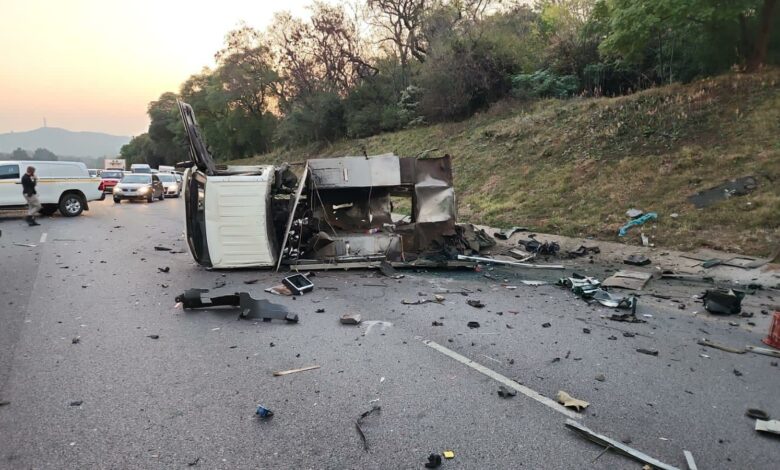
Cash-in-transit (CIT) robberies will continue to prevail for as long as police fail to monitor routes, said an expert in crime and criminal justice.
The N4 highway, mainly between Meiring Naude Road and Rossouw Street in Pretoria, and even leading to Bronkhorstspruit, has been a hotspot for these robberies for several years.
A number of armed suspects have intercepted CIT armoured vehicles, before blowing them up with explosives, then darting off with large amounts of money.
Easy access
Head of Criminology and Criminal Justice at the University of Limpopo, Prof Jaco Barkhuizen told Pretoria Rekord that this stretch of road was susceptible to the crime because of “access to flee”.
Barkhuizen said, “If you look at this vicinity, there are a lot on- and off-ramps in and out of the area without too much worry of being caught.”
He said that the risk of innocent motorists being exposed to harm was huge.
He added that the crimes were strengthened by ecology and the environment and a lack of oversight.
“There is most probably a lack of police visibility.”
Police visibility
Barkhuizen said that police could decrease the number of ambushes to CIT operations by utilising their tools, such as drones, and helicopters, and for all law enforcement to constantly monitor the N4 strip.
“Police have paid millions for equipment and training. There also needs to be intelligence gathered, while police roam the highway.
“We have lost skills in the NPA and police which threatens our intelligence services. Police are trained, however, resources are limited.”
He said South Africa was poor at roaming hotspots to prevent such crimes.
Barkhuizen said that CIT companies were doing everything in their power to safeguard valuables and cash, however, their insurance costs were rising due to increased attacks.
“CIT security companies already install exploding dye packs, their drivers are constantly trained in offensive and defensive driving, however, there is so much money you can spend to protect money until it becomes less profitable for you to do so.
“Even though these companies are insured, their premiums constantly rise due to attacks and profits drop.”
He said research indicated that these crimes were organised and usually syndicates hired individuals from the low socio-economic strata of society.
Barkhuizen said these young men were highly trained, either ex-law enforcement or members of the CIT companies.
“They are trained and are trained on how much explosives to use in their operations.”
Barkhuizen said corruption was endemic in South Africa and bribes were most welcomed by many.
He also added that the more CIT robberies occurred in broad daylight, investor confidence was declining as businesses were sceptical about pouring money into the economy.
“Investors are getting the sense that their money in South Africa is easily accessible to robbers and they will need high security and expensive insurance which is not profitable for them.
“The cost-benefit is already lacking and investors will look elsewhere to place their money where safety and security are not compromised.”
Stats on CIT robberies
Police Minister General Bheki Cele, releasing Quarter 3 crime statistics in February, indicated that Silverton police station had registered two CIT robberies in 2022, the highest since 2019, while Bronkhorstspruit police station recorded 1 in 2022.
The statistics comprised crimes reported to the police from October to December 2022.
“Police will continue to intensify intelligence-led operations to take down individuals or organised criminals hell-bent on terrorising communities.”
Cele said there were signs of improvements in CIT heists, despite the increase at these policing precincts.
“These decreases are attributed to increased police visibility through patrols, stop and search operations, vehicle check-points and roadblocks.”
“Police are also cleaning house and ridding the service of officers who choose to partner with rogue criminal elements,” he said.
Recent cases of CIT robberies
Just to recall a few; the latest CIT crime took place on Monday, July 17, around 17:00 on the N4 between Simon Vermooten and Rossouw off-ramp.
This was the first of two CIT robberies in Tshwane in a space of about 40 minutes.
Police spokesperson Brigadier Athlenda Mathe said at the time that a BMW E90 rammed into the CIT vehicle.
“The collision caused it [CIT vehicle] to overturn,” Mathe said.
Explosives were used to gain access to valuables, while the vehicle [BMW] was found abandoned in Equestria.
The other robbery took place on the R80, north of Pretoria.
Mathe said in the second incident, which happened at 17:45, a CIT vehicle was travelling along the R80 from Soshanguve when suspects in a black Ford Ranger started shooting at it causing it to stop.
– On November 09, 2022 a similar incident occurred when gunfire was exchanged on the highway around 09:30.
– On May, 2, in 2020, a CIT heist came to pass at a filling station in Die Wilgers on the corner of Simon Vermooten Road and Rossouw Street. The vehicle was collecting money when a security guard was accosted by armed suspects, who later fled with an undisclosed amount of money.
– On January 7, 2020, SBV Services’ cash van was ambushed around 16:00. SBV offered a cash reward of R1-million for any information that would lead to the perpetrators.
Later, four men were sentenced to 25 years for the robbery, 15 years for illegal possession of firearms, 10 years for contravention of the explosives act and five years for illegal possession of ammunition to run concurrently as well as an additional five years for conspiracy to commit a crime.
The three worked for SBV while one was a former employee.
Read original story on rekord.co.za

