Diesel is not dead as GWM doubles down on the V8
A Chinese carmaker is doubling down on high-output diesel powertrains while gearing up to launch a V8 GT3 supercar.
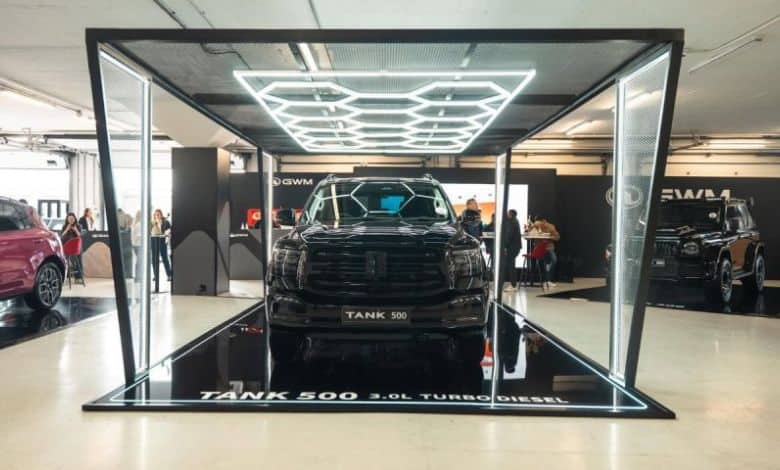
GWM powertrain director Michele Scotti was in South Africa for the 2026 Festival of Motoring, where he helped unveil the Tank 500 and P500 double-cab bakkie powered by GWM’s new 3.0I turbodiesel engine. The four-cylinder unit produces 170kW and 620N.m of torque, while claimed fuel consumption is 7.1l/100km in the Tank 500 and 7.3l/100km in the P500.
Car magazine sat down with Scotti and Conrad Groenewald, chief operating officers of GWM SA, to discuss the new powertrain, GWM’s engineering capabilities and the company’s plans for the South African market.
“We asked GWM for a bigger capacity, more powerful powertrain about two years ago and here it is. This is a showcase of GWM’s engineering capabilities and how quickly our engineers can bring a new powertrain to market,” said Conrad.
“This is chapter two of rewriting the GWM story. We are starting to bring more value propositions into different segments of the market at the higher end that customers are asking for. With this new drivetrain we are catering perfectly to the South African customer.”
While many manufacturers are moving away from traditional internal-combustion engines in favour of hybrids, plug-in hybrids and other technologies, GWM has chosen to continue investing in diesel alongside its new-energy vehicle portfolio.
“We have a global strategy for powertrains. We have observed the trends in Europe and China in the last few years where there was a strong push for electric vehicles, but the recent market feedback is that there needs to be a slowdown of EVs and hybrids,” said Scotti.
“People still like internal combustion engines for a variety of reasons. I don’t want to say that the EV bubble has burst but it has certainly levelled off.”
GWM recognises that diesel remains popular in markets where fuel efficiency, pulling power and long distances between refuelling stops are important. South Africa and Thailand are examples of such markets.
A two-year development cycle
Developing a new powertrain in two years is impressive, but Scotti says GWM’s facilities and streamlined processes make it possible.
“We have a very streamlined process for developing new engines, including strong testing and simulation capabilities. So, when we are configuring the layout and architecture, we can quickly see if it will work or not, and our first prototypes can be tested in vehicles very early on in their development timeline,” he said.
Scotti, who previously worked at GM and McLaren, said the scale of GWM’s operations was one of the things that initially surprised him.
“Arriving at GWM, there were a couple of things that shocked me, including the scale of the industrial vertical integration. We do almost everything in-house, which results in a lot of value for the customer,” he said.
“It also offers us a significantly reduced turnaround time and enhanced reaction to market requirements than a company in Europe that relies on an external supplier.”
GWM has proving grounds, wind tunnels, high-heat chambers and other testing facilities, while Scotti said the company also has one of the world’s largest crash-test facilities.
“We do 2 000 crash tests a year, which is huge and gives us a massive development advantage. This infrastructure really accelerates the capabilities of engineers because they have a lot of toys to play with,” he said.
When asked how GWM’s development process differs from that of established manufacturers, Scotti said the fundamentals remain largely the same but the process is faster.
“We use a very similar development process to European manufacturers. It is just that it takes less time to get from a final design to getting parts on the dyno,” he said.
“Because we produce most of the components in-house and we can do the dyno testing in the same building, we are so much quicker. The development process is similar. It is not that we are cutting corners or doing anything strange, it is just that we can do things quicker.”
“For me, that is something very interesting because I can get things done quicker and I can turn around a project and react to market needs swiftly,” he said.
The in-house approach also allows GWM to address problems without relying on external suppliers.
“If we have issues there is no need for discussions with suppliers, who could say things like it was how the part was used or some other excuse. We simply sort it out,” Scotti added.
Motorsport is calling
Chinese manufacturers have not traditionally been associated with motorsport, but GWM is now developing its own GT3 programme and a V8 engine. Exact details have yet to be revealed, although the project is expected to involve a 4.0l V8 and carbon-fibre monocoque.
“We have big ambitions and are trying to spearhead motorsport in China. We think there is a developing market for that,” said Scotti.
“Motorsport and supercars tend to push the engineering envelope, so it is a great way to hone the level of engineering as one needs to be innovative to hit performance and weight targets.”
“I think that, strategically, chairman Wey wants to develop these projects for their marketing potential but also to push our own organisation to improve and hone our engineering tools,” Scotti explained.
“We presented a GT3 supercar platform in Beijing earlier this year, and based on that, we will develop a GT3 road car going forward,” he concluded.
Browse thousands of new and used vehicles here with CARmag!
The post Diesel is not dead and long live the V8 says GWM appeared first on CAR Magazine.
Breaking news at your fingertips… Follow Caxton Network News on Facebook and join our WhatsApp channel.
Nuus wat saakmaak. Volg Caxton Netwerk-nuus op Facebook en sluit aan by ons WhatsApp-kanaal.