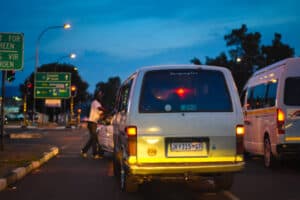
The taxi industry and the related associations play a minimal role in ensuring that their members adhere to safe driving practices.

The mangled taxi that was involved in an accident that claimed 14 schoolchildren’s lives. Picture: X/@Abramjee


The tragedy that happened in Vanderbijlpark resulting in the loss of 14 lives of school kids will most likely happen again.
It might be in Limpopo or the Eastern Cape, or any other province because the conditions that resulted in this horrific accident exist all over the country.
Poor parents in economically disadvantaged townships believe that one way of ensuring a brighter future for their kids is to send them to better schools in town and their primary mode of transportation are minibus taxis like the one that collided with a truck in this instance.
And because this country is obsessed with finding quick reasons for huge tragedies like these, it was quickly discovered that the driver of the minibus taxi was driving with an expired public driver’s permit (PDP).
The minibus taxi itself apparently did not have a government issued scholar transport permit.
What no-one has asked is in what way would the driver being in possession of those two documents have prevented the accident from happening.
Early indications are the 22-year-old driver made poor and daredevilish decisions on the day.
A PDP is issued to drivers without them undergoing any advanced driving skills test. Yes, they are supposed to undergo a medical examination and an eye test, but no skills test to make them better drivers.
ALSO READ: Taxi owner opens up about moments after horror Vanderbijlpark scholar transport crash [VIDEO]
And as with any government process in this country, the issuing of PDPs is fraught with corruption.
The impromptu road blocks that the authorities conducted following the crash will not be sustained over a reasonable period because this is what this country does.
Authorities embark on campaigns and actions to be seen to be doing something, not to reduce road deaths.
Parents will also be blamed for handing their children over to taxi drivers knowing very well some owners do not ensure their vehicles are roadworthy, as if poor parents do not have enough on their plates.
The main culprits, the taxi industry itself, will get off scot-free. And this is where the main problem lies.
The taxi industry and the associations that all taxis must register with play a minimal role in ensuring that their members adhere to safe driving practices, or use roadworthy vehicles to ferry people.
Taxi associations are such powerful bodies that they have made sure government control over their industry is minimal.
It is well known that they have resisted intervention by the government seeking to improve safety standards in the industry.
ALSO READ: Taxi accidents shouldn’t surprise us when there’s no law enforcement
Because of the powerful financial muscle that they have, they should shoulder the greater percentage of the effort to ensure taxis operate safely.
It is estimated that there are more than a quarter of a million taxis on South African roads that ferry 15 million passengers a day.
The authorities do not have the capacity to police each and every trip, but the taxi associations do.
It would make so much sense that taxi industry associations be the ones to take the lead in ensuring passenger safety.
That there are no dashcams and cabin cameras in each and every public transport vehicle in 2026 is a travesty.
Passengers remain at the mercy of not only errant drivers, but have no recourse to report poor driving and unsafe practices.
But, like the trade unions that have become a power unto themselves, taxi associations are a power unto themselves, too.
It is not uncommon for passengers to be told “if you do not like the state of this vehicle, go look for alternative transport” by taxi queue marshals, who report directly to taxi association bosses.
NOW READ: ANC slams ‘arrogant’ and ‘negligent’ taxi industry