Violent disruptions of the KZN legislature could leave a sour taste in the mouth of voters before the 2026 local government elections
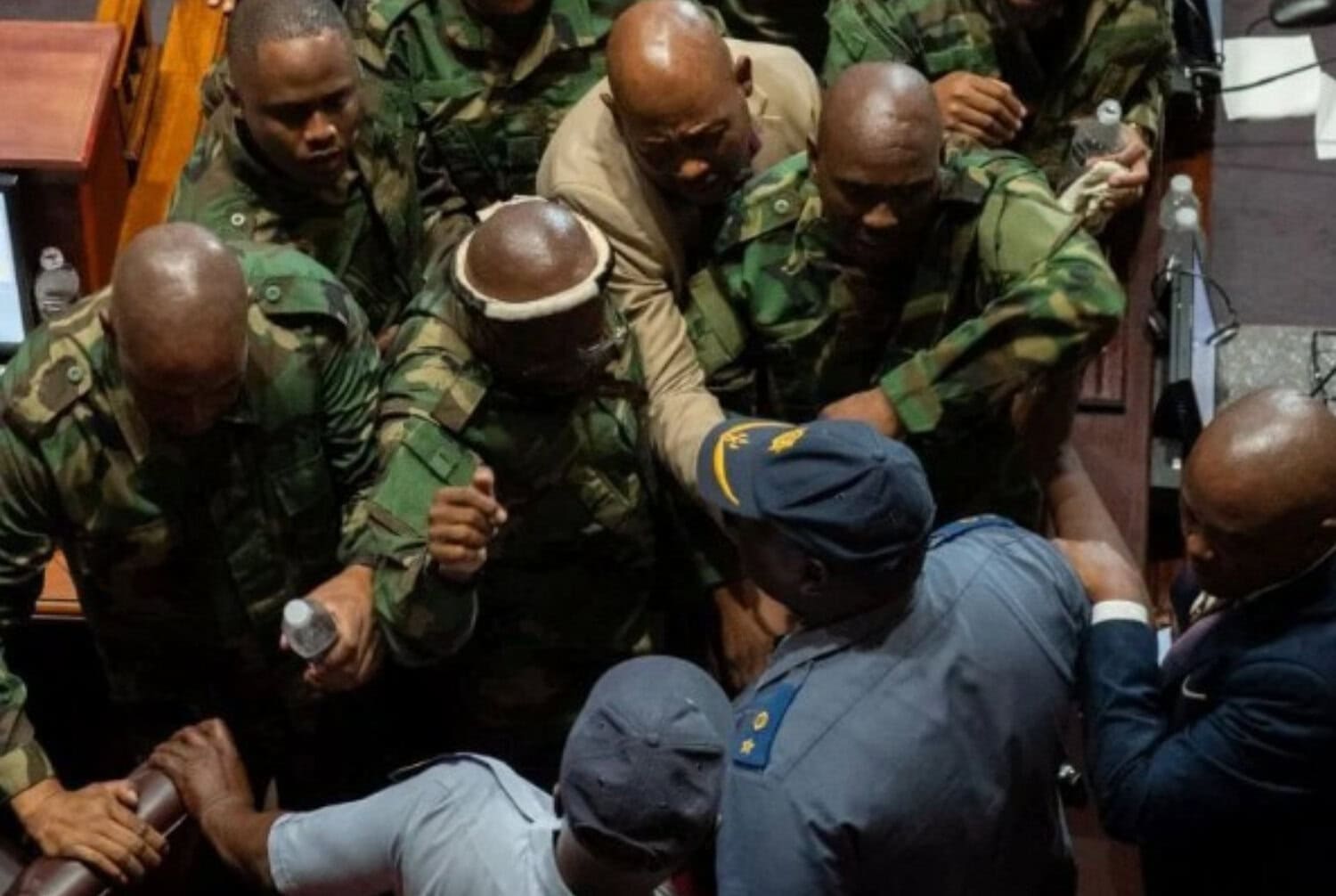
MK party members clash with police in the KZN legislature, on 15 December 2025. Picture: Gallo Images/Darren Stewart


Jacob Zuma’s uMkhonto weSizwe (MK) party sought to celebrate its second birthday by targeting KwaZulu-Natal premier Thami Ntuli in a no-confidence motion, but failed to garner sufficient support for the vote.
An expert believes that for the party to resort to violence to get what it wants in the legislature could become its undoing as South African voters are wary of violent parties.
The party, said political economy analyst Daniel Silke, needs to learn from the EFF, which lost electoral support due to its violent tactics.
‘Credibility will take a knock’
Drama unfolded in the KZN provincial legislature on Monday when MK resorted to EFF-style parliamentary chaos: banging on tables, shouting and physically confronting the police who were present to maintain order in the chamber.
Silke said violence of this nature would not help MK, as voters disapproved of such behaviour, as the EFF had discovered.
“MK’s action will have set them back in a sense in terms of trying to establish the party as some kind of credible alternative governing force within KZN.
“MK’s credibility will take a knock as a result of its actions on Monday, but that will not take the drift away from the ANC, which continues to lose support as well.
“All of this along with potential fragmentation among parties and voters will create an unstable situation in KZN,” Silke said.
Failed motion of no confidence
MK submitted a motion of no confidence against Ntuli, but the ANC, DA, IFP and the National Freedom Party (NFP) voted to allow Ntuli to remain as premier.
The EFF was the only party to back MK’s motion, despite their ongoing political rivalry stemming from the defections earlier this year of EFF members to MK.
The EFF defectors included former MK secretary-general Floyd Shivambu, who has since quit MK to establish his own party, Afrika Mayibuye Movement.
MK, which celebrated its second anniversary yesterday since its establishment by Zuma and his former ally-turned-rival Jabulani Khumalo, has not given up on its battle to oust Ntuli.
The organisation has vowed to challenge the outcome in court in order to enforce a secret ballot.
It is reported that MK was promised support to vote against Ntuli by unnamed IFP and NFP parliamentarians, on the condition that the motion be held in secret to avoid exposing the politicians.
But this support did not materialise. IFP members – if they were indeed involved – feared risking exposure for betraying their party and the NFP’s sole MPL, Mbali Shinga, could have lost trust within the KZN government of provincial unity (GPU) in which she is MEC for social development.
It would have been a betrayal and a display of disloyalty for IFP members to vote Ntuli out.
If Ntuli had been removed, especially with the support of the unnamed IFP and NFP MPLs, it would have spelt the end of the GPU coalition, which is comprised of the IFP, ANC, DA and NFP.
This coalition, which was formed after the May 2024 general election, dominates the 80-member provincial legislature after the parties ousted MK, the election winner with 37 seats.
In comparison, the IFP has 15 seats, the ANC has 14, the DA has 11, the EFF got 2 and the NFP holds a single seat.
No escalation expected
Political analyst and director of the Centre for Peace, Security and Conflict Resolution at Nelson Mandela University Prof Ntsikelelo Breakfast described the MK’s motion of no confidence against Ntuli as “a project gone wrong”.
He said MK has a grievance because it got 45% at the polls in KZN and should have been the party to join forces, perhaps with the EFF, to form the GPU.
Breakfast said, however, the MK party needed to accept that, in a democracy, there were winners and losers and that losers had to accept their loss because “democracy is a numbers game”.
The analyst condemned the scenes of violence involving MK members.
“But I don’t want to overplay this conflict and say that we are going to see an escalation, with political parties fighting and blood on the floor.
“I think what happened was just a spur-of-the-moment thing. Emotions were high, although that should have been avoided.
“So I think the dust is going to settle and it’s going to be business as usual,” Breakfast said.
Silke said the upcoming local elections would show divisions among the electorate in general and that would help small parties to become kingmakers in some councils.
He said that this, along with the MK and ANC losing more votes in future polls, would bring about political instability in the province and municipalities after the 2026 local elections.
NOW READ: Chaos breaks out in KZN legislature as MK party’s motion of no confidence fails