Opposition parties responded to the temporary fuel levy cut as well as additional funding for municipalities and the fight against GBV.
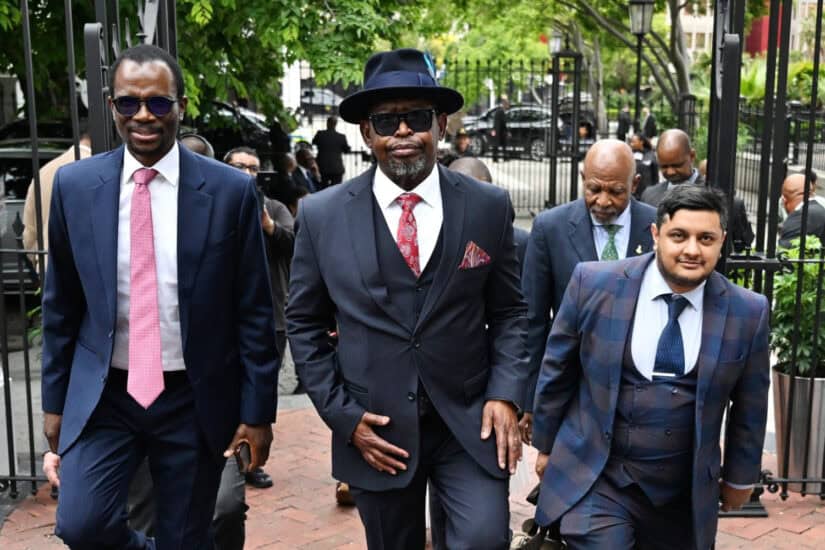
Finance minister Enoch Godongwana flanked by his deputies David Masondo and Ashor Sarupen. Picture: X / @ParliamentofRSA


Finance Minister Enoch Godongwana’s medium-term budget policy statement has drawn mixed reactions, as most accept that no single policy can solve every crisis with a financial magic wand.
Godongwana was widely praised for identifying just under R40 billion in medium-term savings, but detractors differed on where to redirect the funds.
Most welcomed the minister’s honest assessment of slow economic growth, municipal management shortcomings, and cost-of-living pressures.
The fuel levy relief, a two-month reprieve still less than recent price increases, was seen as a token gesture that needed more scrutiny.
Other highlights were the almost R4 billion towards a coordinated response to gender-based violence (GBV) and an increase in the municipal equitable share.
No ‘contingency reserves’
The Freedom Front Plus (FF+) stated that while policy plans were admirable, it would mean little without efficient public expenditure.
“If the current mismanagement and corruption prevalent in most municipalities continue unabated, these additional funds will also be wasted and bring about no improvement in service delivery.
“The only way to turn these dire economic circumstances around is to intensify fiscal discipline. Every rand of taxpayers’ money must be spent wisely,” stated FF+ finance spokesperson Wouter Wessels.
He acknowledged the South African Revenue Service’s increased tax collection, but warned against reactive spending.
“A cause for concern is that the minister increased government expenditure in response to the windfall from higher tax revenue, rather than building up contingency reserves,” Wessels added.
ActionSA’s Alan Beasley wanted more fuel levy relief, but appreciated the additional funding for the police and armed forces.
However, he lamented slow economic growth well below the global average and almost a quarter of the sub-Saharan region.
Beasley concluded that the country’s economic situation was not Godongwana’s sole responsibility, but that of his party’s national coalition partners.
“Two and a half years into the government of national unity, it has failed to present a credible plan to address low economic growth, rising unemployment, increasing poverty and constrained fiscal space.
“The practical impact is that we are not even creating enough jobs to absorb new graduates entering the labour market, let alone provide opportunities for those who are already unemployed,” stated Beasley.
Trade union response
The Congress of South African Trade Unions (Cosatu) also lamented the lack of poverty-alleviation policies.
“Treasury and government collectively missed the opportunity to table a bold package of interventions that would tackle the fundamental crises of a staggeringly high 43.8% unemployment rate, weak economic growth averaging 1% for over a decade, entrenched levels of poverty and inequality, high rates of crime and corruption, and embattled public and municipal services,” said Cosatu spokesperson Matthew Parks.
Cosatu stressed that little was done to address unemployment, with Parks asking why the identified savings had not trickled down to those who needed them.
“It is extremely disappointing that no further allocations have been made to boost the Public Employment Programmes to give hope to 12 million unemployed.
“It is beyond shameful that despite R13 billion worth of savings in social grants, yet again there is no inflationary relief for the 8 million destitute Social Relief of Distress grant recipients,” said Parks.
Publish the fuel levy maths
Similar to the trade unionist, Floyd Shivambu’s Afrika Mayibuye said the fuel levy relief was inadequate, stating it wanted to see the methodology behind Godongwana’s work
“Government must publish the fuel-pricing review, scrutinise levies and margins, monitor the transmission of savings and invest in affordable public transport and domestic fuel-supply capacity,” stated Shivambu.
Godongwana said municipalities would receive an extra R21 billion, with a further R13 billion and R3.5 billion going to metros for fuel-related and smart meter costs, respectively.
Shivambu said when considering the infrastructure and development backlog in major municipalities, the allocations were insufficient.
“Covering higher bulk-service costs does not automatically finance new infrastructure or reverse years of inadequate maintenance.
“Smart meters can improve billing, but cannot create income for an unemployed household or repair a failed water-treatment plant,” the Mayibuye leader stated.
Rise Mzansi’s Songezo Zibi praised the targeted savings, the fuel levy relief, GBV funding, local government support and tax collection improvements.
However, he was critical of housing expenditure cuts and the admission that grants and infrastructure projects were prone to abuse.
While the fuel levy was a plus, Zibi called this and other cost-of-living measures “short-sighted”, stating he wanted to do more for the broader transport sector.
“Temporary fuel levy reductions do not resolve embedded food supply chain costs, and small businesses driving local economies received no targeted relief.
“South Africa cannot build a resilient economy on temporary band-aids. Government must tackle structural cost drivers head-on,” Zibi stated.