

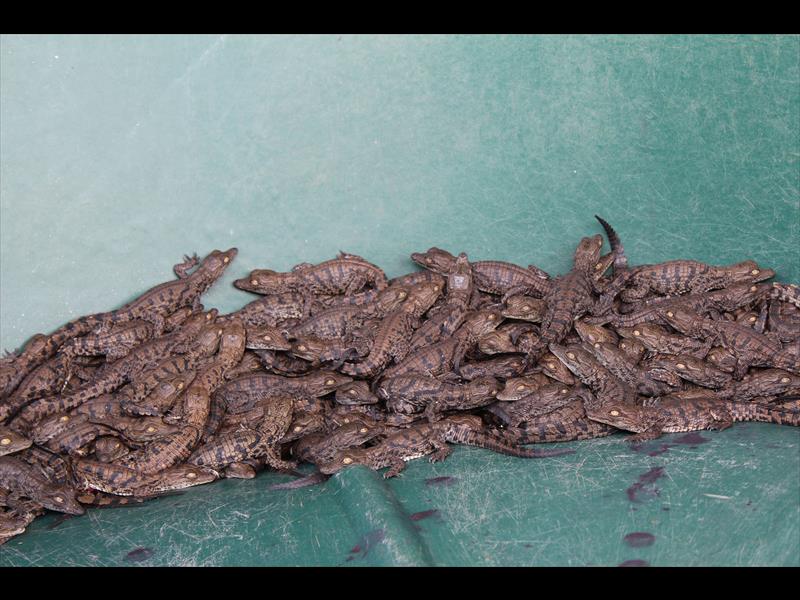
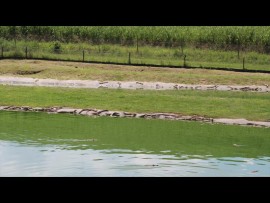
Hidden among the cane fields of Shakaskraal, towards Glendale valley, are a series of dams filled to the brim with hundreds of Nile crocodiles.
Known as ‘Croc Valley’, the facility is a 12 hectare crocodile farm which breeds the animals for their skins, and is home to more than 1000 of the reptiles.
James Oldacre has been running the farm for the last eight years and said he has 600 breeding animals at his farm.
“Crocodiles can live for over 100 years, so breeding animals can be used for a very long time, which is great for my stock,” said Oldacre, who added that each of his breeding females lays a clutch of between 30 and 50 eggs once every year and that this year he is expecting a total hatch of 5000 babies.
He added that the majority of his farm’s skins are exported overseas to countries such as France, Italy and Germany for supply to the European fashion industry.
Oldacre said they slaughter roughly 1000 crocodiles once a year when the animals are six months old and that they sell the meat left over as a by-product at reduced cost to the local community.

“The process of farming crocs is lengthy, as once they hatch, each baby croc has to be dipped in an antiseptic dye to prevent the open umbilical wound from getting infected, and then we have to move them into nursery pens to stay in small groups, as they are most vulnerable at this early stage,” said Oldacre.
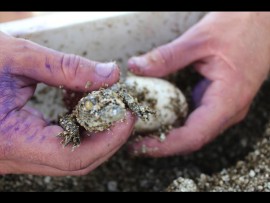
“They call out as soon as they are born in order to locate their mother and encourage their siblings to also hatch,” he added, holding a brand new baby croc.
As the crocodiles reach three months old, they are moved to a larger enclosure and live free range until they are slaughtered three months later.
Once the skin has been removed, it is cured with salt to prevent it from rotting before it is sent to a tannery to be converted into leather.
Although much controversy exists surrounding the slaughter of crocodiles for their skins, the practice has ironically saved the species from extinction.
Throughout the 1960s and 70s, wild Nile crocodiles were hunted by the thousand for their coveted skins, which drastically reduced the populations of the reptiles across Africa.
It was at this time that governments began passing laws to protect crocs and in 1975, CITES regulated the trade in crocodile skins in the hope of reducing pressure on wild crocodile populations and to conserve the species through commercial incentives.
As a result, the regulated farming of crocodiles allowed their numbers to once again increase in the wild, and the species was brought back from the brink of extinction.
Skins from Nile crocodiles make up roughly one third of the global industry, with about 300 000 skins of a total 1.5 million flooding the market every year.
Oldacre’s farm is one of about 30 in South Africa exclusively breeding crocodiles for their skins, and while his facility is not open to the public, it has attracted much attention from curious people walking by.
Do you want to receive news alerts via WhatsApp? Send us a WhatsApp message with your name and surname to 061 718 4438.
Please read our WhatsApp broadcast list disclaimer.
Join us on BBM at 59015786
Join the conversation on Facebook, Twitter and Instagram.
Stay in the loop with The North Coast Courier on Facebook, X, Instagram & YouTube for the latest news.
Mobile users can join our WhatsApp Broadcast Service here, or if you’re on desktop, scan the QR code below.