

Live stream: Rare ‘super blood blue moon’ visible on Jan 31
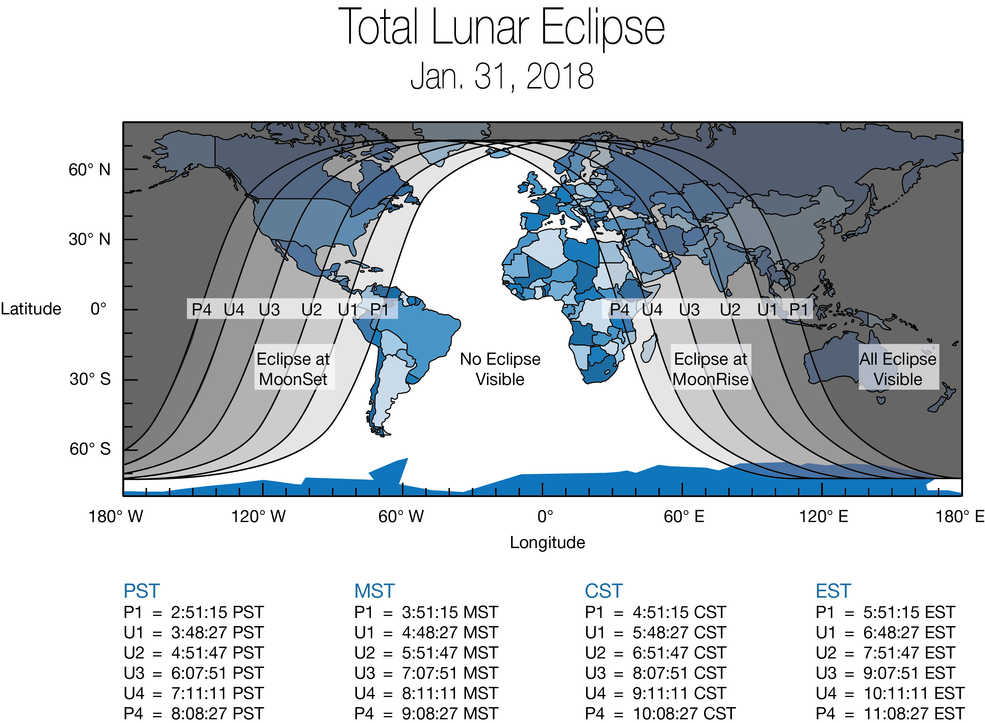
Unfortunately the unique occurrence will not be visible for us in South Africa, but that doesn’t mean you won’t be able to enjoy the show.

A cosmic event not seen in 36 years — a rare “super blood blue moon” — may be glimpsed January 31 in parts of western North America, Asia, the Middle East, Russia and Australia.
The event is causing a buzz because it combines three unusual lunar events — an extra big super moon, a blue moon and a total lunar eclipse.
A blue moon refers to the second full moon in a month. Typically, a blue moon happens every two years and eight months.
This full moon is also the third in a series of “supermoons,” which happen when the moon is closest to Earth in its orbit.
This point, called the perigee, makes the moon appear 14 percent larger and 30 percent brighter.
During the eclipse, the moon will glide into Earth’s shadow, gradually turning the white disk of light to orange or red.
Unfortunately the unique occurrence will not be visible for us in South Africa, but that doesn’t mean you won’t be able to enjoy the show.
NASA has said that people all across the globe – if you have access to the internet – will still be able to view the entire show wherever they are.
So save this link and tune into it when the special day arrives and watch it as it happens: https://www.nasa.gov/nasalive
How rare?
According to Sky and Telescope magazine, “the last time a complete lunar cover-up took place on the second full moon of the month was December 30, 1982, at least as reckoned by local time in Europe, Africa, and western Asia — locations where the event could be seen.”
That event also occurred at the moon’s orbital perigee, making it an extra bright supermoon.
Jason Aufdenberg, associate professor of physics and astronomy at Embry-Riddle Aeronautical University’s campus in Daytona Beach, Florida, said that by his calculations, the last time a supermoon, blue moon and total lunar eclipse all together were visible from the eastern United States was on May 31, 1844.
According to Sky and Telescope, the last blue moon total lunar eclipse visible from North America happened on March 31, 1866.
“But on that date the moon was near apogee, its most distant point from Earth,” it said.
Lunar eclipses during a supermoon happen rather regularly. The last one was in September 2015.
Lunar eclipses occur at least twice a year.
Supermoons can happen four to six times a year.
The next supermoon lunar eclipse visible throughout all of the United States will be January 21, 2019 — though that one will not be a blue moon.
© 2018 AFP
>> Ready to say ‘I Do’ on the Dolphin Coast? Meet the team ready to advise, help and deliver on your big day.
>> Visit our Education feature for a collection of all the best schools, tutoring systems, and even some colleges and training facilities on the North Coast.

Do you want to receive news alerts via WhatsApp? Send us a WhatsApp message (not an sms) with your name and surname to 061 718 4438.
Please read our WhatsApp broadcast list disclaimer.
Join us on BBM at 59015786
Join the conversation on Facebook, Twitter and Instagram
Stay in the loop with The North Coast Courier on Facebook, X, Instagram & YouTube for the latest news.
Mobile users can join our WhatsApp Broadcast Service here, or if you’re on desktop, scan the QR code below.