Know your alien plants: yellow bells
The Northglen News and the Duzi uMngeni Conservation Trust (DUCT) have collaborated to bring readers a series of articles on various alien invasive species. In the second edition of the installment we will be looking at Yellow Bells.

IN the leafy suburbs of KwaZulu-Natal, the subject of alien invasive plants has raised the ire of many conservationists.
Environmentalists regularly remind the public about the destructive vegetation and the impact they can have on our country’s biodiversity.
However, these aliens have, in recent months, become a thorn in the side of home owners, as the new National Environmental Management: Biodiversity Act (NEMBA) regulations state that ‘the seller of any immovable property must, prior to the relevant sale agreement, notify the purchaser of the property in writing of the presence of listed invasive species on that property’. This is according to the Department of Environmental Affairs (DEA).
Home owners who are planning to sell will either have to hire an accredited invasive species practitioner or dust off their gardening books to catalogue these ‘blooming’ pests. Failure to comply could lead to hefty fines.
Now, the Northglen News and the Duzi uMngeni Conservation Trust (DUCT) have collaborated to bring readers a series of articles on various alien invasive species.
We will be getting up close and personal with their identifying features, what makes them so troublesome in our backyards and how they can be eradicated. Last week we explored the Spanish Reed.
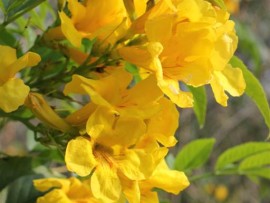
Tecoma stans or Yellow Bells
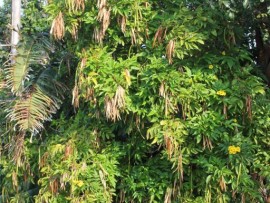
In the second edition of the installment we will be looking at Yellow Bells, a fast growing weed that can be found on roadsides, riparian zones (banks of watercourses), open woodlands, grasslands, forest margins, waste areas, rocky places, sandy lake shores and disturbed sites in tropical and subtropical environments. It is believed that the species originated from the United States and Mexico.
This attractive flowering small tree generally grows to a height of 5m but can occasionally grow up to 10m, said said Bart Fokkens of DUCT.
It is prevalent in the greater Durban area as well as the uMngeni valley.
“Whilst attracting birds and insects it is a fast growing and very invasive plant which produces thousands of light papery seeds which are mainly dispersed by wind and flood water,” added Fokkens.
Tecoma stans is a category 1B plant and needs to be controlled. Seedlings and small plants can be hand-pulled. Larger plants are more difficult to control as they can resprout from cut roots unless these are pulled up and burned after drying. Repeat control is necessary to reduce reinfestations levels, he explained.
“Various chemicals can be used to control the alien species,with cut stump applications being especially effective. When using any herbicide always read the label first and follow all instructions and safety requirements. If in doubt consult an expert,” said Fokkens
Halleria lucida also know as the Tree Fuchsia is an alternative indigenous plant to Yellow Bells.
Four categories of alien invasive plants:
Category 1A: Invasive species requiring compulsory control. Any specimens of category 1A listed species need, by law, to be eradicated from the environment. No permits will be issued.
Category 1B: Invasive species requiring compulsory control as part of an invasive species control programme. These plants are deemed to have such a high invasive potential that infestations can qualify to be placed under a government sponsored invasive species management programme. No permits will be issued.
Category 2: Invasive species regulated by area. A demarcation permit is required to import, possess, grow, breed, move, sell, buy or accept as a gift any plants listed as category 2 plants.
Category 3: Invasive species regulated by activity. An individual plant permit is required to undertake any of the following restricted activities – import, possess, grow, breed, move, sell, buy or accept as a gift – involving a category 3 species. No permits will be issued for category 3 plants to exist in riparian zones.
Related articles:
Dumping endangers Hawaan Forest