More than a century ago, among the rolling hills of Natal, the sound of the bugle organised the day’s activities, the echo of hooves and marching boots filled the air in the colonial military milieu of war ….
All has been transformed.
Today, the school bell alerts everyone to the day’s programme. Loud pulsating footsteps can be heard rushing to specific classrooms in the surroundings of a century-old school established on a historic farm in the Midlands of KwaZulu-Natal…It has become a unique 21st century school; Weston Agricultural College.
In 1913, the farm Weston in the Mooi River area was developed into the Agricultural and Allied Trades School with an enrolment of 15 pupils. The school opened on August 17, 1914; two weeks after the outbreak of the First World War.
Weston’s role in the history of the province is much older and very colourful. Early travellers to this area recorded seeing teeming herds of game, including lions and buffalo. In the early 1850s, a small village developed on the farm Weston, adjoining the Mooi River and a drift, which was a popular crossing point for the transport riders en route to the north. The village like the farm bore the name Weston, after the Governor of Natal Martin West. A post office was established in 1854. Weston village lost its importance when the railway line was built to the west of the settlement, and a new village Lawrenceville, now Mooi River developed.
During the Anglo-Boer War of 1899-1902, Weston became a British army remount depot because of its climate. Over the two-and-a-half years of conflict, the British army purchased 520 000 horses and a staggering number of 350 000 perished. In 2009, Weston Agricultural College unveiled a specially designed Horse Memorial, in the school grounds, to commemorate horses that have died in war, especially during the Anglo-Boer War.
This period of local history is still visible at the school. There are a number of wood and iron buildings, with spacious cool verandas. Two of these buildings are historical monuments, and now serve as teachers’ residences.
The buildings are not the only relics of the war. Over the years, especially during ploughing season, artefacts, are unearthed. This rich hoard from bottles, cutlery and shards of pottery to holsters, horseshoes, military buttons and insignia has led to the establishment of the Weston museum with well-documented and fascinating displays. It is difficult to believe that such a short period has led to this historical treasure trove. Perhaps, it is proof that there has always been a throwaway society!
The boys at the school are encouraged to look for anything, which may date back to this period. The legend exists that two soldiers, buried a trunk of gold coins somewhere on the farm with the intention of retrieving it after the war. Unfortunately, they were both killed in battle. To date, no one has located or retrieved this mythical treasure!
When the school opened on August 17, 1914, the majority of the parents were poor farmers. The schooling was free and funded by the South African government. There was only accommodation for 15 pupils. Early photographs reveal boys clad in work clothes and felt hats employed in agricultural labour. Weston’s livestock was made up of one dairy cow, one span of oxen and two horses. The boys’ leisure activities included learning to ride the oxen, as the horses were not for recreation. Up to the 1930s, Weston was not recognised as an agricultural college or regular high school, though an impressive redbrick, tiled roof school block with imposing entrances was built in 1926. It is still used for teaching. A three-year course was introduced, providing instruction in farm work, ordinary schooling and military training. It was applied with strict discipline. During this time, two workshops were opened: a black smithy and carpentry shop. The emphasis was on skills development. The pupil enrolment increased to 70 boys in the ’30’s. The school offered a comprehensive two-year course to boys who had passed Standard six (Grade eight). The school fees were set at sixteen-shillings per annum! Two hostels Charlton House and Smythe House providing improved boarding accommodation were built in the same elegant redbrick style as the classroom block. In 1943, it was renamed Weston Agricultural College and boys were now able to complete their matric. Until 1991, the college offered tuition from Grade 10 to 12 but that year saw the introduction of the two junior grades. The school grounds present a park-like environment, with established gardens, beautiful trees and flowers that provide a profusion of colours in the warm summer months.
The boys also enjoy the amazing experience of being “down on the farm”. Often a surprise and even an initial shock for city boys, but after five years at the school they are au fait with all aspects of farming. They have “served their time” milking cows, feeding the beef animals, coming to terms with grunting obstinate pigs, and poultry and egg sorting. They have learnt to shear sheep, and train and show steers. Beyond animal husbandry, there has been the opportunity to learn to drive a tractor, put up a fence, fell a tree and burn firebreaks! Few Weston boys need to expand their experience by taking a GAP year. Instead, they are sought after in many fields of agriculture and industry because of the practical and theoretical skills they have acquired.
During the early part of the year, learners prepare to exhibit at the Royal Show in Pietermaritzburg. In addition to the impressive Weston stand, the boys take part in a number of arena events. Year after year, Weston carries away prizes for top quality animals and the showmanship. Some boys are chosen to represent the KZN team to compete at the annual Youth Show.
In the 21st century, Weston has become a rainbow nation school; learners no longer come predominantly from farming stock. They come from all over South Africa and beyond its borders, city boys, country boys and farm boys together with day scholars. The approach to academics has changed radically in one hundred years. The emphasis is on academic achievement, coupled with practical farming experience. The syllabus enables the boys to follow a full academic curriculum or follow courses with contemporary agricultural content.
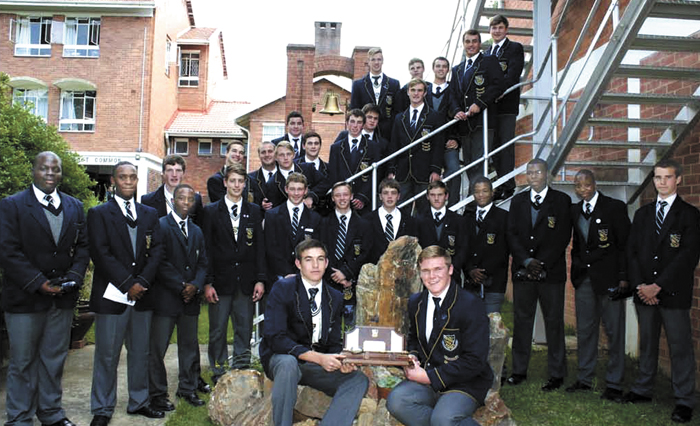
The pupils are exposed to a variety of educational, sporting and cultural experiences, varying from rugby, cricket, canoeing, and horse endurance to debating. Soccer and basketball have become popular sports, though; rugby and cricket remain the major sports. Since 2006, the highlight of the rugby season is the annual derby match for the Dowker Trophy against Treverton College. The two schools are included in the Classic Clashes series, which it is televised on SuperSport. The main event of the cricket calendar is the Weston’s annual Michaelmas Cricket Festival. Outstanding sportsmen are frequently chosen as members of representative provincial teams.
The life of a Weston pupil is challenging during a cold winter, with early morning and late evening temperatures registering below zero. The school day demands mental alertness and physical stamina. Paramount in the education of all boys is instilling the “old school” values of commitment, responsibility, integrity, discipline and sportsmanship. The school has been fortunate to have had a number of outstanding principals, including the legendary Don Paterson from 1961-1982 and the present headmaster Paul Tait, who has been in office for 20 years.
The school motto “Academic excellence with practical knowledge” epitomises Weston Agricultural College.