
Sue catches the moon
ASTRONOMERS, the curious, the superstitious, insomniacs and photographers such as Sue Dewar, were up and active in the early hours of Monday morning this week. The moon that morning was to be a “Supermoom”, and there was also to be a total eclipse of the moon. A “Supermoon” looks larger and brighter to us Earthlings …
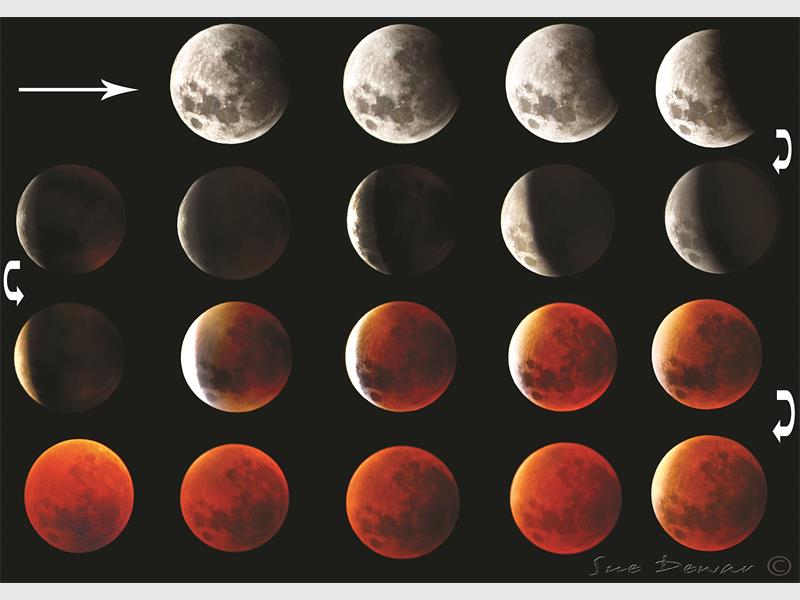
ASTRONOMERS, the curious, the superstitious, insomniacs and photographers such as Sue Dewar, were up and active in the early hours of Monday morning this week. The moon that morning was to be a “Supermoom”, and there was also to be a total eclipse of the moon.
A “Supermoon” looks larger and brighter to us Earthlings because the moon is then at its closest to earth, a phenomenon called its perigee. And total eclipses of Super Full Moons are rare – there were only five in the 1900s, in 1910, 1928, 1946, 1964 and 1982.
After Monday’s total lunar eclipse, a Supermoon eclipse will not happen again for another 18 years, until October 8, 2033.
During the eclipse, the moon takes on a red colour, and the term “Blood Moon” is often used to refer to total lunar eclipses. However, astronomers do not use Blood Moon as a scientific term.
The reddish colour that the Moon takes on during totality happens because of Rayleigh scattering, the same mechanism that causes colourful sunrises and sunsets.
Sue Dewar, who lives in Church Street, took the pictures of the moon from her balcony. For the technically minded she says, “All the photos were taken with my Nikon D7000 and my 50-500mm/f4.5 Sigma lens.
“I had the camera on a tripod, worked in manual mode and used a remote control. I started taking the photos from 3:00am – 4:45am (and took over 300 photos).
“Speed varied between 0.8sec – 1/500 sec; F/stops were all 6.3; ISO varied form 100 – 800 depending on the speed.”
Thus we have a fantastic record of this cosmic event as seen from Vryheid, a speck in the Universe, by a lady on a balcony.
Thanks, Sue Dewar.