
Vryheid farmer battles against fall armyworms
Farmers fear that an uncontrolled infestation will put South Africa’s food security at risk, especially after the strain that agriculture has taken as result of the crippling El-Nino induced drought.
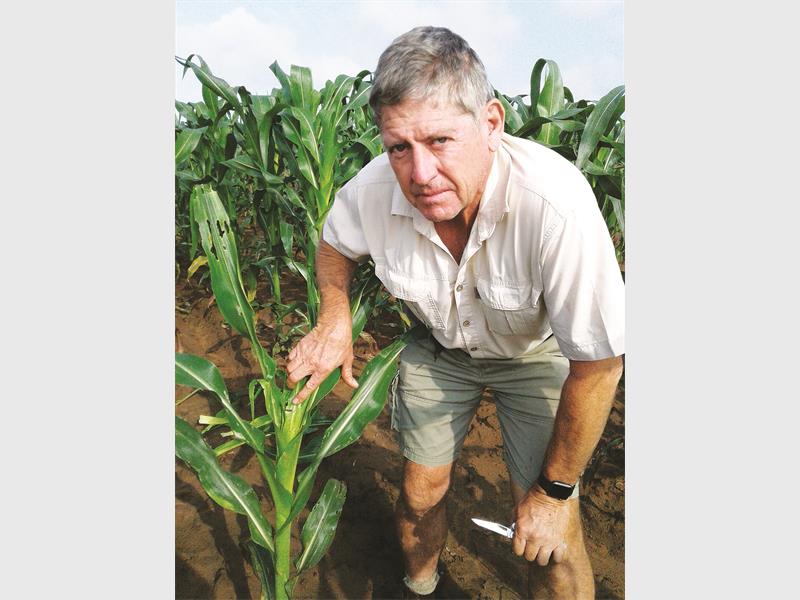
A fall army worm (FAW) infestation has been confirmed on a Vryheid maize farm by an entomologist.
South African commercial crop farmers have been on high alert for this quarantine pest since last month when it infiltrated South African crops for the first time.
FAW, which originates in South and central America, was spotted in Nigeria last year, and quickly spread to several West and central African countries, before appearing on farms in Limpopo, North West and Free State.
This week the KwaZulu-Natal Department of Agriculture and Rural Development confirmed that there were fall army worm infestations in maize crops in Amajuba, uThukela, uMkhanyakude and Zululand Districts.
Farmers fear that an uncontrolled infestation will put South Africa’s food security at risk, especially after the strain that agriculture has taken as result of the crippling El-Nino induced drought.
Günther Muhl, who owns the farm in the Blood River Poort / Scheepersnek area just outside Vryheid town, said he confirmed that the caterpillars devouring his young maize plants are fall army worms last week.
“When I first noticed the damage to the crops, I thought that it might be a stork borer worm infestation, which is common to this area and easily managed. I checked after I sprayed with pesticide and saw the worms were still alive so I called an entomologist out and he confirmed that they were army worms. I sprayed again, but still about 30% of the worms survived. I applied a different type of granular pesticide manually today and 90% of those that were left have died, but the 10% that are still alive seem resistant to the pesticide,” said Mr Muhl on Monday afternoon.
Mr Muhl said that he was monitoring the situation very carefully and since it was only a small percentage of his farm that was affected, he did not see the infestation as a crisis.
“We are beating it down and we are winning, so I am not stressed out… But I am a little worried so I will continue to watch the crops very closely,” he said.
Only the young maize plants, which were planted late as a result of the drought, seem to be affected on Mr Muhl’s farm at this stage. The army worms have not infested the older maize plants or the GMO crops, which were treated with the pest resistant Bt gene.
According to Dr Gerhard H Verdoon, director at the Griffon Poison Information Centre who was quoted in TimesLive this week, “The army worm moves with passage winds and weather fronts and also through hosts plants. Main transmission is through wind and weather fronts. They can move thousands of kilometres a week. They are already resistant to pyrethroid insecticides and to a lesser extent organophosphates and carbamates also. Other pesticides seem to kill the larvae but only when they are exposed and not when they have entered the cobs.”
Anyone growing crops, especially maize, sugar cane, sorghum, soybeans, groundnuts and potatoes, is warned to be on the lookout for the fall army worm and to contact their pesticide suppliers for help if they suspect an infestation. It is believed that flocks of birds may also be an indication of an outbreak.
The fall army worm is easily identified by the upside Y visible on its dark head and by the spots on its underbelly. When they eat leaves, they do not leave the ‘windowpane’ appearance on the leaf which is typical of the stork borer worm. Instead these worms eat all the way through the leaf, leaving a gaping hole.
If left uncontrolled this worm could have a devastating effect on the agricultural industry.