
Six arrested at Pongola guest house for suspected rhino poaching
Carlo Engelbrecht, the owner of a Vryheid game farm, has been actively involved in the fight against rhino poaching and believes that the most practical way to protect the rhinos is to legalise the trade of rhino horn.
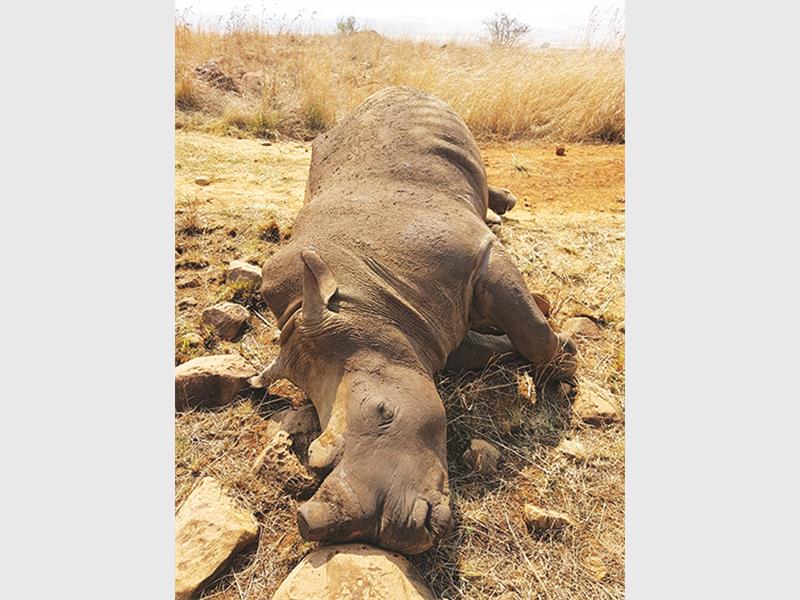
SIX suspected rhino poachers were arrested at a guest house in Pongola two weeks ago, where they were believed to have been preparing for their next rhino horn heist.
Captain André Pizer and his team from Pongola SAPS seized a rifle CZ550 magnum with the serial number removed, seven live rounds, two hunting knives, an axe, a trigger guard and a silencer upon the arrest, and are being lauded for their proactive approach in dealing with a crime that has claimed the lives of 93 rhinos in KwaZulu-Natal this year.

Vincent Mathothe (42), Hloniphani Khumalo (34), Mhlekiswa Dlamini (47), Florence Lubisis (39), Mogala Ragolane (53), and Frans Tshabangu (48) last appeared at the Pongola Magistrates Court on Wednesday last week.
“The suspects were denied bail and remain in custody until their next court appearance. We really feel good about this arrest and thank the community for tipping us off. Working together means we can adopt a proactive, rather than a reactive way to deal with crime, and in doing so we can prevent crime and save lives,” said Pongola station commander, Colonel June Mbongwa.

Musa Mntambo, communications officer for Ezemvelo KZN Wildlife, reports a significant decline in the number of rhinos poached in KZN, from 192 cases in 2017 to 93 cases recorded in 2018.
“The police are very effective in what they do and we are working closely with the community, the police and the justice department to reduce the number of rhino poaching incidents even further,” said Mr Mntambo.
He admits, however, that despite their best efforts there are still many factors contributing to the slaughter of rhinos in wildlife reserves.
“The price of rhino horn is very high and the demand for it has increased. As long as there is a market and people are buying the horn, there will be poachers,” he said.
ALSO READ: PREVIEW: Paulpiet rhinos targeted by ruthless poachers
“We have also found that poachers are becoming more sophisticated. In the past, poaching happened at night and they used guns and axes. Now, poaching can take place at any time of the day and they are using darts as well. We can really do with more security at our game reserves but it is not feasible at the moment. In the meantime, we are thankful for community involvement which has led to a number of arrests. We are grateful to members of the community for being our eyes and ears.”
Carlo Engelbrecht, the owner of a Vryheid game farm, has been actively involved in the fight against rhino poaching and believes that the most practical way to protect the rhinos is to legalise the trade of rhino horn.
“Just take a look at the area between Paulpietersburg and Pongola. When I started up, every farm had up to eight rhinos on the property. Now, there are only three farms in the area that still have rhinos. All the rest have sold off their rhinos because it is not worth keeping them,” said Mr Engelbrecht.
“If you look at the stats, most of the rhinos are being poached on government land. We are doing our best in the private sector. We try to ensure that we have the best security, and the money to pay informers comes from our pockets… But it is not enough. The risks of keeping rhinos are too high.”
ALSO READ: GRAPHIC: 9 more rhino slain in Hluhluwe-iMfolozi Park
Over the years, the cost of a rhino has decreased, while the profit to be made from rhino horn has grown exponentially, according to Mr Engelbrecht and Mr Mntambo.
“I am not doing this just for the money, but running a game farm is a business. I was recently offered R180 000 for a 10-year old rhino cow. That’s nothing. It’s R18 000 a year and with the risk involved, I should rather have kept cattle. If the value of the animal is going to drop to that extent, what’s the use in looking after them? That is the sad reality,” continued Mr Engelbrecht.
“According to my information, the horns are being sold for R350 000 per kilo in the Far East. The guys on the ground (the poachers) get about R100 000 per kilo here. If we legalised the trade, consider that a rhino produces about 2kg of horn per year, that’s R200 000 a year and that rhino would be worth millions alive. The problem is that the value of the horn is gaining while the value of the animal is decreasing and the risks involved with keeping rhinos is higher, so farmers would rather get rid of the animal. This reduces the number of rhinos on reserves. This approach is not working to save this animal and government needs to consider this,” he concluded.
Do you think that the trade of rhino horn should be legalized in South Africa? Do you think that this will effectively preserve the existence of rhinos? Tell us how you feel. E-mail estella@caxton.co.za or whatsapp 079 256 7570.