Vryheid paramedic reflects on 26 years of saving lives
After 26 years in emergency services, Frikkie Bekker still answers the call when his community needs him.
When an accident or emergency happens, panic, fear and confusion often take over. Then the paramedics arrive.
They are often seen as the silent heroes of a community, arriving when people need help most, taking control of the situation and getting to work while everyone else is often left wondering what to do.
26 years in emergency services
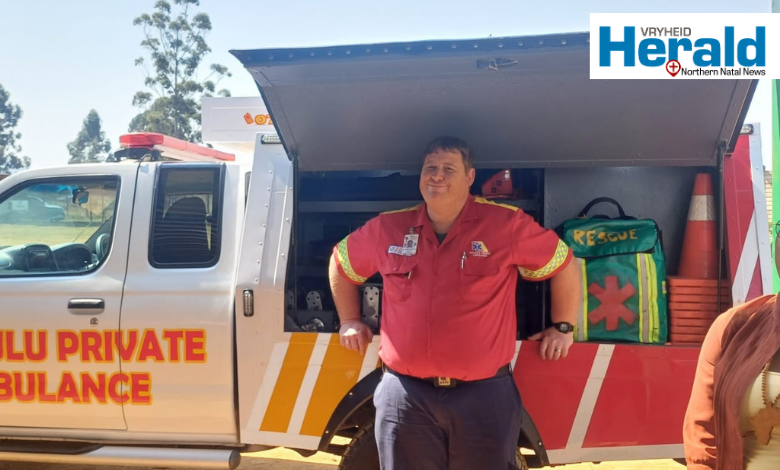
For Frikkie Bekker, this has been his life for 26 years. It has been almost 10 years since the Vryheid Herald last profiled Frikkie. Back then, he was an operational member of the KwaZulu Private Ambulance Service
community service unit, driving the little NP200 bakkie that became a familiar sight at accidents and community events.
Today, Frikkie is the regional manager for KZN North, responsible for Vryheid and Newcastle, while also assisting in Pongola when needed. He has also gained additional rescue qualifications, allowing him to
take on specialised rescue work in the area.
But after 26 years, the reason he continues is still simple. “I guess the passion we serve with prevents us from having a ‘normal’ day. That unexpected case and knowing we make an immediate impact is what seems to keep me going.”
He started his journey as a fire cadet and event first aider. Now, after more than two decades in emergency services, he jokingly describes himself as an ‘EMS dinosaur’. “I will admit I now fall into a class
where we are referred to as ‘dinosaurs of EMS’.”
Keeping calm when seconds matter
Accidents are unpredictable, but Frikkie says the R33/R34 crossings at Lakeside and Junction continue to keep emergency crews busy. He has also seen a decline in the number of accidents over the past two years, which he believes may partly be linked to poor road conditions slowing motorists down.
For anyone involved in a crash, his advice is simple. “Stay calm.” Adrenaline can mask injuries, meaning pain may only appear hours later. “In my own case, I did not have immediate pain but only developed issues five hours later in my chest and shoulders.” His advice is to call for help as soon as possible and, where possible, for people with first-aid training to assist. “I have personally trained many a ‘student’ in these techniques and have seen first-hand the difference that they make on a scene.” He describes trained members of the public as extensions of EMS crews who help carry the load until professional help arrives.
Paramedics are human too
Frikkie also wants people to remember that paramedics are human. “Please remember paramedics are humans too. We are also affected by what we see and attend.” At an emergency scene, however, emotions have to be put aside. “We have to adapt and present a facade on scene that you as a person may deem as rude or arrogant.” He says paramedics have to stay focused and manage the scene, the patient, bystanders and other emergency workers at the same time. “You are judging a uniformed person in a high-stress environment with various responsibilities and plans running in the head at 300km/h.”
So, when you see a paramedic away from work, perhaps give them some space. “If you see them at a braai standing aside, having a chat, let them be and allow them to switch off.”
Family and the outdoors help him switch off
For Frikkie, family is an important part of switching off. “My wife and children I love to bits and it is my mission to make sure I am home with them at night.” He enjoys spending time outdoors, reading and working with his hands. He has also followed in his late father’s footsteps by joining the Ezemvelo honorary rangers, giving him another opportunity to work with young people and teach them about conservation. “It gives me good time to ‘switch off’ as we work in areas where cellphone signal is limited.” His passion for working with young people also carries into his emergency work. “The young people are the future of our communities. They are tomorrow’s leaders, farmers, nurses, etc. Their education is paramount.” He uses humour when speaking to them about emergency services and safety. “If we can influence a young mind with what we do and make them safe in the process, I feel I have succeeded in education.”
The calls that stay with you
After 26 years in emergency services, Frikkie has experienced the highs and lows of the job. Sometimes crews can do everything possible for a patient, only to learn at hospital that the person will not survive. “It hits really hard when the medical officer comes to you and says, ‘Well done, brilliant effort, valiant job, but the patient is not going to survive this.’” Yet he keeps going. “What keeps me at it is the ability to make
a difference in a person’s life.”
For young people thinking about entering emergency services, his advice is to keep learning, get fit, find a hobby that helps you switch off and get exposure to the industry early. And listen to those who have been doing the job for years. “Listen to the old-timers, the salty paramedics, the moustache man sitting on the couch who has been classed as a dinosaur of EMS.”
After 26 years, Frikkie may jokingly call himself a dinosaur. But the passion is still there. And when the next call comes in, he will still answer.
The news provided to you in this link comes to you from the editorial staff of the Vryheid Herald, a sold newspaper distributed in the Vryheid area.