
En Passant – Bennie Groenewald remembered
TRADITIONALLY, at least for my generation, policemen approached the scene of a suspected crime saying, “’Allo, ‘allo, ‘allo, what’s going on ‘ere then?” Now, as I understand it, they don’t approach a crime scene because “There’s no van available”, but that’s another story. At this time of year it is possible to say, “Aloe, aloe, aloe”, without sounding anything like a policeman, because around town …
TRADITIONALLY, at least for my generation, policemen approached the scene of a suspected crime saying, “’Allo, ‘allo, ‘allo, what’s going on ‘ere then?” Now, as I understand it, they don’t approach a crime scene because “There’s no van available”, but that’s another story.
At this time of year it is possible to say, “Aloe, aloe, aloe”, without sounding anything like a policeman, because around town and in the surrounding veld the aloes are in flower, and very spectacular they are too. Aloe, aloe, aloe indeed.
I wish I knew more about aloes, ‘cos I actually know nothing. I confess that I have not knowingly ever seen the aloe named after our little town, the Aloe vryheidensis, and would probably not recognise it if I did. And yet, it’s really special having an aloe named after our town.
I mean, you’ve never heard of the Aloe paulpietersburgis, have you, nor the Aloe ladysmithenis, even the Aloe durbanisis…? Stone me, there ain’t even an Aloe newyorkenis, Aloe londonis nor Aloe pekingis pekingis. Nope there there ain’t no such aloe, but there is an aloe called Aloe vryheidensis.
That is why on the coat of arms of the AbaQulusi Municipality, and on the logos of the Vryheid Country Club and the Vryheid Lions Club, there is an Aloe vryheidensis. That is why on the front page of the Vryheid Herald, up in the masthead above the title, there is a picture of the Aloe vryheidensis, which as I understand it was originally discovered and described by a bloke called Groenewald back in 1936.
How he knew he’d stumbled upon a new species of aloe I don’t know, because there are over 500 species found from southern Africa, up into tropical Africa and in parts of the Arabian peninsular. You also get aloes on some of the islands off the African coast, including Madagascar and, oddly I think, on the island of Sardinia in the Mediterranean.
The most commonly known aloe, I would guess, is the Aloe vera (vera meaning true or genuine) extracts of which you will find in all sorts of toiletries, like soaps and moisturisers. And yet, oddly enough, Aloe vera does not exist in the wild, and no one seems to know exactly where it did originally come from. It’s DNA, they say, is closest to an aloe found in Yemen, which makes sense since the ancient Egyptians believed in its healing and medicinal properties, and Yemen is just across the Red Sea from Egypt, a couple of days’ barge ride for an enterprising pharaoh with unlimited slaves.
This DNA analysis has now confidently stuck aloes in the botanical family Xanthorrhoeaceae, subfamily Asphodeloideae, I kid you not, and I also challenge you to say Xan-wossname and Aspho-ding-a-malary after a couple of stiff whiskies. Zan-thor-ho-ace-ee-ay and As-fo-del-oid-ee-ay.
Despite the tongue-twisting classification, I think most people recognise an aloe when they see one, with their rosette of fleshy green to grey, sometimes striped or mottled leaves. Some aloes perch on the ground, some have stems a couple of metres high, like those in the veld between here and Melmoth. Some species have stems which are branched, which I’ve seen somewhere but can’t remember where.
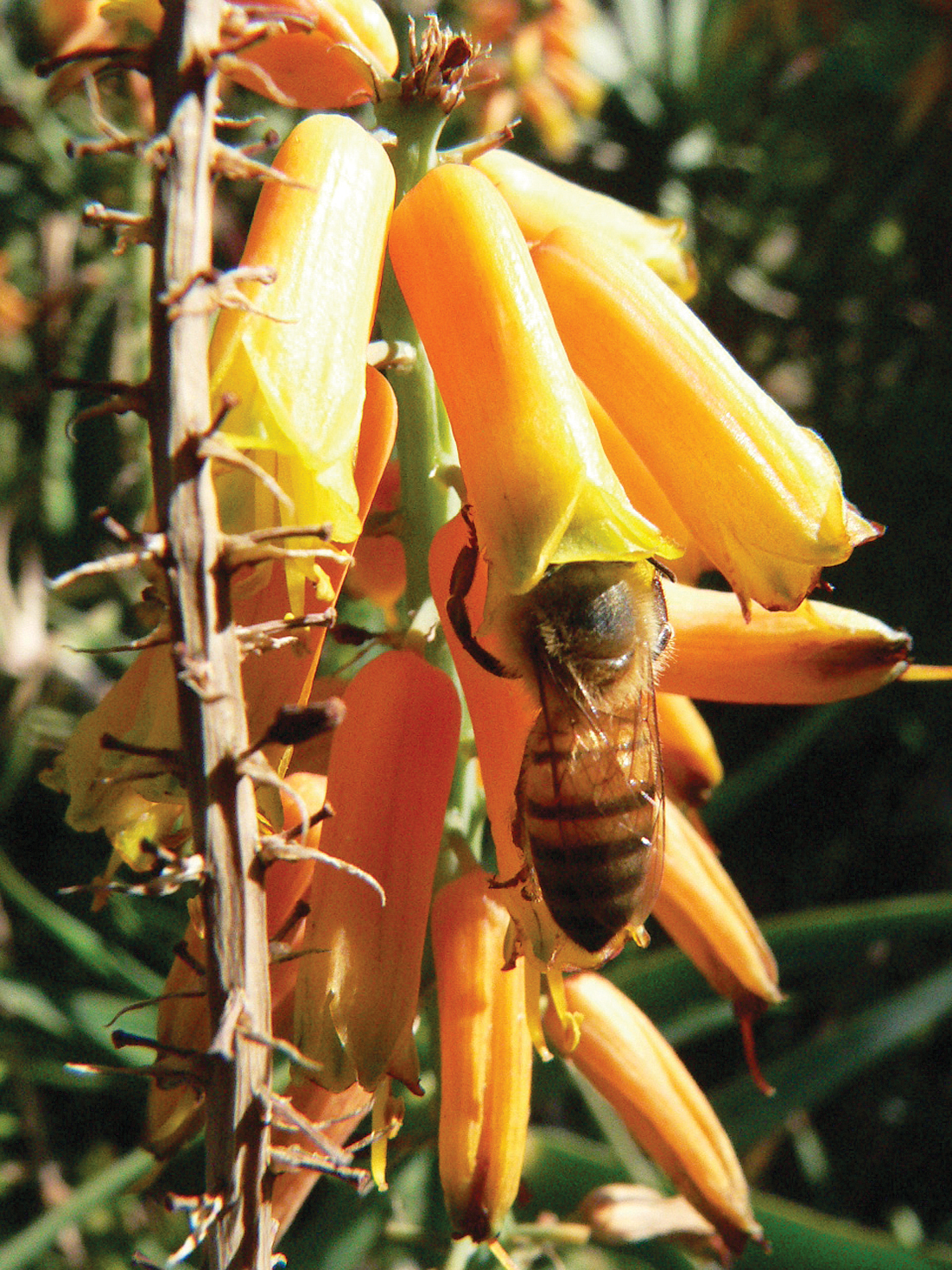
There are some beautiful aloes now flowering in the Klipkerk gardens. The flowers are tubular, yellow, orange and red, and last week you could see bees crawling right into the tubes to collect nectar and pollen. I wonder where their hive is in the middle
of Vryheid’s CBD?
For all that, for all the 500-plus species of aloe, they seem to have little real and evident use to us, except to supply a splash of colour (and feed bees) in winter. Aloe vera and a couple of other species are grown for their extracts, but even then, their health
benefits are not all entirely clinically proven. I’ve seen claims that Aloe vera stops cancer tumours growing, lowers cholesterol levels, eases inflammation and soothes arthritic pain, prevents kidney stones, cures ulcers, ends constipation, stabilizes blood
sugar and reduces triglycerides in diabetics. The list goes on and on. If all true, it would be a wonder plant.
And old BH “Bennie” Groenewald who first described the Aloe Vryheidensis? He died in 1990 (born 1907), was a botanist, and wrote a book The Aloes of South Africa, South-West Africa, Portuguese East Africa, Swaziland, Basutoland, published in 1941
in Afrikaans. I’ve seen the book for sale for 300US dollars, none of which will buy old Bennie a beer now.
Bennie is also remembered by having a plant named after him, the Euphorbia groenewaldii (I kid you not). It is a “tuberous rooted euphorbia”, discovered in 1936 on stony hillsides near Polokwane, once called Pietersburg. The discoverer, Dr F van der Merwe (“Van” to his pals down at the Castle Arms), named it for his friend Bennie.
So, in the botanical world Vryheid is remembered and Bennie Groenewald is remembered, and that’s how it should be.