
Railworker from Moolman killed by a stray Allied bomb in Germany
"They lay together in coffins without lids, on the day of the funeral, in a room with a glass front which we walked past in single file to see the beautiful flowers which were sent from the community of the little town of Bad Tolz, and to say adieu and salute our pals, which brought forty-eight of us to shed a tear, not only for the friends we had lost, but also for the wonderful gesture from the people who after all were our enemy."
Researched and submitted by André van Ellinckhuyzen
James Edwin “Jimmy” Kruger of the South African Railway and Harbour Brigade, and the 7th Armed Reconnaissance Battalion, was born in Newcastle in 1911.
He was the son of Marthinus Johannes Hendrik (Martin John Hendry) Kruger, who was born in Dundee, Natal. Jimmy’s mother was Mathilda Christiana Kruger born Dalgleish. Martin and Mathilda were married in the Presbyterian Church in Newcastle in 1909, and they lived at Tayside near Dundee, also in Francis Road in Glencoe, and in Heeren Street in Vryheid.

Before the war Jimmy was a Rail worker employed by the S.A.R., and he lived, and worked at a small railway station named Moolman, between Paulpietersburg and Piet Retief.
Jimmy had six siblings named: Frederick Ludwig Kruger, Martin Johannes Henry Kruger, Wilhelmina Sophia Johanna de la Guerra (Quearra) born Kruger, Pieter Jacobus Thomas Kruger, Louis Christiaan Henry Kruger, and Harry David Dalgleish Kruger.

The De La Guerra or De La Querra family are in possession of numerous war time letters written home by Jimmy Kruger, mostly being “Kriegsgevangenenpost” from Stalag VIIA”, as well as letters by Jimmy’s brothers, addressed to their mother, sister and family. As was the fate of many South African servicemen during the war, Jimmy Kruger was also taken POW during the battle for Tubruk in June 1942. Months later he found himself in a POW Camp in Germany where he would spend his days cutting stone in a quarry.
The Vryheid Gazette dated 17 November 1944 reported as follows:
“L/Cpl James Edwin Kruger (S.A.R. & H Brigade) has been killed whilst in a working party from Stalag VIIa by a bomb jettisoned from a plane over Germany…….L/Cpl. Kruger was the second son of Mr. and Mrs. M.J.H. Kruger of Heeren St, Vryheid, who have a son in the workshops in Egypt, also a son fighting in Italy, in addition to one recently discharged.”

The other South African who had been killed, together with Jimmy Kruger when a stray Allied bomb was dropped on the quarry they were working in, on 22 September 1944, was Private Marthinus Jacobus Prinsloo, originally from the farm Arendskrans, at Lekmansdrift, near Queenstown in the Eastern Cape. Prinsloo was attached to the Umvoti Mounted Rifles (UMR), and like Jimmy Kruger, Prinsloo was a Railways Official, and he resided, and worked in Vryheid, before the war.

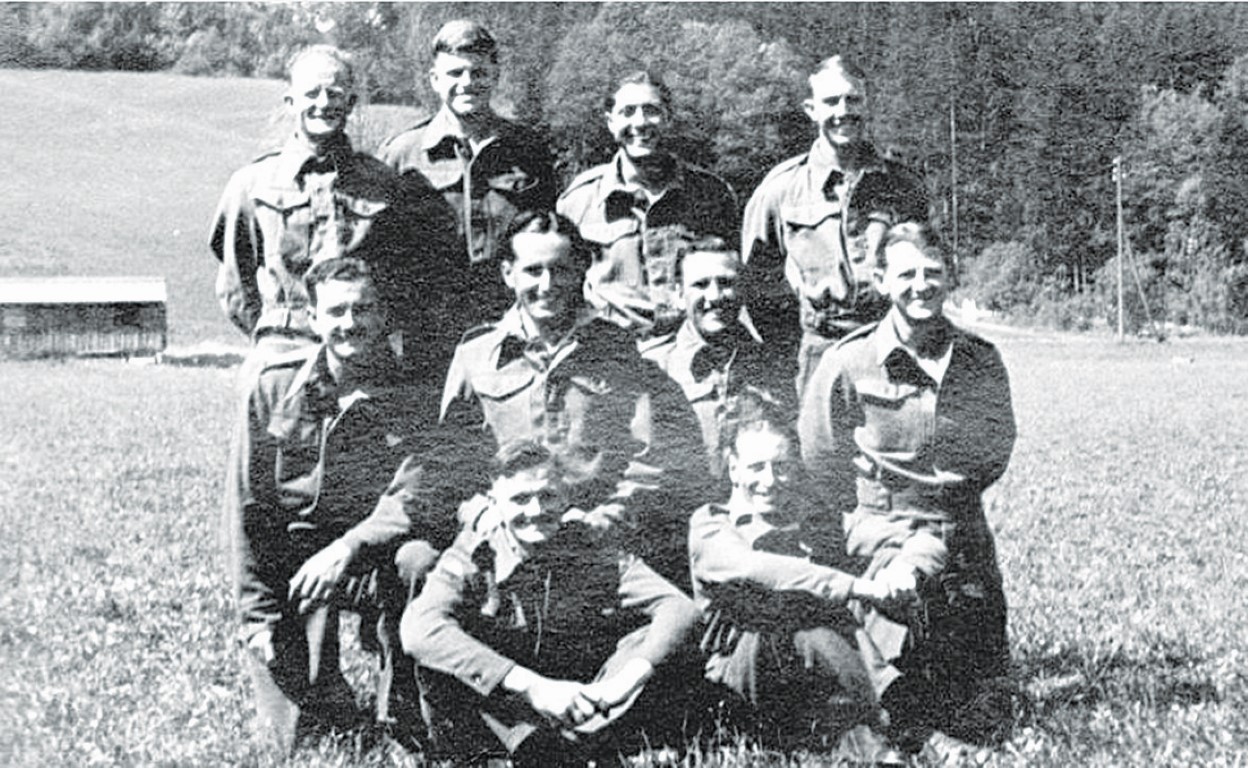
In The War Time Scrap Book of Pvt. Gilbert Mileham “Gil” Algar, Algar described how a group of POW’s, which included himself as well as L/Cpl Kruger, Pvt Prinsloo and others, had been selected to move out of Stalag VII(a) and into an abandoned school gymnasium in the nearby town of Bad Tolz in Bavaria, Germany.
Twenty-five South Africans and twenty-five British soldiers were accepted to go to working camp at Arbeitz Kommando 3657 at Bad Tolz, Bavaria near the river Isar. On Friday 22 September 1944 two of his fellow POW’s, Kruger and Prinsloo were killed, together with the owner of the Quarry in which they had been working, when a stray bomb jettisoned from an Allied aircraft landed in the quarry and exploded right there where they had been.

Algar pasted photographs in his war time scrap book with him standing right next to the two killed service men, and on pages marked page 124 and page 125 he wrote:
“We awakened on a sunny morning not knowing that tragedy would strike during the day. An elderly couple arrived at the hospital to pick up prisoners to help them at their quarry as they were short of stone cutters. Prinsloo, Kruger and Robertson went off with them for the day some distance away out of town. We all went to our jobs as usual and during the afternoon we noticed people gathering at the reception area of the hospital. Being inquisitive I went to see what was going on and was shocked to see Robertson sitting at the wheel of the black car belonging to the old people. Blood was running down his face and into his eyes, and before I could get nearer to him he was escorted into the hospital while the old lady sat in the office with a complexion as white as snow as she talked to a doctor. It took a long time before we were told that one of our bombers was in trouble preparing for a crash landing as it was hit by anti-aircraft guns and jettisoned his bombs in to the quarry. Prinsloo, Kruger and the old quarry man were killed. Robbie took the wheel of the car and drove the old lady back to the Hospital for help, where he was x-rayed and they found a sliver of steel lodged very close to the brain which the doctors rightly would not take the chance of removing. Prinsloo and Kruger’s bodies were brought to the mortuary before being transferred to the cemetery. They lay together in coffins without lids, on the day of the funeral, in a room with a glass front which we walked past in single file to see the beautiful flowers which were sent from the community of the little town of Bad Tolz, and to say adieu and salute our pals, which brought forty-eight of us to shed a tear, not only for the friends we had lost, but also for the wonderful gesture from the people who after all were our enemy. I can still see all the flowers surrounding the coffins in the room, which usually occupied six or more caskets with a corsage or so, which is still vivid in my mind. The burial was simple although a lot of familiar faces were seen in the background. We wore our own army uniforms and caps, boots shining as if new, which we used only for such occasions. We were smart and at our best behaviour when marching to and from the graveyard, …………”
Gil Algar, was born in 1923, and when retired he moved to Port Elizabeth, and lived in Walmer, until his death in January 2007.

L/Cpl. James Edwin “Jimmy” Kruger and Pvt. Marthinus Jacobus Prinsloo rest in the Durnbach War Cemetery, just east of Bad Tolz in Germany.
Lest we forget.

Also read: VHS old boy was killed in North African conflict zone
Make sure you follow us on our social media platforms for regular updates