Jukskei pegged as tough sport
While the complexities of the sport are numerous, many enjoy jukskei and hope to promote its growth.
It’s said to be the third most difficult sport in the world, trumped only by golf and snooker.
An indigenous game, even coaches and players admit they have trouble translating the complex and technical rules into simple terms for amateurs and newcomers.
Despite this, jukskei is growing in popularity year after year.
Daleen Roos, the Director: Administration for Jukskei South Africa, explained the precision sport promoted teamwork, concentration, hand-eye coordination and balance (and owing to the many rules, attention to detail).
Players can be as young or old as allows them to throw the skey.
“You must know your opponent’s score, the technical side and the way to win. You must know the strengths of your team members too,” Mrs Roos added.
The rules
Likened to horseshoe tossing, the objective of jukskei is throwing a skey underarm from a fixed pitching line, toward an upright peg embedded in the sandpit, while attempting to score more points than the opposition.
Throw distance ranges from four to 16 metres, which is why jukskei can be called a ‘game of centimetres’.
One to four people can comprise a team; members of both teams will attempt to land the skey as near as possible to the peg in pursuit of 23 points, generally over three sets.
Thus, a perfect score for an entire game would be 15 points (five per set).
Explaining the game with examples, Mrs Roos said if team A had won one set (five points) and time was called during the second set, points would be divided between teams A and B according to who led at that time.
The unplayed third would then be equally divided, as both teams’ scores should equal 15.
“A player can either try and play closer to the peg, or use the skey to knock the others out. Another tactic is to hit the peg and land outside its reach, forcing the opposition to ‘burst’.”
As the landing of skeys can be unexpected, Mrs Roos said the rule of measuring distance from the closest possible point meant sometimes skeys were measured even though buried in the sand.
Styles of throwing
There are numerous ways of throwing a skey to suit the situation.
Mrs Roos said the usual underarm straight throw was sometimes changed by the motion of the wrist, causing the skey to spin, land handle inwards or even fall diagonally.
“It all depends on your control of the skey.”
Presiding officials
There are no umpires directly in charge of play, except if there is uncertainty as to the movement of a skey, or if players require clarity on rules or the next steps to be taken.
There is a coach for every team, allowed to give advice but never to directly affect the game.
Safety regulations
* Wait your turn.
* Do not walk in front of a player throwing a skey.
* Follow the skey with your eyes.
* Never stand behind the thrower while he/she is swinging.
Equipment
Play is conducted in a rectangular sandpit, which adjoins onto a cement area marked by distance lines.
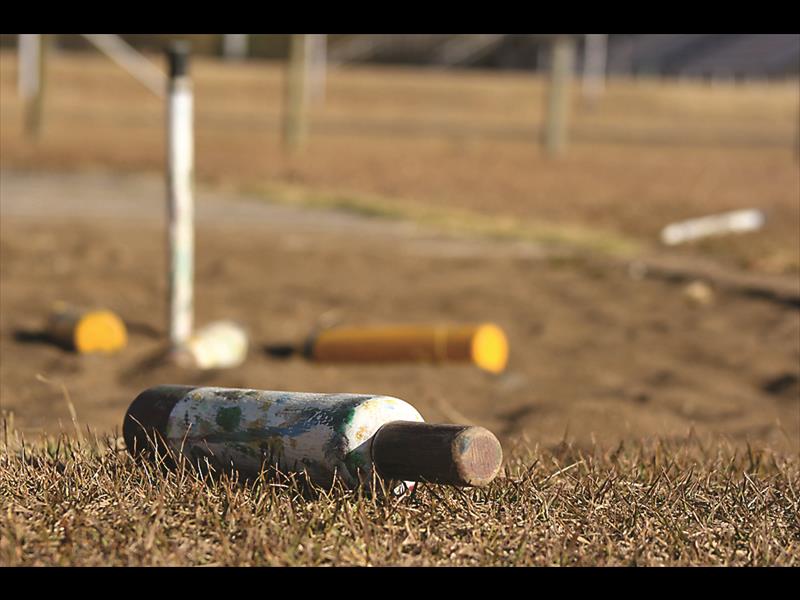
Skeys can differ in size (senior men play with heavier and longer skeys than children and females), material (wood and rubber in particular), handle style (straight or tapered) and even the way players prepare them.
“My mother put glue on her handle for grip, but I can’t play like that.”
Other pieces include the peg (placed in the sand to a certain point), a marker string or gut (pulled taut across the court to find the centre point) and a caliper (to measure the closest skey to the peg).