Mortimer Cup was once the only sport in town
"The whole tone of the tournament was definitely social, although there was some good hockey too..."
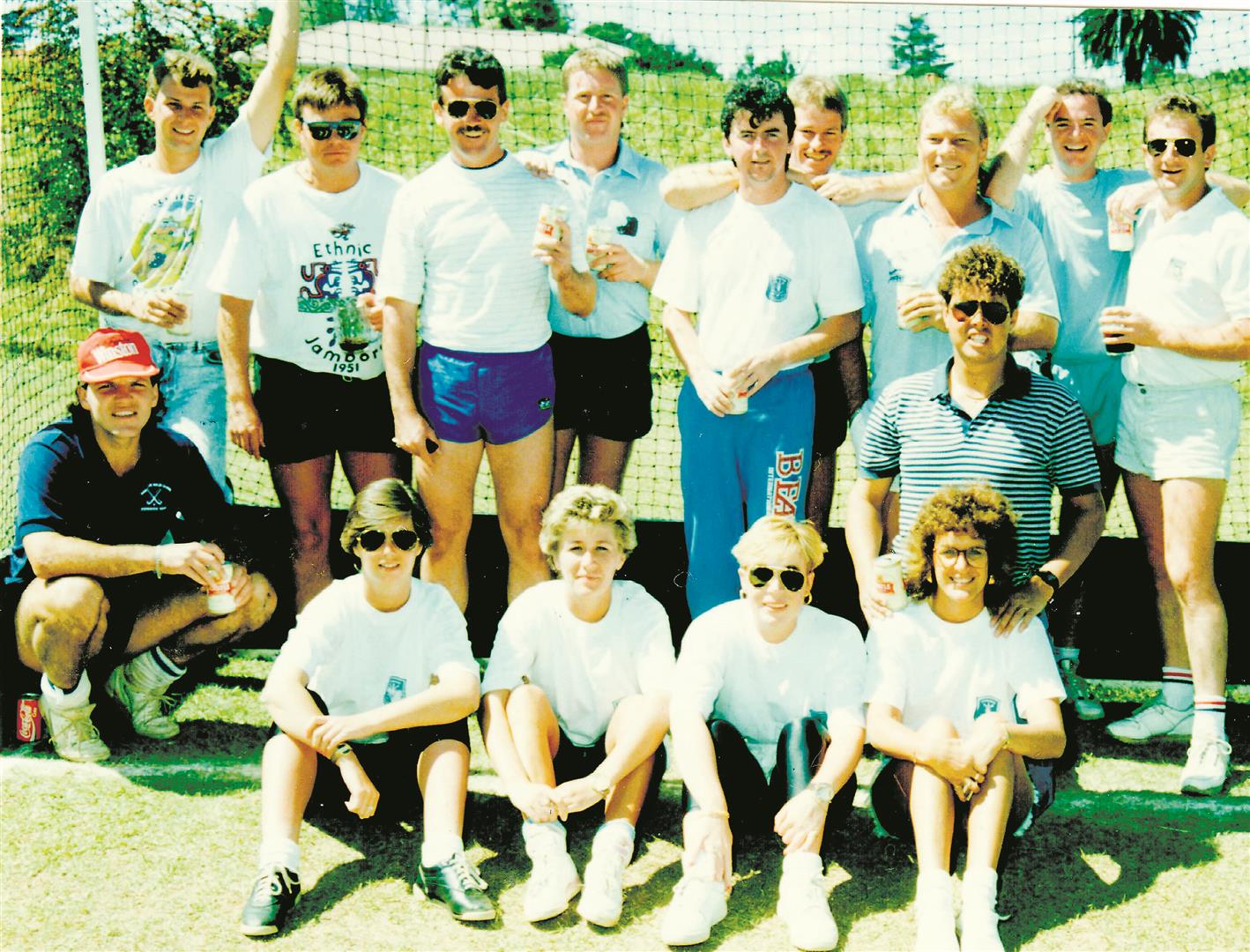
The Mortimer Cup hockey tournament was a fixture on the Dundee sporting and social scene for almost 70 years – from 1927 until 1996. The tournament was typically held over the Easter Weekend. However, it was first held during the July school holidays, says Dundee historian Stuart Clark, who now lives in the USA but has written a book about his childhood in Dundee.
It was a “mixed” tournament, with five women and six men on each team (the goalie had to be male). The venue was always King Edward Park in Union Street – the cricket oval. “My first recollections of the Mortimer Cup weekend go back to the years before the first time I played in the tournament, which was in 1961. My school diary for Sunday, July 9, 1961, contains the notation “Played in Mortimer Cup for ‘The Teenagers’ team.
“Those early recollections are of hordes of exuberant hockey players descending on the town, filling the main street with cars from distant places, and filling the bars and hotel lounges with the occupants of those cars. However, I don’t recall ever attending the tournament before 1961.
“I have always assumed that the cup was named after A.W. Mortimer, a local Dundee businessman, and the mayor during the World War 1 years of 1915 though 1918. Given that Mr Mortimer was long gone before I grew up in Dundee – and am not sure how he was involved.”
“The 1960s and 1970s were probably the heydays of the Mortimer Cup from an attendance point of view, but even then probably not from a behaviour point of view. That is the period in which I was involved in the Mortimer Cup, as I last played in the tournament in about 1971 or 1972. In the years of my participation, the Mortimer Cup tournament was definitely the party event of the Natal hockey calendar. “On the scheduled Mortimer Cup tournament weekend, players started arriving on the Saturday around midday (most people still worked on Saturday mornings in the 1960s!). The vicinity of the Royal and Masonic / El Mpati hotels
– which were always filled with hockeyplaying guests – was always the centre of the off-the-field, informal social action. “There was normally a dance on the Saturday night, and dance venues included the El Mpati Hotel on the corner of Victoria Street and Boundary Road, or the Agricultural Hall in Union Street.
These were exuberant affairs, especially as regulars who played each year at the tournament renewed their acquaintances. “Hockey was played all day on the Sunday, followed by a dance and / or braai at some venue.
Once again, the Agricultural Hall was a regular venue for the after-tournament braai. At least one year, the Sunday night event was held at the Glendee Yacht Club on the shores of the Tom Worthington (Hattingspruit) Dam.
The following Monday found some players engaged in social ‘pick up’ games at the field, while others gathered in the courtyard of the Royal Hotel, where there was drinking, singing, and (on at least one occasion) a semi striptease by one of the lady players from the Durban Collegians team!

Susan Joubert (neé) Rohrs tackling Kelly Kelbrick and Mike Holliday in the heyday of the Mortimer Cup.
“The tournament attracted as many as around 30 teams, generally playing in two divisions. The whole tone of the tournament was definitely social, although there was some good hockey too. Some clubs consistently entered teams of high standard, eg Dundee, Ladysmith, Newcastle, Estcourt, Zoo Lake, Benoni, Durban Collegians, Maritzburg Collegians, Old Johnnies, and my own eventual team, the Hurlingham Rovers – a social team from Natal University, Durban. Other clubs that participated generally sent their social teams too, staffed with players who were more into partying than hockey! “I expect that the Dundee team
probably appears on the cup as the trophy winners more often than most others. Stalwarts of Dundee men’s hockey teams in the 1960s included Roy Kirkness, James ‘Stiff’ Teversham, Keith Cavanagh, Glyn Durham, Graeme Elliott, Mike van Wyk, Clive Bunting, Tony Krugel, Shaun Richards, A.D. ‘Kelly’ Kelbrick, Dave Levine, Dennis Gehren, Peter Abraham, Robert Whysall, Paul Whysall, Neil Whysall, John Lloyd and John Veglia.
Women’s team stalwarts included Leonie van Wyk (nee Vincent), Yvonne Kirkness and Springbok Loretta Maree.” Chery Elliott has more recent memories of the Mortimer Weekends:
“The guys used to mainly stay at the Royal and the dare on a Saturday morning was for them to only dress in their socks and run past the police station to the Oval. It caused quite a stir to see this bare men running down the street.” She also recalls the municipal fountain being filled with soap and some of the more ebullient players taking early morning foam baths – probably much to the horror of the municipal fathers.
There is also the legend of one William Scott who dressed and played as a woman for the entire weekend and even tricked then Mayor, Dave Ware, into dancing with ‘her’ after prize giving in the Moth Hall. “If only we had Facebook back then,” laughed Cheryl. The Mortimer Cup now lies in the Dundee Story section of the Talana Museum.

HAVE YOUR SAY:
Like our Facebook page, follow us on Twitter and Instagram or email us at dundee.courier@caxton.co.za. Add us on WhatsApp 071 277 1394