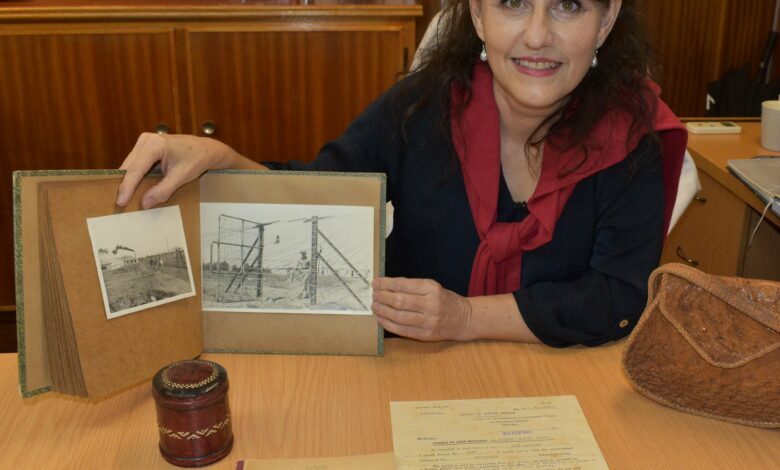
Adri Jansen, the librarian for special collections at the NWU, shows some of the photos, documents, permits and artefacts that were among Willi Paul Karl Lange’s personal belongings during his incarceration. Willi made the handbag and three wallets himself. The photos are part of an album by L.T. Weichardt titled “Agter Doringdraad”. Photo: Supplied.
A new donation to the NWU’s Library Services focuses on what life was like for these men during their incarceration. Heinz Lange of Somerset West donated this historical collection of documents, artefacts and heirlooms in January this year.
Adri Jansen, the librarian for special collections at the NWU, shows some of the photos, documents, permits and artefacts that were among Willi Paul Karl Lange’s personal belongings during his incarceration. Willi made the handbag and three wallets himself. The photos are part of an album by L.T. Weichardt titled “Agter Doringdraad”. Photo: Supplied.
Taken prisoner, isolated from loved ones and incarcerated with thousands of others in lice-infested camps. This was the reality of many German men living in South Africa and South West Africa during the Second World War when the government of former Prime Minister Jan Smuts held them in internment camps. A new donation to the NWU’s Library Services focuses on what life was like for these men during their incarceration. Heinz Lange of Somerset West donated this historical collection of documents, artefacts and heirlooms in January this year. The collection, along with a video interview with Heinz, was displayed in the Ferdinand Postma Library on the NWU’s Potchefstroom Campus from 16 March.
Meet prisoner #807/40
Heinz’s father, Willi Paul Karl Lange, was incarcerated for six years, first at the Andalusia/Jan Kempdorp internment camp and later at the Baviaanspoort camp. Most of the items in this special collection are marked with his prisoner number #807/40. The collection contains fascinating original historical documents, correspondence and permits for visits from Willi’s wife, Bertha. It documents the time since he was imprisoned as a 26-year-old until his release six years later at the age of 32. Other artefacts that round off the collection include mostly handmade items like a hat, a leather book cover Willi made for Bertha, a handbag, three wallets with Andalusia engraved on them, and a Waverley cigarette tin covered with carefully crafted leather.
Willi Paul Karl Lange made this from an empty tin of Waverley cigarettes. He covered it with leather and masterfully crafted the patterns as a gift for his wife. Photo: Supplied.
A life captured
Willi’s correspondence shows that life in the internment camp was not easy. Suicides were rife, and the monotonous passing of time must have been soul-destroying, but Willi did not allow conditions to grind him down, and he used his time as best he could. It was in the dreary camp that he learnt to play the mandolin. He also broadened his knowledge by attending various courses presented by the other prisoners (some of whom were professors). Courses in bookkeeping, mandolin lessons, rugby games and jiu-jitsu were all keenly pursued in the camp. According to Adri Jansen, the librarian for special collections at the North-West University Libraries, the camp had a profound impact on Willi and his family. Bertha, his South African wife, was pregnant when he was incarcerated. Not only did she lose her husband for six years but he was also the breadwinner of the family. She had to move back to her parents in Green Point, Cape Town. After Heinz’s birth, she moved to her sister in Gardens to survive.
“She had to travel from the Cape to Jan Kempdorp to see Willi. She could only see him for half an hour each month. During these visits, they could talk to each other through a chicken-wire fence with guards watching them the whole time. As young children were not allowed to visit, Willi only saw his son, Heinz, after he was re-leased. By that time, Heinz was already almost six years old.” Adri says these men were not imprisoned because they were politically active – they were taken merely because they were German citizens. To make matters worse, it took 10 months after the war ended in 1945 for the prisoners to be released. “If losing so much precious time weren’t enough, they had to wait until March 1946 to be reunited with their families.” Life would never be what it was before the men were incarcerated. The effect the camps had on the prisoners lingered with them for a long time. According to Bertha, Heinz’s mother, his father suffered from post-traumatic stress after being released and avoided people for some time.
Willi Paul Karl Lange took mandolin lessons during his imprisonment. Some of the music books are handwritten, while a few are printed. Photo: Supplied.
Lest we forget…
Adri believes the collection gives everyone who sees it the opportunity to reflect on a piece of South Africa’s history that is not often talked about. “The collection gives us pause to remember that this happened in our own country. Freedom is frail. If we fail to remember, we are doomed to repeat history,” she concludes.
Liezl Scheepers is editor of the Parys Gazette, a local community newspaper distributed in the towns of Parys, Vredefort and Viljoenskroon. As an experienced community journalist in all fields for the past 30 years, she has a passion for her community, and has been actively involved in several community outreach projects as part of Parys Gazette's team.