The Dome is not what it was
f you could restore about 10 km of vanished Vredefort rock vertically above where you can stand in the Dome today, its top would be roughly where an airliner cruises, around jet-stream altitude.
On a long haul flight in a jetliner you may cruise at up to 42000feet or 10,7km above the ground. Now consider this.
The world’s biggest and best preserved meteorite crater is just a ghost of its former self. A jet would have been at ground level when the crater was formed.
If you could restore about 10 km of vanished Vredefort rock vertically above where you can stand in the Dome today, its top would be roughly where an airliner cruises, around jet-stream altitude.
I did a thought experiment to imagine how it is that the original crater surface, that formed on impact about 2,023 billion years ago, can have eroded by the height that a jetliner flies. We know it has eroded from various kinds of scientific evidence.
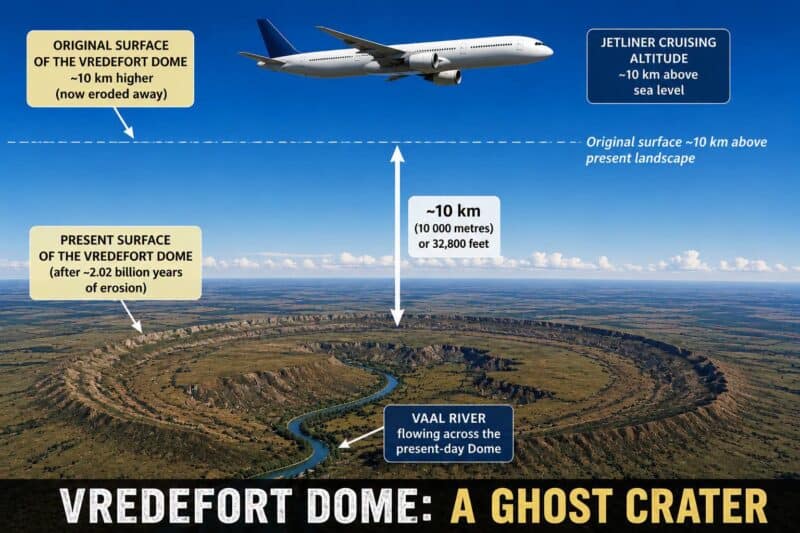
For one thing, the shatter cones that formed around the rim of the crater tend to orientate themselves towards a vanished point sky between 8 and 12 km above the present surface. These conical shaped rocks were deformed by extreme shock.
Another indication is the rocks now at the surface which would originally have roared up from deep down and overturned. They have clearly been exposed by later ice, water and weather erosion over vast spans of time. They show marks of glacial grooving and scouring, showing they are what remains of thicker layers.
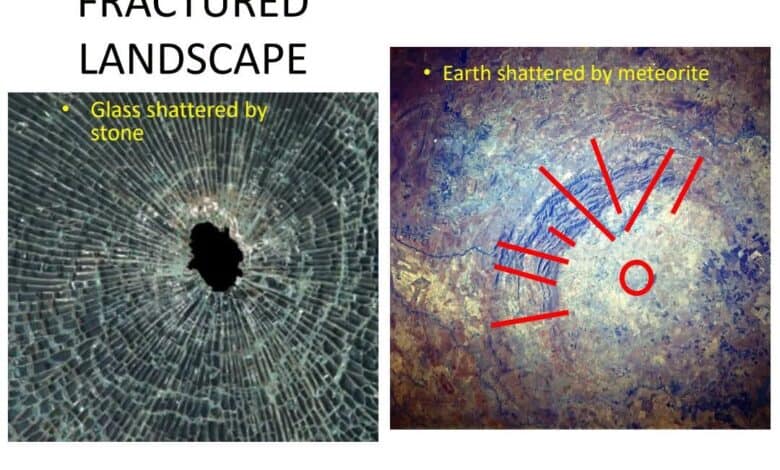
And then there is the Vaal River itself, which has cut down from a surface far above the original crater. This surface was deposited during Karoo times on top of the older crater, burying the Dome and its surrounding rings of mountains. The river is what geologists call a superposed watercourse that, as it wore away the land, found radial cracks pointing towards the centre of the Dome.
These cracks cross the concentric rings of the huge three-ringed crater. The landscape is like a pane of shattered glass hit by a stone. See the illustration.
So what we have at Vredefort is the remnant of a much more prominent feature – a ghost. It is still very impressive and scenic with towering mountain ridges in the Dome Bergland, the first of the three rings.
My thought experiment asked how much a landscape needs to be eroded, per year, to reduce it by 8-12 km over two billion years.
The answer astonished me. A mere ,005 mm annually will produce what we have today. To do this experiment I added the later Karoo overlay to the Dome’s original surface, giving a total depth of 10,5km of combined surface. That’s a very cautious guess as the Karoo may have been a lot thicker.
About 0.005 mm per year is five micrometres a year, or expressed more intuitively, 1 millimetre every 193 years. No-one can notice this amount of erosion without precise instrumental measurement.
The Dome does not require some fantastically violent, continuous stripping process to account for its present exposure. Almost imperceptible average denudation, sustained over deep time, is enough to remove a mountain-sized thickness of crust.
One thing you do notice when driving through the first ring, the Bergland, is that the mountains are rounded whalebacks. This is the result of relatively “recent” (300 million years ago) erosion by the ice cap as Southern Africa floated through the South Pole.
Of course the actual history was nothing like steady erosion. There were probably pulses of rapid uplift and erosion, long intervals of near-stasis, burial beneath sediment, glacial scouring, Karoo deposition, renewed uplift and later stripping. But the arithmetic gives us an extremely useful baseline.
The processes doing the enormous work can be almost invisible on the human timescale. A person standing in the Dome for a lifetime might see virtually no lowering of the landscape attributable to regional denudation. Yet given two billion years, that same rate can remove a rock column higher than Everest.
Next time you take a long flight and reach cruising altitude, look down. You don’t have to imagine the vanished portion of this very old crater: there it is.
* I am currently working on the third and final draft of a new book on the Dome, Crater of Gold. This post and others like it are summaries put online for comment and reaction. It is not the work of AI but my own research using diverse sources, personal observation and some sourcing by ChatGPT and from Google.
Join well-known author and tour guide, Professor Graeme Addison, on a tour or to get a self-drive briefing of the Vredefort Dome. He can be contacted on 084 245 2490 or https://vdome.co.za