When good intentions steal a wild future
Imprinting happens during a short, important stage early in a bird’s life, when it learns who its parents and social companions are
I watched her life slip away peacefully, but inside me, anger overwhelmed sadness. I cried, unable to tell my tears of heartbreak from my tears of rage. My fingers stroked her colourful feathers. “I am sorry that humankind let you down,” I whispered, but she could no longer hear me. The vet folded gentle hands over mine. That touch gave me the courage to walk away, knowing I had made the right decision.
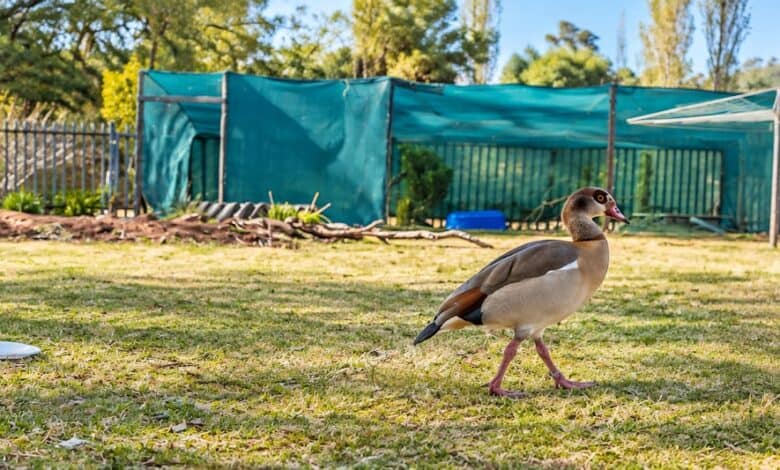
On the morning of June 12, she arrived at Parys WADER in a box. There was no blanket. One corncob lay beside her. I estimated that she was about three months old. Her eye patch had started to form, but she did not yet have the brown patch on her chest – the ‘kol’ that gives this species its Afrikaans name, Kolgans (Egyptian Goose). Her wing feathers were not fully developed either.
I moved her gently into a slightly larger pen lined with faux grass and gave her fresh water and food. She was terrified of her new surroundings. Our resident Egyptian Goose and Yellow-billed Duck came to investigate. They serve as foster parents to the young waterfowl in our care, but for now, I kept the newcomer safely inside her enclosure while they became accustomed to one another.
The following day, I moved her into our large flight enclosure. For about a week, she could see and hear the resident waterfowl without direct contact. This is usually enough time for a new bird to begin finding its place in the flock. She remained distant and confused. I limited my contact with her and gave her space.
After a week, I opened the enclosure and allowed her to join the others. She immediately targeted the Yellow-billed Duck with unprovoked attacks. I had to separate them again.
Two months after she arrived, she was ready for release. Until then, every waterfowl patient at Parys WADER had left through a soft release. We open the enclosure and let them explore on their own time. They usually return for food and shelter at night for up to three days. Then, one day, they do not come back.
That is the goodbye we hope for.
This young goose did not follow the others. Twice, she got into trouble in the busy streets of Parys, walking in the road instead of moving away from people and traffic. I returned her to the safety of her enclosure.
After another week in captivity and a consultation with our vet, I found what seemed like the perfect release site: a farm outside Parys with several dams, other Egyptian Geese, and no busy roads. By then, I suspected that she might be imprinted, but she was still wary of me. She was not tame. I could not touch or catch her. That gave me hope that a hard release far from town might work.
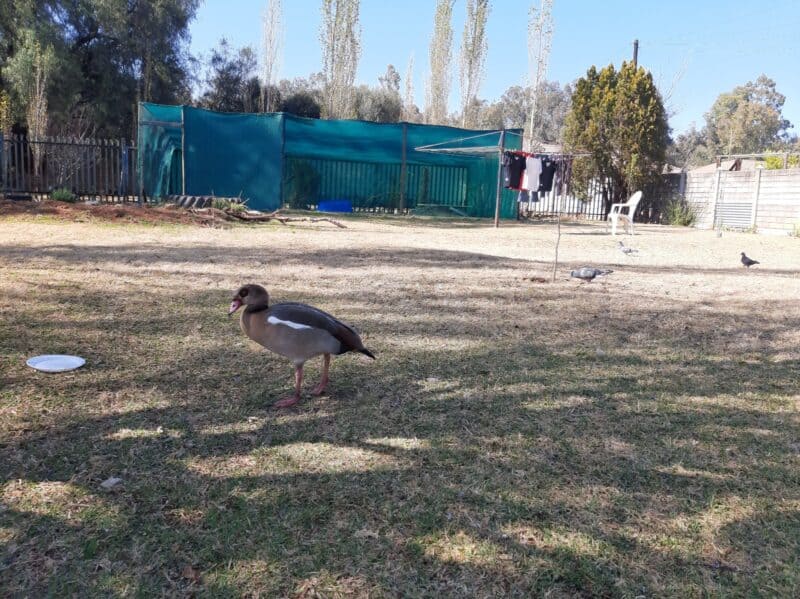
At the farm, I opened her travel crate. She sat inside and watched her new surroundings. I tipped the crate slightly so that she could step out. She walked out and stood beside me, staring at the open water. Other Egyptian Geese called and flew around the dam.
I moved away, hoping she would explore her new home.
She followed me.
After an hour, I decided to leave. I climbed into the car and started driving away. She ran after the car.
She did not fly after me. She ran.
I turned around, got out, and began walking around the dam. A pair of Egyptian Geese landed on the water. Our goose flew towards them and started a fight. Then she returned to me.
That was the moment I knew she was imprinted.
I managed to capture her and took her back to Parys WADER. I clipped her flight feathers to prevent her from reaching the busy streets of Parys again. Then I began searching for a permitted sanctuary that could provide lifelong care.
Over the next few weeks, I continued trying to socialise her. Every attempt failed.
Yesterday, she attacked one of our young goslings and almost killed it. She injured three others.
She had no safe or humane future left. She could not return to the wild. Her aggression ruled out life with other birds at a sanctuary. The only way to keep everyone safe would have been to confine her alone for the rest of her life.
Egyptian Geese are highly social birds and can live for up to 20 years. Keeping her alive would have made me the person who sentenced her to years of isolation.
After consulting our vet and my mentor, I drove to the vet’s consulting room with the decision I had tried so hard to avoid.
I cared for her for 116 days. She was young and healthy. Egyptian Geese pair for life. She could have found a mate, raised many offspring, and lived an amazing life.
I do not know who raised her or exactly what happened during the first three months of her life. I may never know. What I do know is that someone else’s irresponsible choices left me to make the most difficult decision.
The person who begins a story like this with good intentions seldom sees its final page. The rehabilitator and vet do. We carry the distress of every failed release attempt, introduction, and search for another option. We do not leave that trauma behind when we walk out of the consulting room.
That is why I am angry.
If you find a young, injured, orphaned, or displaced wild bird, please do not try to raise it yourself. Contact a permitted wildlife rehabilitator and arrange appropriate care.
She should have flown towards the other geese and the open water. Instead, she ran after my car.
Good intentions are not enough to protect a wild animal’s future.

Read: A duckling is not an easy rescue
Imprinting
Imprinting happens during a short, important stage early in a bird’s life, when it learns who its parents and social companions are. If people raise it too closely, the bird may attach to humans and treat them as its social group instead of learning how to behave with its own species. This can affect how it relates to other birds, chooses a mate, and survives in the wild. The damage may be permanent.
Habituation
Habituation happens when a wild animal experiences people so often that it gradually reacts less strongly and loses some of its natural fear. Unlike imprinting, this does not change which species the animal identifies with. However, a habituated animal may allow people to come too close or approach them willingly, which can place both the animal and people at risk.