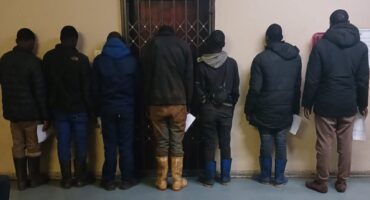
CPF highlights crime hotspots and more
Randfontein’s CPF outlines crime challenges, identifies hotspots and proposes initiatives, from streetlight protection to community funding, to improve safety and collaboration.

The Community Policing Forum (CPF) convened a crucial meeting to tackle rising crime and pressing safety concerns in the community.
CPF chairperson Ruan Sheppard explained that, due to a power outage at the planned meeting venue, the session was moved to a WhatsApp group, where he discussed the crimes impacting the community.
The meeting started with the legal framework of the CPF, followed by the difference between a sector and a ward. A sector is divided by the police into smaller and manageable service areas, while a ward is the area in which the municipality subdivides Randfontein.
CPF structure explained by Sheppard:
• Each police station must have a functioning CPF structure
• The police sub-division divided their area of responsibility into sectors; some sectors are vast and thus get subdivided as sub-sectors
• Where an area is subdivided into sub-sectors, the community of that sub-sector gets called to a meeting where they would elect a management structure to represent them
• Where a sector is not subdivided, the community gets called to a meeting where they would elect a management structure to represent them
• Where sectors are subdivided, the sub-sector management of all sub-sectors in the sector would come together to elect a management representing their entire sector
• Once all sectors have a structure, the management of all the sectors comes together to elect an Executive Committee that would represent the entire CPF structure on a Station level of the police station they represent
Randfontein is divided into four sectors:
• Sector 1 and Sector 2 are not subdivided
• Sector 3 is subdivided between a residential area and the Affri Village Mega Project
• Sector 4 is plots and farms, subdivided into 3 sub-sectors
• Sector 4.1 represents a portion of the farms
• Sector 4.2 represents the remaining farms
• Sector 4.3 represents the Dan Tloome Mega Project
Crime challenges in Sector 3 are outlined:
• Street lights and cable theft are severely crippling our street light infrastructure; many of the repaired infrastructure are already crippled
• Digging in Freda Avenue, Homelake, continues. Until now, houses haven’t been left without electricity due to cable theft, yet criminals keep digging
• Armed robberies
• Drug use and dealings
• Assault
• Robberies
• Theft of motor vehicles
• Theft of gate motors and alarm beams
Crime hotspots identified:
• Homelake, of which Freda Avenue is the biggest concern, as it is the border between three sectors. It is overgrown, has limited working streetlights and illegal dumping. It also has the perfect hiding spots for criminals
• Randgate has numerous abandoned houses providing shelter for the homeless, drug users and petty thieves
• Riebeeck Lake provides the perfect hiding spot for criminals and a quick and easy escape through all the overgrown vegetation
• The dam opposite the church on Greenhills Avenue also provides shelter
• Greenhills Stadium and the Golf course, the golf course has trees, overgrown vegetation and the non-functioning streetlights on North Way Road provide the ideal situation for criminals
Key factors driving crime in the area:
• The lack of working streetlights
• Areas overgrown with vegetation and having illegal dumping provide a quick and easy hiding spot for criminals.
• Community members who don’t open cases when a crime is committed, leaving that suspect to roam free in the streets
• Community members who report a crime, but when the stolen items are recovered, don’t want to proceed to open a case against the suspect, again leaving the suspect to roam the streets as a free man
• Abandoned houses and properties, including houses in Randgate, the golf course and Riebeeck lake, which provides the perfect hiding spots and place for easy escape, as it is overgrown with trees and vegetation, and there is illegal dumping
Sheppard continued to note the importance of reporting a crime. He stated that, regardless of the nature of the crime, if a case is not opened, evidence does not exist, and the suspect is then innocent according to the law. A case can further be opened even if the victim does not know who the suspect is. When a suspect is then eventually found, they can be linked to a crime, whether through eyewitnesses or evidence, including fingerprints, blood, camera footage or whatever is available to prove guilt.
Crimes can only be considered in statistics if they have been reported.
If a person has been killed or a minor victim is involved in a case of rape or assault, or other similar crimes. However, in most cases, crimes need to be reported by the victim.
Sheppard noted, “A suspect must have been seen by a direct eyewitness, who must provide a written statement in which he states that he witnessed the suspect commit the crime, or physical evidence should exist that could link the suspect to the crime.
“Just because someone is in possession of stolen goods, it doesn’t prove that person stole the items. Someone else might have stolen the items and given or sold them to the suspect, meaning that the suspect can’t be charged for theft. He could be tried for being in possession of stolen goods or for purchasing stolen goods. Unless a physical eye witness saw him steal or actual evidence exists, proving that the suspect was the one to steal the items.”
He mentioned another thing to consider is, if an area doesn’t report crimes, there is a possibility that police resources might be moved to other high-risk areas, and eventually the police become undersourced.
Sheppard also added a few issues when it comes to reporting crimes:
• In most instances, the victim themselves must be the complainant opening the case
• Certain police officials might not be as helpful as others, hence they could be reported
• All police officials are ranked according to the Ranking Structure, and they have their names on a name tag. It is important to get the official’s name, especially if you are reporting the official for not doing his/her job or for unprofessional behaviour.
• When reporting a case, it is critical that you give facts that you are sure of. You are allowed to say that you don’t know or that you are unsure.
He mentioned that if a police official is not doing their job or refuses to help, the CPF can assist in posting the complaint to the Vispol commander.
“It is crucial that the person who is the victim contact us directly. It is difficult to lay a complaint on someone’s behalf, as we would have questions that you might not be able to answer when reporting a person for not doing their job. The Vispol commander would require facts directly from the victim and not hearsay,” added Sheppard.
Proposal put forward to curb streetlight cable theft:
• Where there are concrete poles, we will be removing the back cover where the circuit breaker is. The cables for the light would be directly connected to the main feed cable, where the back plate was, which will now be filled with concrete, leaving no more chances for the cables to be stolen
• The same method will be applied where there are steel poles, with the cables running underground. The breakers would be removed from the back plates, and the light’s cables would be connected directly to the main cable. The back plate would then be welded shut and in full, leaving no place for tools to be inserted to break open the panel
• The trees will also be trimmed around the street lights, providing more visible light and also less chance of a criminal climbing a tree to steal cables from the top
• The day and night switches or timers will also be rectified
• There are roles of cable and light fittings that were ordered to repair the dead or defective streetlights. While we wait for the stock, we will be working on safeguarding, according to the above-mentioned plans, after testing the efficiency of the current action plan
Sheppard further added another proposal from the CPF.
“The lack of safety in our community has many contributing factors. Many of those factors affect crime in some way. To expand our abilities to address as many of the factors affecting crime as possible, I would propose that we register an NPC aimed at working in favour of addressing all the factors affecting crime.”
The aim would then be for donations to be made to the NPC. The NPC would then fund the needs of the CPF so they are able to remain functional. The remainder of the money will then be used to address issues affecting safety, including the ones mentioned above, as well as clean-ups and fencing off trouble areas as well and add solar lights in parks and veld areas. Funds can also be used for the protection of infrastructure and painting street signs.
“The ultimate plan of safety is that funding can be used to install cameras in our community,” said Sheppard.
Financial issues entities struggle with:
• Every CPF of every police station must generate their own funds
• The funds we generate are the funds we use for fuel for patrollers, equipment such as jackets, flashlights and so forth
• Many of our community members are under the impression that CPF is generating a lot of money, when in reality, currently, CPF is kept alive by donations of a mere 13 people, in good months, maybe 30 people
• We are currently having the majority of groups in Randfontein. Looking at Sector 3, we have about 2 000 members
• If each person can donate R50, this would generate R100 000 per month, money that could fund CPF as well as community projects as mentioned above. With a possibility of R100 000 a month, we could accomplish a lot in a short time
“The abovementioned is only a handful of proposals for projects that we can look at to improve our community, hence the proposal for creating an NPC to serve our community,” concluded Sheppard.