VIDEO: Tshwane ordered to pay 29 000 employees their due salary increase
Tshwane spokesperson Selby Bokaba said the metro was shocked by the ruling since the panellist acknowledged Tshwane had liquidity problems.
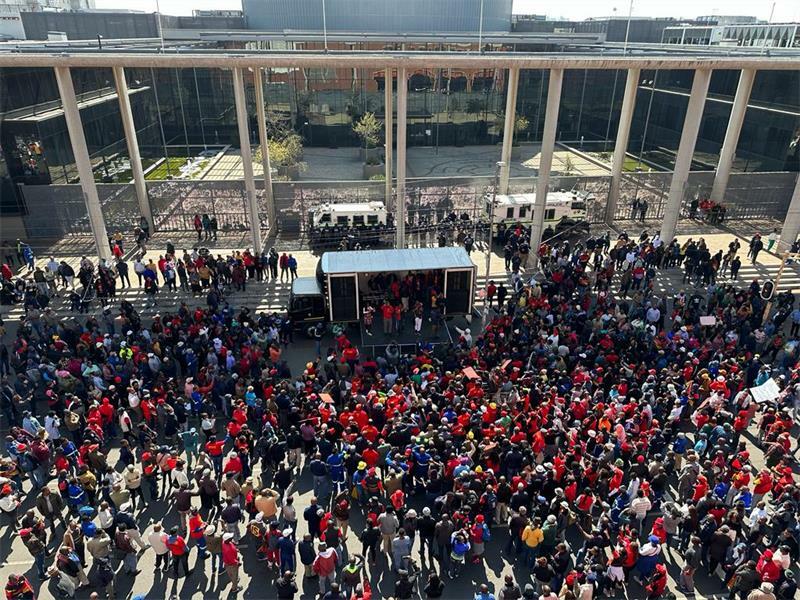
Tshwane has taken a knock in its bid for exemption from signing off on the R602-million salary increase to its employees who have been on an alleged strike for more than seven weeks.
The South African local government bargaining council (SALGBC) dismissed Tshwane’s application and ordered it to comply with the 2021 salary increase agreement with immediate effect.
On August 10, Tshwane applied for an exemption from dishing out the salary collective agreement to the Independent Municipal and Allied Trade union (Imatu) and South African municipal workers union (Samwu).
Samwu and Imatu were opposed to the exemption.
Tshwane had complied with the salary agreement in the second year of its operation 2022/2023 in an amount of R489- million, then applied for the exemption for the financial year 2023/2024.
On September 10, SALGBC senior commissioner Eleanor Hambidge ruled that Tshwane had sought exemption from increasing the salaries of 29 000 employees that fell within the three-year agreement it entered with the unions in 2021.
The agreement covered the years 2021 to 2024.
“Is abundantly clear that Tshwane is in financial distress with major liquidity problems, as borne out by National Treasury mid-term recommendations, the Auditor-General report on the 2021/2022 annual financial statements and the Moody’s report which all clearly indicate that there are solvency issues with creditors not being paid,” Hambridge said.
“The 2022/2023 annual financial statements do, however, indicate a slight improvement, but there are still challenges with liquidity and being in a position to pay creditors. However, regarding the budget for 2023/2024, I hasten to add that a budget is a projection, which indicates an overall increase in expenditure and income of 6% and thus it is anticipated that these measures will go a long way to ameliorate Tshwane’s financial predicament,” she explained.
She said Samwu raised in its submissions that Tshwane had made provision for the salary increase in the 2023/2024 financial year and based on the actual expenditure in the 2022/2023 financial year, compared to the budget provision of the 2023/2024 medium-term revenue and expenditure framework report (MTREF).
“No reference was made to the actual budget provision which is R12 640 889 388 and when compared to the actual expenditure for 2022/2023 in an amount of R1 494 593 387, after leaving a difference of R11 146 296 001. It is fair to both the applicant/employer and the employees to conclude that sufficient provision has been made in the 2023/2024 budget to cover the increase in an amount of R602-million,” she said.
“I am further persuaded to decline this exemption application, as granting such has the potential to undermine centralised collective bargaining in this sector.”
Tshwane spokesperson Selby Bokaba said the metro was shocked by the ruling since the panellist acknowledged Tshwane had liquidity problems.
“This is disappointing as the metro has presented solid arguments supported by evidence as to why these increases are unaffordable.
“Tshwane’s financial position is exceptionally fragile and, as such, we embarked on an extensive cost-cutting exercise by reducing budgets by 30% across departments.”
He said the ruling further provided grounds for review to the Labour Court.
WATCH:
The Capital City has been a battleground of instability, violence and intimidation since the unlawful strike action started on July 24, which has severely affected service delivery operations.
Since July, the metro has been unable to render service, such as fixing power failures, pipe leakages and sewer blockages.
The strike also forced the closure of customer service centres, the withdrawal of bus services after buses were allegedly pelted with stones and disrupted waste collection as trucks torched leading to residents dumping their refuse illegally everywhere.
The unlawful strike is driven by demands to implement salary increases for the years 2021 and 2023.
City of Tshwane working hard to restore water to parts of the city
Do you have more information about the story?
Please send us an email to editorial@rekord.co.za or phone us on 083 625 4114.
For free breaking and community news, visit Rekord’s websites: Rekord East
For more news and interesting articles, like Rekord on Facebook, follow us on Twitter or Instagram