UP’s Giving Garden remains true to its name
The garden is also a valuable space for practical training and research on edible orphan and indigenous crops for UP students and staff.
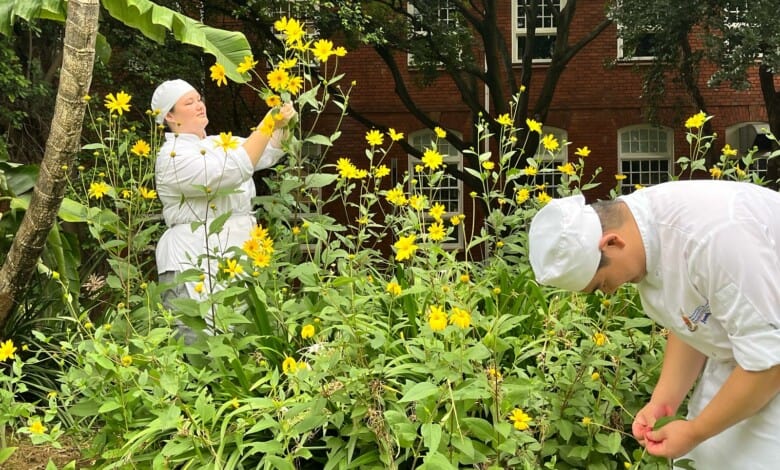
The University of Pretoria’s Giving Garden remains an advocate for food security as it has provided around 100 community food gardens in Gauteng in 2024 with free cuttings, seedlings and tubers of lesser-known and easily grown crops.
Situated in the heart of the Manie van der Schijff Botanical Garden on the Hatfield Campus, it is also a valuable space for practical training and research on edible orphan and indigenous crops for UP students and staff.
The 2 300-square-metre garden is a “living library” of lesser-known crop species and a “supply store” for home and community gardeners who want to cultivate such edible plants in their garden. Visitors are encouraged to take plant material, as sharing is central to the garden’s philosophy.
The Giving Garden co-ordinates a skills transfer opportunity for staff and students looking to grow their own food. Meanwhile, it is facilitating the inclusion of often marginalised members of the university community into research projects that address issues related to their work, everyday lives and overall well-being.
“Our Giving Garden is both a living garden and a philosophy, through which we introduce gardeners to the potential of orphan and indigenous crop plants as sources of food,” said Richard Hay, Curator of the Future Africa Indigenous and Orphan Crops Collection.
“We are always trying to propagate as much crop material as possible with the biggest potential to feed communities.
“This is done in consultation with communities, to make sure that they would like to grow and eat such plants. This requires interaction with community groups to raise awareness about agro-biodiversity.”
Hay added that the project helps them select crops that are fairly low maintenance and easy enough for even beginner gardeners to grow, yet still yield enough to eat.
“Plant material is donated regularly to community gardeners, such as those supported by the ABBA Embrace Foundation, an NGO that supports community food gardens to improve household food security.”
He said the most recent donation in December 2024 was of chaya (Cnidoscolus aconitifolius) cuttings.
“This small, hardy South American tree spinach has protein-rich leaves and is very pest-resistant. It’s one of the few plants that produce an abundance of edible leaves, which can shade each other out, and slow growth.”
Orphan crops were in the past grown for food but nowadays are seldom cultivated due to various socio-political and socio-economic factors.
Jason Sampson, Head Curator of UP’s Manie van der Schijff Botanical Garden said orphan crops were historically domesticated for and by use of people, without access to the myriad inputs required to produce modern food crops.
“Such plants are thus eminently suited to an agricultural practice that is closer to nature.”
Hay and Sampson started the Giving Garden in 2022 on land previously used for flower identification studies.
They selected some of the 250 species growing in a specialist collection housed in the Future Africa Campus Orphan and Indigenous Crop Collection, Sampson’s brainchild, with Hay as curator.
“The domesticated form is reliant on human intervention. It must be cropped regularly to grow well, or else it stunts itself,” Sampson explained.
Sampson said the garden also houses the following:
– Leafy vegetables Brassica species such as Ethiopian Kale and Mutshaina (a leaf vegetable from Venda),
– Egyptian Walking Onions: an ancient Silk Road hybrid between the common bulbing onion and the spring onion that produces bulbs on flower stalks instead of seed.
– Sunchokes: a North American tuberous sunflower
– Tsenza (Coleus esculentus) an Indigenous African root vegetable that was once hugely important to people in Southern Africa before being replaced by such crops as potato and taro)
– water chestnuts (Eleocharis dulcis) an aquatic vegetable native to Asia-naturalised in South Africa
– water spinach (Ipomea aquatica),
– Kenyan cabbage tree (Moringa stenopetela) and
– Kei apples (Dovyalis afra).
Hay said it is also a teaching and learning space for second-year students doing practical work as part of the undergraduate module in agroclimatology and sustainable crop production systems.
“Students are tasked with growing a crop in a little plot and making a vlog of their learning journey during the course of a semester,” Hay explains.
Sampson and Hay run workshops and readily provide advice to home and community gardeners and small-scale farmers looking to diversify their cropping options.
They recently started writing a column about the cultivation of orphan species for the Botanical Society of South Africa’s website, aptly named ‘The Giving Garden’.
ALSO READ: East councillors, volunteers repair potholes
Do you have more information about the story?
Please send us an email to bennittb@rekord.co.za or phone us on 083 625 4114.
For free breaking and community news, visit Rekord’s websites: Rekord East
For more news and interesting articles, like Rekord on Facebook, follow us on Twitter or Instagram or TikTok.