Cape Town model can help Pretoria prevent crime
The Mother City’s MMC for Public Safety, JP Smith, visited Pretoria communities with DA mayoral candidate Cilliers Brink to discuss lessons he has learned in his more than 15 years as safety leader in Cape Town and how these can be applied to Pretoria.
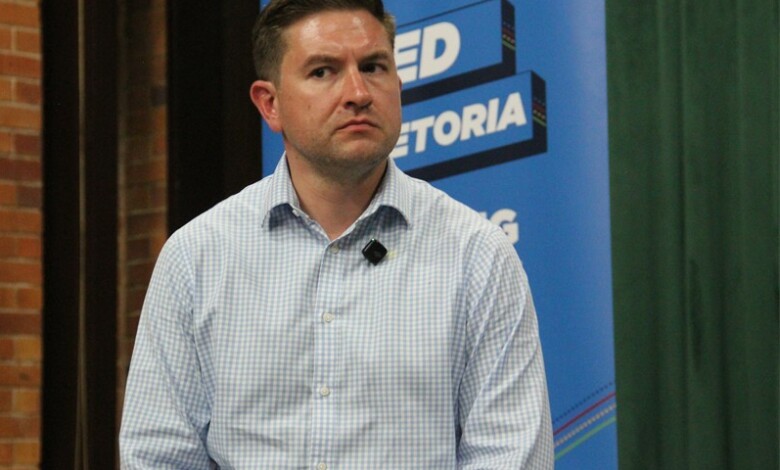
On November 20, the DA’s mayoral candidate for Tshwane, Cilliers Brink, met with Cape Town’s MMC for Public Safety, JP Smith, to discuss how to improve security in Pretoria.
They visited local communities to get first-hand feedback about law enforcement, safety and the decline of service delivery.
The visit included Centurion, Pretoria east and Eersterust, where Smith met various safety stakeholders and community members.
This formed part of a broader effort to determine what the metro could learn from the Cape safety model.
Brink believes Cape Town’s approach proves how local government law enforcement can fill the gap where national structures, especially the SAPS, fall short.
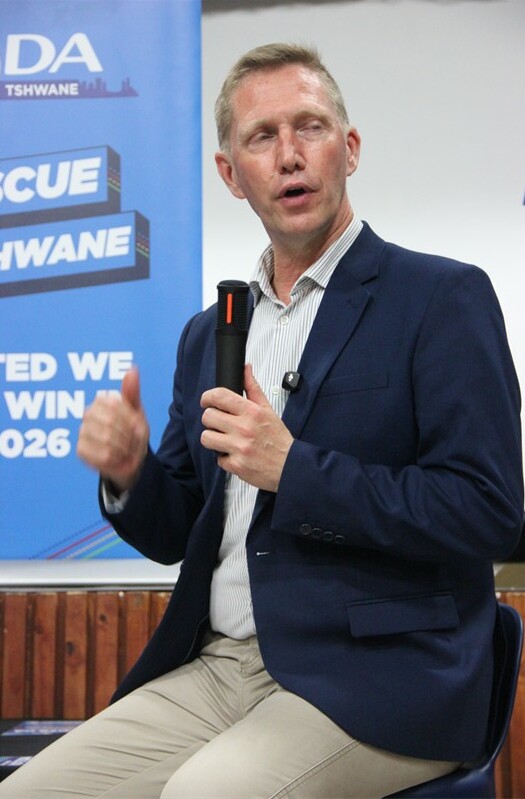
At a safety meeting in Ward 57, Centurion, communities expressed their frustration over rarely seeing visible policing or metro police law enforcement.
According to residents, nobody knows where the Tshwane metro police is anymore or what law enforcement is taking place, because there is no action after charges are laid and their vehicles are never seen.
Various communities have also complained that service delivery by the SAPS, especially at stations and also with regard to reaction times and detection work, is deteriorating fast in Pretoria.
Smith reacted to these complaints by showing how Cape Town’s metro had to intervene when the SAPS’ capacity declined.
He said Cape Town has just trained more than 800 new law enforcement officers, of which a large group will be deployed soon. He warned that cities nationwide are feeling the impact of a nationwide loss of police officers.
“When you stop to perform your core responsibilities, as the police has done, crime will climb. Especially violent crime. The quality of life of everyone in all communities is dismantled when laws are not implemented,” said Smith.
He also refers to the nationwide backlog in forensic cases. He said 41 000 cases are still waiting for processing.
He acknowledged that the Cape metro will go to court soon to expand the city’s investigative powers through law enforcement to enforce completed court cases with sufficient evidence, judgments and sentences in the courts.
According to him, such a breakthrough could create a national precedent that could also benefit cities like Pretoria.
He explained that the Cape metro recently deployed five law enforcement officers per ward. They report daily to a ward commander, who helps the city accurately monitor crime patterns and respond quickly.
Smith added that fines do not change minibus taxi drivers’ behaviour. The only effective measure is to impound vehicles and creatively implement existing traffic and city by-laws.
He also emphasised their metro’s recent success in the removal of 2 369 firearms from the streets in Cape Town suburbs.
According to him, the power of an activated and equipped neighbourhood watch should not be undermined. Cape Town spends millions annually to support its 50 000-strong neighbourhood watch system with equipment, including bicycles, whistles and basic technology.
“We offered this knowledge and technology to the metro because working together is the only way to prevent crime.”
Smith also emphasised that informal traders should be regulated fairly but strictly. He said their metro’s approach is to support traders where possible but to collect goods when by-laws are systematically violated. Such regulated support is, according to him, essential for urban renewal and to keep permit systems credible.
Brink listened carefully during the visits and reacted with the following: “You cannot regulate without punishing the violations where necessary. I was recently on a listening tour through the city to hear what is bothering communities in all the regions. I also took heed of Smith’s words to me years ago: ‘If you want to control crime, you must control the roads. To enforce this, the metro police must have control over their own officers. The top command must know where every officer is. And to prevent misuse, a computer-supported system must be used’.”
Smith explained that Cape Town is already using such a system. “You cannot, in Cape Town, have thousands of armed officers walking around and not know where they are. We are using a system that shows us where every officer is. You can follow it like your Uber app. To me, it looks like the metro police is not equipped to do their work. There are hundreds of officers, but only 250 vehicles.
In Centurion, Smith also visited a terrain owned by the Passenger Rail Agency of South Africa where land grabs have taken place. He said his metro found that immediate action is vital because such land grabs are often orchestrated by organised crime groups. They position themselves as landlords to illegally collect money from desperate people for accommodation.
Brink reckons the Tshwane metro must, just like Cape Town, have emergency accommodation ready to support legal action against land grabs.
He referred to an event where private land owners had to spend R5-million to prevent land grabs in Centurion.
He said the metro must learn from Cape Town’s Safe Spaces programme to determine how shelters can be made legally available for illegal residents who are being evicted.
Smith said Cape Town’s land occupation unit has 187 members and uses aerial survey technology, including drones, to prove how long people can truly live on a terrain. He believes this prevents people from falsely claiming in court that they have been living there for years and cannot be evicted.

He describes drones as the true game changers in modern urban safety.
He also pointed out the importance of a well-trained K9 unit. He said the dogs play a critical role in the finding of drugs, and that Cape Town’s unit with 30 dogs is one of the most efficient in the country, with their champion dog, Virus, as expert sniffer dog and his dog handler the combined nemesis of drug lords.
Do you have more information about the story?
Please send us an email to bennittb@rekord.co.za or phone us on 083 625 4114.
For free breaking and community news, visit Rekord’s websites: Rekord East
For more news and interesting articles, like Rekord on Facebook, follow us on Twitter or Instagram or TikTok.