
Nature Farming is ZZ2’s answer to food security
“To many South Africans tomatoes, onions and avocados are important contributors to their daily nutrition. These are freely available and can be bought from street corners all over Southern Africa. This availability has been achieved through Nature Farming, a method of production that is ZZ2’s contribution to food security.” This from Bertus Venter, Chief Agronomist …
“To many South Africans tomatoes, onions and avocados are important contributors to their daily nutrition. These are freely available and can be bought from street corners all over Southern Africa. This availability has been achieved through Nature Farming, a method of production that is ZZ2’s contribution to food security.”
This from Bertus Venter, Chief Agronomist of ZZ2 which is a large scale farming company operating mainly in Limpopo. He explains that the company has invested in 15 years of research and developed a manner of farming which has been branded Nature Farming.
This type of farming can be described as moving away from some of the harmful aspects of industrialised farming concepts by including the more sensible concepts of organic farming. It subscribes to a strict protocol developed by a team of international experts and is followed in detail by farmers and agronomists employed by ZZ2.
The pursuit to embrace nature’s laws and systems into ZZ2’s values is a way of life after being written into the company’s mission statement in 2003.
ZZ2 has been able to address the decline of soil health through the use of compost and manure, crop rotation and long dormant periods of fields; up to seven years. Soil health is the primary goal of Nature Farming and is obtained by using biologically active compost, compost tea and effective microbes.
A laboratory was also established to monitor and improve on Nature Farming practices.
An integrated pest management approach is followed and entails products that have the least impact on the environment, such as planting eggplants next to tomatoes as catch crop. Fermented plant extracts are manufactured from plants with medicinal properties, like the extreme invader, lantana, to replace harsh chemicals to control nematodes, one of the biggest threats to tomato production. To curb the negative effect of fertilizer on the microbial population, inorganic fertilizers are replaced, as far as possible, with carbon-loaded fertilizer and organic material.
Research in the use of natural predators has been an ongoing process in the last decade. In 2015 this research was formalised when BioBee, an international supplier of biological pest control products established a local branch with ZZ2 as shareholder. This is especially applicable to crops in net houses, a major focus of the company to intensify production.
“By developing Nature Farming, we have contributed to food security in South Africa,” Venter concludes.
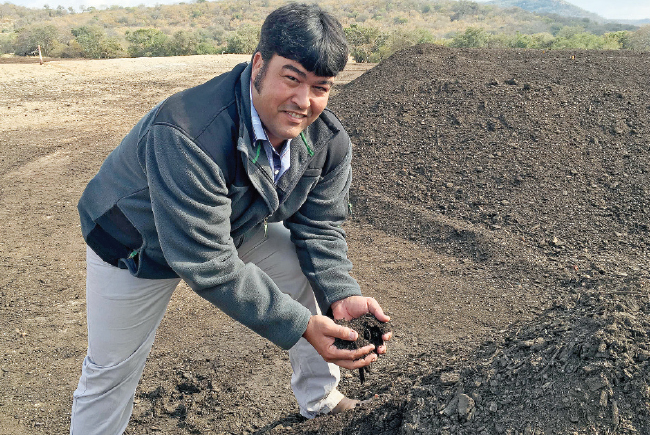
Photo: Supplied -Bertus Venter, Chief Agronomist of ZZ2, shows some of the biologically active compost at the ZZ2 Nature Farming compost site.