
What does R500 actually buy you in 2026?
Even with Limpopo's lowest inflation rate at 3.1%, R500 - R1 000 doesn't go far. A nutritional food basket for a family of four now costs R3 848.
POLOKWANE –There’s a strange arithmetic at play in Polokwane’s grocery aisles and shopping centres in 2026.
R500 used to feel like a decent amount of money at the supermarket. Today, depending on what you put in the trolley, it can disappear remarkably quickly.
For households already under pressure from rising food, transport and housing costs, the question is not always how much food costs in total.
Sometimes it is much simpler. What can R500 actually buy you in 2026?
On paper, Limpopo residents have reason to feel slightly less squeezed than the rest of the country. Stats SA data shows the province recorded the lowest inflation rate in the country at 3.1% in April 2026, significantly below the national average of 4%. The Western Cape, by comparison, recorded 4.8%.
What a food basket costs in 2026
Review Online put together two deliberately basic shopping baskets of R500 and R1 000 using current prices in Polokwane.
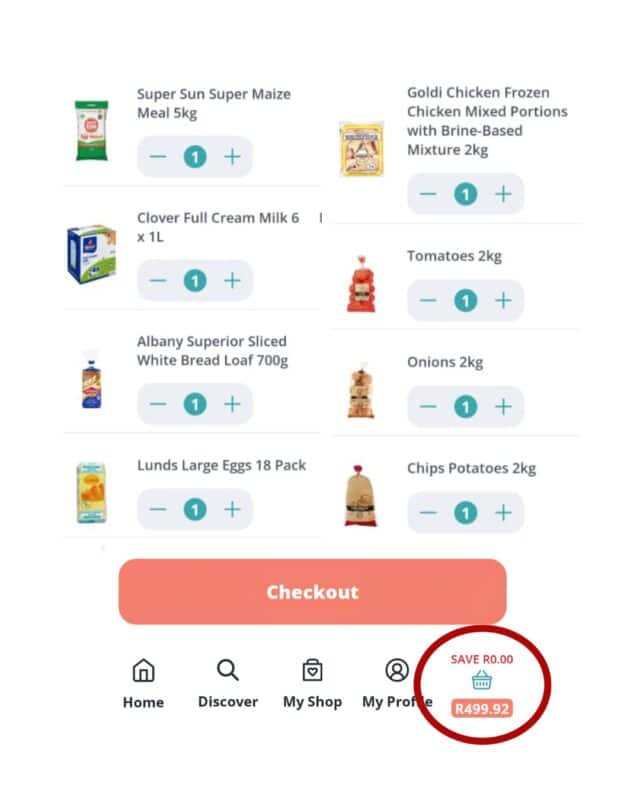
It is a substantial amount of food at first glance, but it is also important to look at what the basket represents.
- There is no cooking oil, rice, sugar, tea or coffee
- No fruit or vegetables beyond the basics
- No toiletries, cleaning products or household extras
- No meat beyond the chicken
It shows how quickly a seemingly reasonable amount of money can be consumed by a handful of basic necessities.
Doubling the budget makes a noticeable difference, but not as much as consumers might expect.
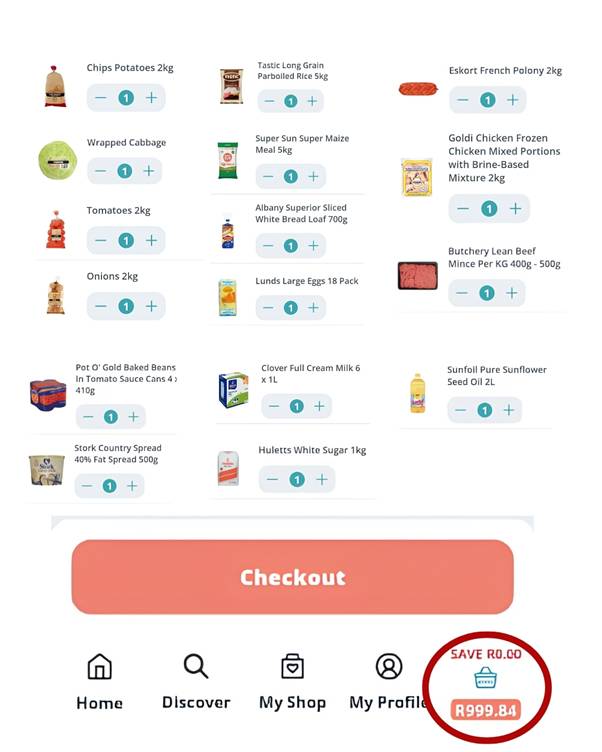
The R1 000 basket expanded the shopping list to include a few more staples and provides considerably more variety. But it still isn’t a month’s groceries for a family.
The national picture
There is another measure that puts the baskets into perspective.
According to the Pietermaritzburg Economic Justice and Dignity Group (PMBEJD), which tracks the cost of 44 basic food items across the country, the average cost of the foods families prioritise and buy first stood at R2 921.85 in July 2026; up R20.72 (0.7%) from June 2026 and R12.71 (0.4%) year-on-year.

But the gap between what families can afford and what they need for proper nutrition may as well be a chasm.
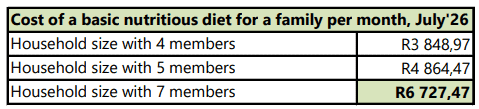
A basic nutritional food basket for a family of four cost R3 848 in July 2026.
The minimum wage reality
For a general worker earning the National Minimum Wage of R30.23 an hour, the numbers just aren’t good.
PMBEJD calculates that the average worker earns R5 562 before any deductions. Combined, transport and electricity consume around 62.4% of the worker’s maximum wage.
ALSO READ: Nearly 1 in 3 Limpopo residents unemployed as rate hits 32%
That leaves just R2 090 for food and all other household expenses.
With the nutritional food basket cost, even if every remaining cent went towards food, a family of four would face a shortfall of R1 758 if there was only a single breadwinner.
But household income varies considerably depending on how many people work.
The Polokwane middle-class squeeze
What about the households earning more; the ones who don’t qualify for indigent assistance but still feel the financial pressure?
The national average take-home salary is R21 228 per month, which falls just below the R22-R75k range researchers at the UCT Liberty Institute define as middle class.
Many who consider themselves middle class are, statistically, just below the threshold.
Based on data from July 2026, the average salary in Polokwane is R15 750 per month before tax, or R13 635 after deductions. That is R7 593 less than the national average take-home.
ALSO READ: What entry-level jobs could pay, if you can find one in Limpopo
A nutritional food basket (for four) then consumes slightly over 28% of that salary. Even for a household with two incomes, the remaining money would still have to cover expenses such as toiletries, cleaning products, insurance, healthcare, education, fuel, debt repayments, and more.
So, what is R500 really worth?
In 2026, it is enough to put a few basics in a trolley, but far from enough to guarantee a family everything it needs.
The figures suggest that the real measure of affordability is not simply the price of individual groceries, but how much of a household’s income is left after the bills are paid.