Disteneng’s dogs
He lives a destitute life after having lost everything in Disteneng’s ongoing relocation process a year back. The only thing that remains is braving the elements and winter nights with a borrowed blanket in a canopy positioned among shacks in Polokwane’s own Nkandla. The main thoroughfare into Disteneng leads past a spot which locals have …
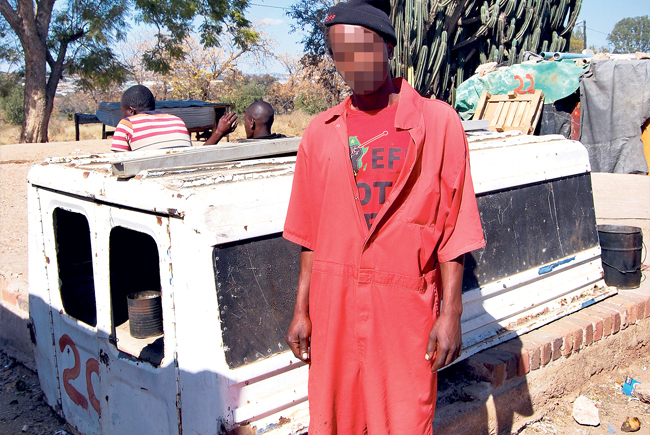
He lives a destitute life after having lost everything in Disteneng’s ongoing relocation process a year back. The only thing that remains is braving the elements and winter nights with a borrowed blanket in a canopy positioned among shacks in Polokwane’s own Nkandla.
The main thoroughfare into Disteneng leads past a spot which locals have dubbed Nkandla, but this nucleus does not boast the safety of a compound perimeter, plush interiors or upgraded security features. Here residents are left to their own devices, fighting off the elements and the criminals while battling with an evident lack of service delivery. Life in Disteneng might be devoid of the petrol bombs of the past, but nowadays residents live in fear of the killings and robberies while braving a health hazard, water interruptions and lack of ablution facilities, all evidently inadequate for the estimated 3 000 locals and foreigners residing there.
Living in a canopy
Following up on complaints about the dire situation in Disteneng, Polokwane Observer stumbled upon a man who is but one individual amid a growing mass having determined to occupy Nkandla after having lost their dwellings in the ongoing relocation process. He referred to his shack and belongings having been demolished and removed in May last year, despite having been cleared for allocation to a site and given the golden pass – a sticker on the door – to stay in Disteneng. After having stayed there for 16 years, his life came to a standstill the day he got a phone call to alert him that his shack was being demolished without prior notification, he told Polokwane Observer. His only shelter was the canopy of a bakkie, he said. Photographed next to it, he pointed out that he asked for a blanket from a neighbour in shack a metre away.
A few metres on is the shack of another man who also lost his dwelling after as many years of residing in Disteneng. He has settled next to a cement slab that is the only remnant of what was once a church that used to be central to activities in the neighbourhood. He stressed that he was adamant to stay. He was willing to pose at his shack where an Economic Freedom Fighters (EFF) advertises his political preference.

Around him the encroaching grass has grown taller and the area contains a desolate appearance in contrast to what it was in the past before shacks were removed. The single ablution facility on a slope behind the cluster of shacks was bound to overflow, they indicated. A further hundred metres up the road among neatly demarcated stands a single ablution facility is positioned at an intersection. Moving deeper into the informal settlement one gets a sense of animosity towards the inability of the local municipality to offer what is perceived as adequate services.
At one of two taps pointed out while passing through, a man in a Bafana Bafana t-shirt was among those gathering to eagerly make use of the resource while still available. He is quick to emphasise that the African National Congress (ANC) would have to relinquish his vote to the Democratic Alliance (DA) in this year’s local government elections. While in conversation more young kids and older women emerge, having painstakingly pushed wheelbarrows with plastic containers up- or downhill to where water has become available again three days of no access to the life-giving source. That was almost two weeks ago. Last Tuesday the same occurrence repeated itself when there was no water again, it was learnt. From a woman elsewhere in Disteneng it was learnt that Polokwane Municipality had dispatched a truck around 22:00 the previous night, paying erratic visits to the area after dark.
“Life in Disteneng is very bad”
Since December sporadic water shortages have become a regular occurrence in Disteneng, another resident pointed out. Ongoing intervals have resulted in residents having to pay an arm and a leg for water being sold at R5 for 20 litres – totalling R20 a day – by an outsider who visits with a bakkie. Lack of ample ablution facilities forced residents to live like dogs, compelling them to relieve themselves in the bush in the dead of night while still having to avoid wondering off too far from their dwellings out of fear of being attacked by lurking thugs in search of cash and cell phones, he said. Other than that they remain afraid of the killings that characterise life in the settlement. The previous week, he stressed, two residents had been attacked by knife-wielding attackers.
The following weekend the corpse of a Zimbabwean national was discovered in Disteneng. According to him taxi drivers were afraid of entering Disteneng late at night and before sunrise, thus they have to team up with other residents to walk to the intersection along Nelson Mandela Drive when needing to leave for work early morning. He too aired his dismay with Polokwane Municipality not delivering on their promises. “Life in Disteneng is very bad,” he stated in conclusion.

Response from Polokwane Municipality
The question of the relocation of former Disteneng residents to private land on nearby Extension 109, instead of what was supposed to be Extension 106 next door, was among issues raised with Polokwane Municipality when approaching spokesperson Matshidiso Mothapo for comment.
Mothapo responded saying there were no longer people in Extension 109 as everybody was settled in Extension 106, which was municipal land. When following up on the matter a source residing at Extension 106 confirmed that they had been relocated there in May this year in terms of an agreement reached with the municipality that undertook to relocate them to Disteneng. He said they would have been happy to be relocated to either Disteneng or Extension 78, as per initial arrangement that was not adhered to, as long as it was a permanent place of residence for the 27 affected families. Yet again the municipality did not deliver, he stressed. “The government of the blacks chooses people who they want to give services to, but during elections they want all people to vote. Other’s votes are useless, because they are not helping them. The government of the blacks shows poor leadership and is corrupt. We don’t want to be promised the services that they don’t deliver. They make promises when they want to be elected. After the elections they forget the people.”
In his response to a question about the decision to relocate the people of Disteneng, Mothapo said informal settlements in their nature were hazardous and not conducive for human habitation and upbringing of children.
“Chapter 2 of the Bill of Rights in the Constitution of RSA indicates that ‘everyone has the right to have access to adequate housing’ and it further states that the ‘The state must take reasonable legislative and other measures, within its available resources, to achieve the progressive realisation of this right.’ Therefore, the Municipality is upgrading informal settlements within its area of jurisdiction to a standard that will ultimately realise the constitutional mandate. Since 2005 the Municipality has upgraded six informal settlements. The main reason to relocate and re-settle the residents is to improve their lives and living conditions.”
Asked how many people currently lived there, he said an estimated 1 690 people have been re-settled in formally demarcated sites at Extension 78. “This is a formal township (and) no longer (an) informal settlement.”
On the duration of the relocation process he indicated that it was 95% complete, and that the remaining 5% was disturbed by the protest that took place in the area on 22 June this year but would be completed soon.
With regards to service delivery issues, he responded saying initially the municipality had installed nine street taps and 11 VIP toilets.
“Due to re-settlement of people according to the Township Lay-Out map, people moved away from the said infrastructure. A contractor (currently on site) has been appointed to install permanent sewerage and water connections in the township, which project will ultimately address basic services challenges for good. Asked for further clarification, he said during the relocation of people from Disteneng to Extension 106 they left nine taps in the area of which six were closed and only three were left.

“The 11 VIP toilets remaining were reduced to nine after two were vandalised, according to Mothapo. “The moved people were once more returned to Disteneng, but to the far side away from the place where the nine stand pipes were. In the new side 10 new stand pipes were constructed for the community and also four VIP toilets were installed. At the old site where nine VIP toilets were left we added four to make it 13. In short there are 17 VIP toilets and 13 stand pipes at Disteneng (Extension 78).”
In conclusion he addressed future plans for the settlement, mentioning the provision of infrastructure and construction of houses. “There are sites reserved for middle income earners for self-build, which will be sold at market related prices.”
Story and photos: YOLANDE NEL
>>observer.yolande@gmail.com
Featured photo: Living in a canopy.