
South African women lead positive Covid-19 statistics
Even though numbers now lean more towards female confirmed cases, experts are not sure that there was any scientific backing yet for this being the case.
South African women, contrary to international trends, lead the statistics for Covid-19 infections in the country.
Covid-19 cases: South African breakdown
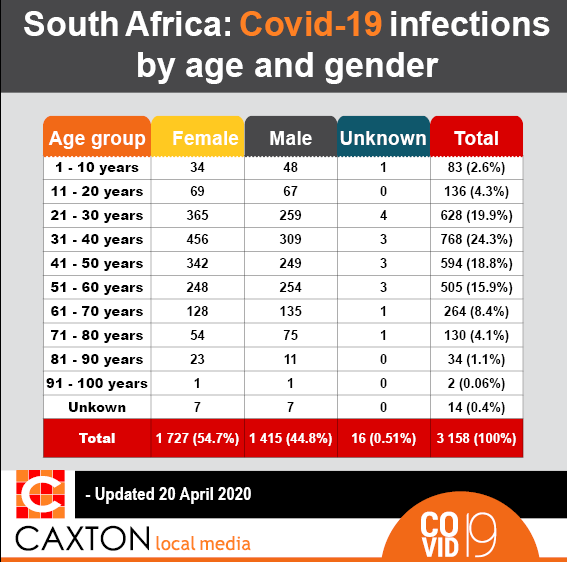
A breakdown of the confirmed Covid-19 infections by gender show that to date, around 10% more women than men have been positively diagnosed, while 16 cases (0,51%) have not been allocated by gender.
Women contributed to 54,7% of infections, while men stood at 44,8%.
Some 3 300 cases have tested positive as at 20 April, with 58 deaths recorded.
On Sunday, at which time 3 158 cases had tested positive, women in the age group of 31 and 40 years old were recorded as being the biggest category with 456 cases, followed by women in the 21 to 30 years old group (365).
Women in the 41 to 50 year category (342 cases) was the third worst affected group and these categories make up 37 % of the known 3 142 cases at the time men aged 31 to 40 counted 309 cases, followed by 21 to 30 years old (259 cases) and the 51 to 60 years old category with 254 cases. A total of 83 children under 10 were infected, while two people aged 91 and older had tested positive.
It is early days still since the first case was announced in the country on 5 March, and Dr Alfred Thutloa, PhD, Head of corporate and Marketing Communications at the South African Medical Research Council, said that numbers now lean more towards female confirmed cases, but he was not sure that there was any scientific backing for the reason.
“Although scientists are still studying the epidemiology of Covid-19 and research on this is accumulating, recent studies actually show that men lead by far with Covid-19 infections worldwide.
“No country or territory could speculate with accuracy how the pandemic would behave, what we know is South Africa’s Covid-19 trajectory is unique: unlike most other countries, it did not see an exponential increase in cases after its first 100 cases. Professor Salim Abdool Karim, Chair of the minister’s advisory committee on Covid-19 attributed this pattern to:
- the country had seen three epidemics: one among travellers, a second among their contacts and a third epidemic of community transmission;
- by the time the lockdown began on 26 March, the first two epidemics had largely burnt out, and community transmission was not occurring at a significant level.
World Health Organisation
WHO Library Cataloguing-in-Publication Data addressing sex and gender in epidemic-prone infectious diseases such as Covid-19 stated that in most societies, women are more likely than men to be caregivers for the sick in both health-care settings and at home. In this capacity, women are more exposed than men to infectious agents.
Pregnancy induces many changes to the immune system, and for some diseases, pregnancy is a risk factor for a more serious course and outcome. The elderly are also particularly vulnerable to infectious diseases and in most societies this group has more women than men.
Breakdown across the world: Infections and deaths
Based on data and analysis released by the Chinese Centre for Disease Control and Prevention, men and women have been infected in roughly equal numbers, but the death rate among men was 2,8%, compared with 1,7% among women.
Looking at other countries’ infection rate, Italy has shown, on 20 April, an infection rate of 50,2% for males and 49,9% female cases, but the death rate was 67% males and 33% females. Finland, with 3 489 cases on 17 April, although recording 48% male and 52% female cases, the death rate recorded was 72% for males and 28% for females. The Dominican Republic, with 3 286 cases on 13 April, 55% male and 45% female cases, recorded 79 % male deaths and 21% female deaths. All other countries where gender-based statistics were available, saw more male deaths, and sometimes significantly more, even though there were no big difference in male and female cases, but with male cases reported dominating in most countries.
If looking at deaths, two countries namely Egypt, when having 3 330 cases, recorded 250 deaths (two per million of its population) and Morocco, with 3 046 cases, reported 143 deaths (four per million of its population) and South Africa with 3 300 cases on 20 April, recorded only 58 deaths (one per million of its population).
Number of infections to grow in South Africa – Mkhize
Health Minister Zweli Mkhize has repeatedly warned that South Africa’s confirmed infections were not a true reflection of the spread of the virus in the country, and that a truer picture would only being to emerge toward the end of the third week of the national lockdown.
The big increase in positive cases over the past few days appears to bear him out. The number of new tests conducted by the public sector, according to the statistics released on Monday, is double that conducted by private laboratories.
Recently, Prof Karim noted that proactive measures undertaken by government, including the lockdown and intensified tracing efforts, had bought the country some time to ready its medical response, but said that data presented regarding tests, whether relative to cumulative totals or active cases, is still too thin for solid analysis as less than 0,2% of the population has been tested.
As government increases its testing efforts — through door-to-door campaigns and mobile screening facilities — the number of positive cases will, naturally, rise. So too will the number of deaths.
Karim said South Africa with its high HIV and TB burden of disease, may face a protracted coronavirus outbreak, if these conditions prolong viral shedding. He predicts the peak of infections to be during September.
People of all ages can be infected by the new coronavirus (2019-nCoV). Older people, and people with pre-existing medical conditions (such as asthma, diabetes, heart disease) appear to be more vulnerable to becoming severely ill with the virus. There are talks about a voluntary lockdown for older people until after September this year, to prevent excessive deaths.
* Notice: Coronavirus reporting at Caxton Local Media aims to combat fake news
Dear reader,
As your local news provider, we have the duty of keeping you factually informed on Covid-19 developments. As you may have noticed, mis- and disinformation (also known as “fake news”) is circulating online. Caxton Local Media is determined to filter through the masses of information doing the rounds and to separate truth from untruth in order to keep you adequately informed. Local newsrooms follow a strict pre-publication fact-checking protocol. A national task team has been established to assist in bringing you credible news reports on Covid-19.
Readers with any comments or queries may contact National Group Editor Irma Green (irma@caxton.co.za) or Legal Adviser Helene Eloff (helene@caxton.co.za).