
Your frequently asked Covid-19 questions
The Head of Internal Medicine at the Pietersburg Provincial Hospital, Dr Phetho Mangena, and virologist at the hospital, Dr Vongani Muthambi, answer some frequently asked questions about Covid-19.
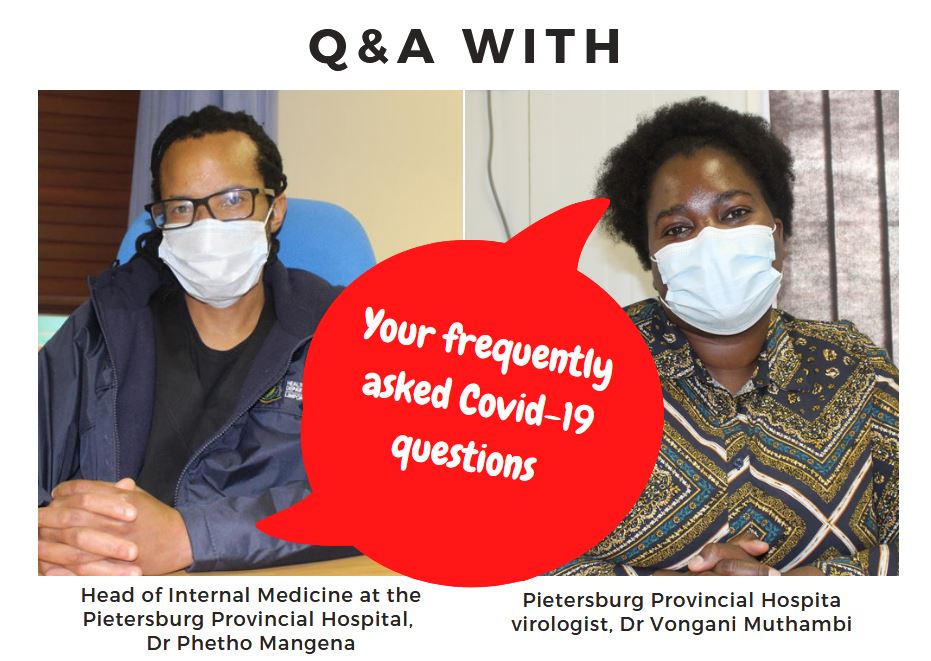
POLOKWANE – We currently find ourselves in uncertain times, where there might be more questions than answers.
Review spoke to Head of Internal Medicine at the Pietersburg Provincial Hospital, Dr Phetho Mangena, and virologist at the hospital, Dr Vongani Muthambi, to get some answers to frequently asked questions about Covid-19.
Mangena is in charge of the Covid-19 unit and Muthambi is responsible for the Covid-19 tests conducted at the hospital.
Muthambi says the Coronavirus is like any other viral infection that targets the immune system.
“You will often hear people say the virus does not kill but it damages the immune system which weakens your body’s defences against other illnesses.”
What should I do if I’m sick and at home and think I might have contracted the virus?
Answer: Call your local doctor and explain the symptoms you have to them before you make your way there. Also mention that you think you might have contracted the virus. If you use public institutions, you can make your way there but ensure to wear a face mask or clothing item that covers the mouth and nose. Sanitise frequently and immediately let the staff know of your suspicion when you get there.
What should I do if I have contracted the virus and is currently isolating at home, and my symptoms worsen?
Answer: Call emergency medical services and alert them of your condition, including that you have tested positive for the virus. Make sure you have a face mask on when they arrive.
Why do Covid-19 test results take so long to be announced?
Answer: There is currently a backlog for tests due to a shortage of chemicals that are necessary for the test. The chemicals are in high demand and need to be shipped from outside the country. The process used to test for Covid-19 is also quite lengthy and there are only two testing centres in the province.
How does one get to the department’s quarantine sites?
Answer: If you have tested and are waiting for your results or have been in close contact with a confirmed case, the department will allocate you and transport you to the quarantine site. There are no walk-ins – you need to be referred by the department to stay in the quarantine facilities.
How effective is a cloth mask?
Answer: The reason why everyone is required to wear a mask is because the virus spreads through small droplets. Sometimes they are so small they cannot be seen with the naked eye. When you wear a mask, it prevents the droplets from passing through. This way you protect yourself from contracting the virus or spreading it unknowingly.
What does it mean to be asymptomatic?
Answer: Being asymptomatic means that you have contracted the virus but do not show any symptoms of the virus. You can still spread the virus if you are asymptomatic. You need to isolate for 14 days, even if you do not show any signs of the virus.
How does one properly isolate at home?
Answer: Isolation means that you must not come into contact with anyone. You should not share any communal spaces such as a kitchen or toilet with other people in the household. No direct contact is allowed. Your food should be delivered to your door, where you should collect, eat and place after you are done.
What should I do if I have come into contact with a positive case?
Answer: You should quarantine for 14 days and if you show any symptoms, consult a healthcare professional to get tested for the virus. The quarantine serves as a window period to ensure the accuracy of the results.