Opinion: Stimela’s 45-year legacy echoes SA’s ongoing struggles
As Stimela marks 45 years with a new album, their music still mirrors South Africa’s storms, of struggle, survival and hope, writes Malesela Maubane.

POLOKWANE – Afro-fusion band Stimela’s release of a new seven-song album titled Through the Storm to mark 45 years of existence is surely an exciting moment for their fans and music lovers.
The celebration which includes live performance is amidst the band experiencing deaths of its members such as Ray “Chikapa” Phiri, Isaac “Mnca” Mtshali, Tsietsi Daniel Motijoane, better known as Nana Coyote and Lloyd Lelosa over the years.
It was intriguing to learn that the name Stimela was conceptualised after the band was stranded in Mozambique after a performance and they had to sell their equipment for one of the band members to travel back to Mbombela on a “steam train” to summon help.

Having travelled to Samora Machel’s country, specifically Maputo and Matola in 2009, I remember seeing it as a country having gone “through the storm” as a result of the civil war.
Stimela’s music has always touched on socio-political and socio-cultural themes, with their music becoming the soundtrack of people overcoming everyday life’s struggles.
Listening to witness testimonies at The Madlanga Commission of Enquiry, it is becoming evident that the country’s criminal justice system was going “through the storm.”
As if talking about the alleged looting of over R2 billion at the Tembisa Hospital, part of the lyrics to their song Pamberi Ne Chimurenga goes “But along, came the looters and deceivers with the tongues of deception.”
The fraud, corruption and crime allegations at different commissions and committees including the Zondo Commission, are certainly getting South Africans to ask the question “when does it stop”?
The strumming by Zimbabwean-born Louis Mhlanga on Guitars of Chimurenga took me back to the tracks Silang Mabele and Two Birds by Vusi Mahlasela, one of my brother Lesitja Ronest Maubane’s favourite artists.
My brother introduced me to the afore-mentioned Mahlasela songs together with others Tonkana and When You Come Back.
Our country’s colonial and apartheid history including the people’s resistance is well known.
The late Matsobane Morris Matsemela is one of those who fought for a free South Africa and it was through several close and personal conversations with him that I got an understanding that music and the struggle for freedom were intertwined, not just “whispers in the deep.”
In 2011, Matsemela was awarded the Order of Luthuli in Silver for “His excellent contribution to the struggle against apartheid and standing for the ideals of a free, just and democratic South Africa.”
Matsemela was born 94 years ago on 5 November in Maune village, Ga-Mashashane, and his political activities were mostly in Lady Selborne, Pretoria. As an operative of uMkhonto we Sizwe (MK), he was detained and tortured for nearly a year from 1 April 1964 by known members of the South African Police (SAP) on accusations of sabotaging the Ministry of Agriculture.
In a letter titled “We will not be silenced” published in the New Age newspaper on August 30, 1962, Matsemela wrote “The SAP can try to handcuff us like cattle but our minds are free”. These words are consistent with Stimela’s song Singa Jindi Majita and perhaps confirmation of his tenacious spirit even in the face of trials.
The Maune village native’s resolute character, once again in the spirit of Singa Jindi Majita, is written about by John Seakalala Mojapelo in his book The Corner People of Lady Selborne where he wrote “The former post office mail delivery man had appeared alone after futile attempts by the State to bribe him to give evidence against his comrades in arms.”
Matsemela weathered the apartheid torture storm, serving a total of seven years’ sentence at the Pretoria Prison, Leewkop Prison later transferred then Robben Island in 1965 whereupon his release in 1971 was banished to Lenyenye in Limpopo’s Mopani District.
Going back to Stimela, I interacted with the band in Musina during my stay in 2003-2008. Similar to the northern Pretoria township, Soshanguve, the multi-cultural town bordering Zimbabwe, holds a piece of my youth and history.
Having left my home village, Mohlonong, Ga-Mashashane for study opportunities in Gauteng, I cast my first ballot in Soshanguve during the 1999 General Election and the year I was completing my journalism studies at the erstwhile Technikon Northern Gauteng (now Tshwane University of Technology Soshanguve South Campus).
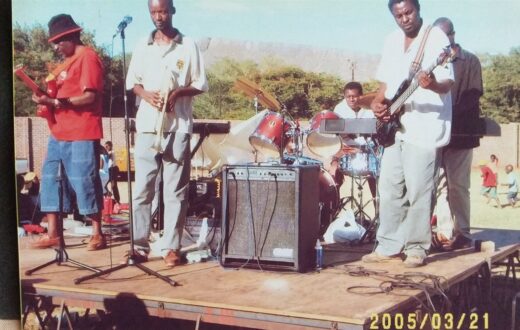
Interaction with the legendary Stimela during the Musina Annual Show around 2005, was possible, because besides being a freelance journalist for Capricorn Voice, a Limpopo local newspaper, I was also the de-facto marketing manager of the Nancefield township, Musina based Midrands Jazz Band.
The Limpopo border town is the hometown of the late Arabi Mocheke, whom I had the pleasure of meeting on several occasions during my journey with the defunct jazz band. Mocheke had connected the jazz band with a recording studio in Melville, as Johannesburg is where he mainly showcased his remarkable skills as a cultural activist and music promoter.
Unlike Stimela, Midrands Jazz Band went “through the storm” and never survived. Members such as Isaac “Bro Ike” Mashaba (bass), Jimmy Chaima (drummer), Maginya (guitar), Shelton Kundlande (vocalist), Ewald Mochike (vocalist), Nokuthula “Thuli” Hongwane (lead vocalist), Albert “Maginya” Masindi (organ), and Martin Molefe (conga drummer) passed on thus resulting in its break up.
Ivan Kwatlande, musically known as Archieman (trumpet), Patrick “Bro Pat” Masindi (lead guitar) and Alfred Chuene (piano) are the band’s only surviving members. I became aware through a recent call from Archieman, that he is working with Bro Pat to produce new music.
Stimela has recorded a variety of gold and platinum-selling albums with a sample of their discography including Fire, Passion and Ecstasy (1982), Look, Listen and Decide (1986), The Unfinished Story (1987), Out of the Ashes (1996) and A Lifetime (2010).
Significantly, their 1985 album Shadows, Fear and Pain mirrored life in South Africa during that year, especially for the African population as a result of the State of Emergency declared by the apartheid government.
The triple developmental challenges of poverty, inequality and unemployment in South Africa are a constant reminder that the country is still going “through the storm, meaning the revolution continues as Stimela sings on the song Pamberi Ne Chimurenga. The people of South Africa evidently still need to carry the spirit of Singa Jindi to survive “through the storm”.
Maubane is a non-practicing journalist, communicator, and storyteller.