Shafinaaz Hassim captures attention with human trafficking narrative
Author Shafinaaz Hassim continues to captivate with her writing and recently enticed members of Timbuktu Book Club in her home town to engage in a discussion centering on her tenth and latest offering, The Economics of Love and Happiness. With the novel addressing the issue of human trafficking, she afterwards entered into an email interview …
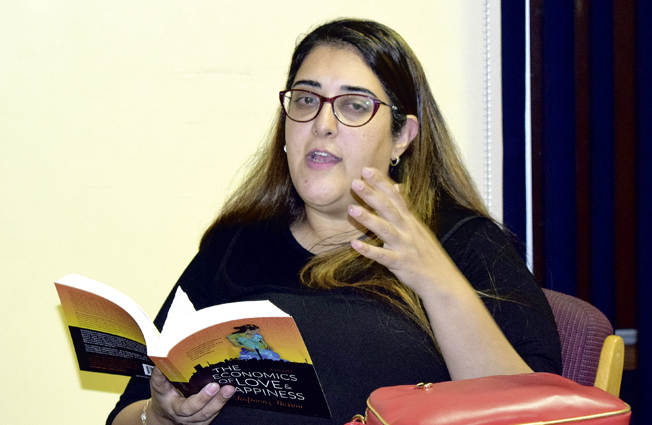
Author Shafinaaz Hassim continues to captivate with her writing and recently enticed members of Timbuktu Book Club in her home town to engage in a discussion centering on her tenth and latest offering, The Economics of Love and Happiness.
With the novel addressing the issue of human trafficking, she afterwards entered into an email interview discussing, among others, the story line, the reason for the chosen topic, focussing on the infringement of basic rights and that of women and releasing the book at a time when the country has paused to reflect on gender-based violence.
She explained that especially after the 2010 Soccer World Cup South Africa had been seen as a lucrative site for trafficking of women and children. “It’s problematic in that we are made even more vulnerable as a country when our children are seen as commodity, and the rural poor are targeted as they then don’t have the resources to follow up in the quest to locate missing children. Because not much has been written and our structures often tend to be overwhelmed, we need to raise awareness among the public every way we can,” according to Hassim.
Speaking to the book not being her first time to focus on the infringement of basic rights, women’s rights and human rights through her writing, she elaborated by saying that as a sociologist it was her primary focus and it began with her first book, Daughters Are Diamonds which was based on her thesis. “And as a South African it’s impossible to overlook the various and complex social injustices that affect our society, and so I’m drawn to highlighting these issues, unpacking them and contributing to the continued conversations on how to overcome them and find lasting solutions to the social ills we encounter on a daily basis. Some inherited through historical inequality and some evolving crimes and issues that are part of an increasingly globalised world.”
To the question about it somehow seeming timely to be releasing the book into the market when there was that much emphasis on violent acts against women, she responded saying The Economics of Love and Happiness took a while to research and take shape to a degree that she was satisfied to be presenting. “Reporting facts is one necessary dimension but presenting fictional characters that represent real and serious issues like trafficking, prostitution and other more insideous issues like racism and Islamophobia as raised in the novel, creates a new challenge of authenticity and staying true to one’s purpose as a writer. I also believe a book will be born when it’s ready to be heard or when it’s needed as a balm or solution or motivation for society to make a change. Readers will change the world.”
Asked whether she regarded society as reluctant to rise in unison on issues of gender-based violence and, in that instance, human trafficking, she said if there was reluctance in any pockets of society then it would be due to lack of knowledge and awareness that trafficking is an issue or problem. “Various organisations, media agencies and books like mine will add to the wave of creating awareness so that people’s minds are opened to the idea that more needs to be done. There are numerous social crime prevention units and organisations, men and women working hard to undo the scourge of gender-based violence in our midst. We keep up the good fight knowing that there is more work to be done. And every South African has the ability to make a small bit of difference.”
She continued mentioning that she was building on her Nisa Qamar series for young adults, which has been already shortlisted for the Mahla awards in 2017 and 2019 and the prestigious Sanlam Youth Literature Prize 2019. “It’s been great fun getting to develop a young, evolving character who is proudly South African for young local readers. The series is a fun and entertaining collection along with my way of documenting some wonderful childhood memories, even though Nisa is not based on my own life. Nisa Qamar is also a tool for dealing with issues that children face as they grow. The third book in the series is expected to be published early in 2020.”
She concluded saying that she was writing full time and that her family was a priority in her life. “I’d say I have the best of my passions in good balance. I’m very grateful for that.”
Story and photos: YOLANDE NEL
>>observer.yolande@gmail.com