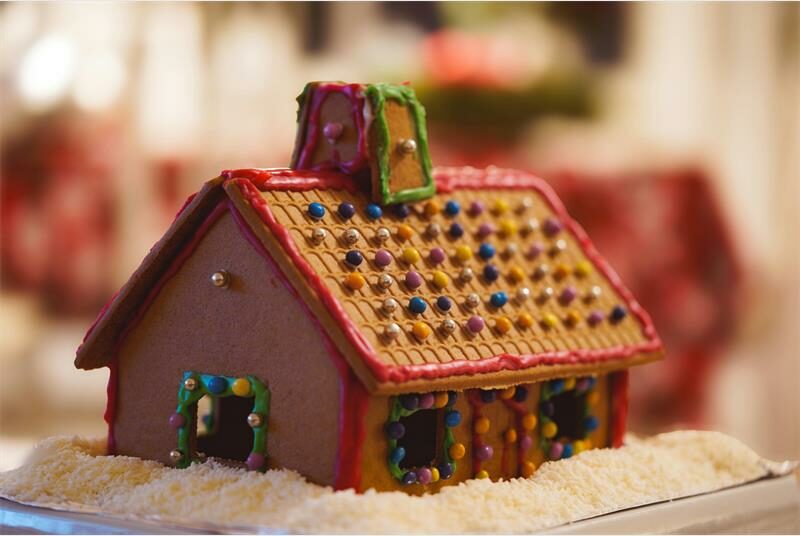
Staff recipe: The perfect ginger cookies for ginger cookie houses
This flop-free recipe and decorating inspiration will make sure you have the perfect edible centerpiece for Christmas lunch.

Christmas is a busy time, and you’ll have a million things to do, so why worry about your ginger cookie house failing? Follow this recipe exactly and you’ll have a perfect cookie base for your Christmas table.
Brakpan Herald journalist Charma du Plessis obtained this recipe from a family friend, whose ginger cookie houses always turn out perfect.
The recipe makes roughly 50 cookies, but is also perfect for roughly one house with some left over. A cookie mould or cutters are ideal for this.
Preheat your oven to 180 degrees Celsius.
Ingredients by weight
• 250g butter
• 530g sugar
• Two large eggs
• 180g golden syrup
• 650g cake wheat flour
• One tablespoon ginger powder
• Two and a half teaspoons baking powder
• Two and a half teaspoons baking soda
• One teaspoon salt
Instructions
1. Whisk the softened butter and sugar together.
2. Add in the eggs and syrup, mix thoroughly.
3. Dust in the dry ingredients with a sieve and mix thoroughly.
4. Chill the dough in the freezer for at least 20 minutes.
5. Roll out small sections in between two sheets of parchment paper, then use cutters or lay into greased baking moulds.
6. Put a sheet of parchment paper into your baking tray if you are using cutters, sticking the corners down with pea-sized dollops of cookie dough. Add your cut cookie panels in, leaving roughly 2cm of space around each panel for expansion.
7. Bake the cookies for 12 to 15 minutes in the preheated oven.
8. Remove from the oven and cool for a few minutes, before moving panels to a wire trivet or cooling tray to cool fully.
Icing recipe
This royal icing recipe makes a big batch, perfect for decorating other Christmas cookies on top of the ginger cookie house, unless you use a lot for your decorations.
The ingredients are roughly 480g of icing sugar, three egg whites, a teaspoon of vanilla extract and 10 to 15 tablespoons of water.
To make the icing, whip up the egg whites until a thick froth or foam is formed, but not to stiff peak consistency. While whisking, add the icing sugar slowly. Use no less than 480g, but if it’s needed you can add more to reach the right consistency.
If your icing is too thick, add the water in tablespoon by tablespoon until it reaches a fluid, satiny consistency that forms ribbons when you scoop it. It should level out after whisking in five to 10 seconds.
If it is too runny, keep whisking to introduce more air to the mixture or add more icing sugar. For piping consistency, to use it as glue for the ginger cookie house and for the decorations, it needs to be slightly thicker and cool.
At room temperature, royal icing takes six to eight hours to dry completely, depending on the humidity and heat of your kitchen. To halt drying, you can cover the bowl with cling film laying directly on the icing, covering the entire batch. If there is any air near the icing it will start to dry.
If it has started drying, a quick stir will make it soft again.
Extra tips
Now that you have your cookie panels and your icing ready, you can start decorating and assembling. First you have to take these extra steps to make sure your project is a success:
• Cool the cookies on a cooling rack or wire trivet, covered with a food net, for several days. The longer a ginger cookie sits the harder it gets. When straight out of the oven they are very soft and squishy. Do not be tempted to put them back in the oven, we promise they are done.
• You can use plastic bags as piping bags if you don’t want to buy extra items, but piping tips are non-negotiable. Plastic bags stretch and tear, and without a piping tip they can cause a huge mess while piping.
• Syringes (without needles) make the perfect piping tool for finer details and line work, especially if you want even lines and uniform frills.
• Decorate your panels individually first before you assemble, and allow the icing time to dry enough that you won’t smudge it with assembly. It’s easier to decorate when the panel is laying flat. Let the decorations dry for at least five hours before assembly, as you do other festive chores in between.
• When assembling, build your cookie house around an object to keep it stable as it dries. You can also tie the wall panels together with ribbon, loosely, so the cookies don’t fall outwards.
• Let the walls dry before adding the roof and other loose decorations like windows, shutters and doors. Window sheets go in before you add the roof, and this can be isomalt, hard melted sugar or plastic packaging sheets, whatever you have. You can also forgo the glass completely.
• When adding smaller loose decorations like icicles, or sweets like Smarties, M&M’s or Astros, hold the piece to the house for a few minutes to make sure it sticks. Some pieces will still fall off, but this ensures they hold on longer.