Volunteer firefighters scale iconic Johannesburg apartment block in full protective gear
Five members from ECSA share their experience of the gruelling 54-story climb to the top of Ponte City Apartments.
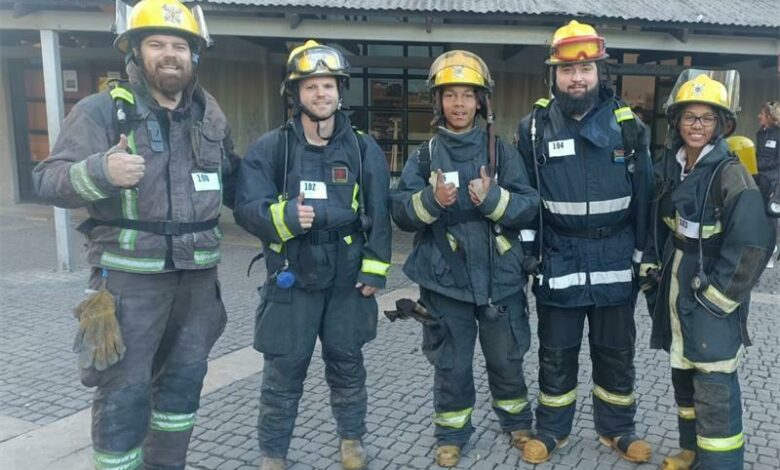
Volunteers have a deep desire to serve but are also motivated by a challenge.
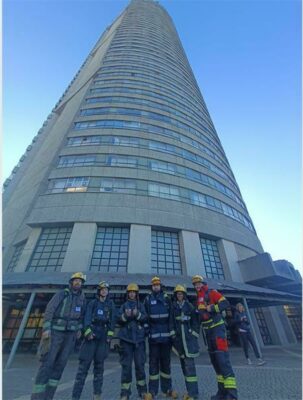
Five members of Emergency Control South Africa (ECSA) dared to march up one of Johannesburg’s most iconic structures, on July 1.
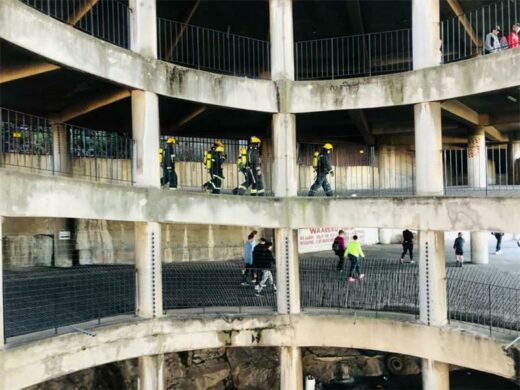
The Ponte Challenge summons adrenaline junkies to climb their way to the 54th floor of the cylinder one step at a time over 900 times.
Pieter Boshoff and Rudie de Bruin completed the challenge for the second time while Jason Young and Alex and Tiana Pailmann made their debut at the concrete colossus, inspired by their colleagues and the unique experience.
The brave quintet answered a few questions about their time inside Ponte City Apartments:
Q: Did you do it in full gear and how did those 50 or so floors feel compared to the largest buildings you have been through?
Jason: Done in full gear with an approximate weight of 25-30kgs. Climbing those 54 flights consecutively was tough work but we were constantly pushing each other to complete it. My largest building previously was maybe 8-10 stories.
Pieter: The first time I was in rescue gear so I did not have structural fire fighting boots and I had no Self Contained Breathing Apparatus (SCBA), a weight advantage of around 10kg. This time round I was in full structural gear. The 54 floors compared to other buildings are humbling to be honest, especially when you reach the top and look out the windows and see the view from the top.
Q. How do events like this tie in with the ECSA ethos?
Rudie: The Ponte Challenge gives us as ECSA crews the opportunity to interact with the community out there, showing and telling them more about what we do as a volunteer fire rescue organisation. In that way, we also get the opportunity to inspire the younger generation to grow up to be future firefighters of the world.
Alex: It is great to have our team doing events like this, it creates a great bond between us.
Q. How do firefighters differ from other first responders like paramedics or security guards?
Tiana: I think the weight of the gear is a lot more than what other first responders are used to. The physical fitness requirements I think are similar though, between paramedics and firefighters anyway.
Jason: Firefighters, paramedics, and security guards are all first responders who play critical roles in emergencies. While there may be some overlap in their responsibilities and skills, there are distinct differences in their character and the nature of their work.
Alex: Every different job has its own character. You as a firefighter train hard to help those in need. Every time you go out to assist in a fire, you learn more, as every incident is different. Our profession teaches you to not take anything for granted.
Pieter: Firefighters generally run towards danger relying on their training and experience. A lot of the characteristics cross over but the main difference for me is the ability to work in high temperatures for extended periods, you require a high level of tolerance and fitness. Thus we do these types of challenges to ensure we are fit enough to do our job.
Rudie: I am a qualified medic working operationally in the private emergency medical services sector and when you are in this type of industry, you should be here because you have a passion to serve and protect, it doesn’t matter if you are a paramedic, firefighter or law enforcement.
Q. What other volunteer work is ECSA involved in and how can the community assist?
Jason: The ECSA fire rescue unit provides specialised rescue and rapid intervention teams to respond to fire callouts, grass as well and structural fire incidents. It also responds to vehicle rescues at major motor vehicle accidents, supports entities with missing persons, and search and rescue operations providing aquatic rescue response teams as well as technical rescue functions to mention a few.
Pieter: We as ECSA are involved in a few different projects like school programmes and the local community policing forum, educating them on the correct steps to take when in a fire emergency believing we can inspire young people to take up firefighting as a career. ECSA delivers a free service to the community, all our members are self-funded, and the community can assist us with donations, to help us keep our services free of charge to the community. We do run fundraisers from time to time, and we urge the community to follow our social media pages for updates on our operations and details about fundraisers.
Tiana: ECSA is a voluntary organisation where trained professionals help their community with fire and rescue assistance. I think the biggest way the community can assist us is by making donations or sharing our social media pages so that it reaches people who are in a position to make donations. All equipment and running costs for ECSA come out of the pockets of the volunteers involved and any help we can get will always be appreciated.