Palm Court dojo hosts successful Kumite challenge
The day revealed what true combat demands, and the students enjoyed pushing their skills to new levels.
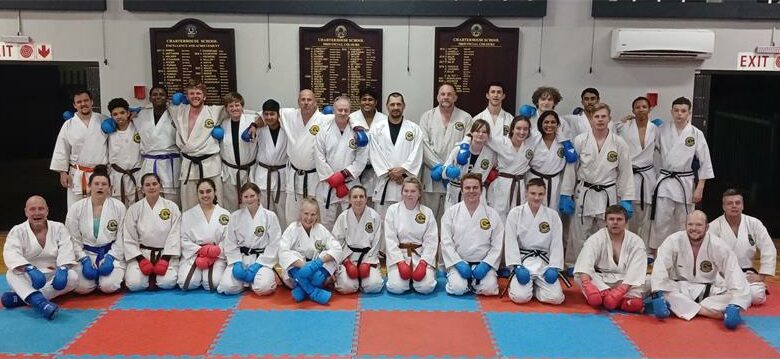
Palm Court Karate held its annual 50/100 Kumite Challenge during the dojo’s Gashuku (training camp).
The event, held over the weekend of October 25, tested both endurance and spirit, with younger students sparring continuously for 50 minutes, while senior karate-ka faced an intense 100 minutes of kumite, fought in two-minute rounds.
Sensei Mario Sequeira, the head instructor at the dojo, said the experience was designed to challenge students both physically and mentally.
“Not only was this physically taxing, but mentally, students had to dig deep and overcome challenges not usually found in our everyday, comfortable lives,” he said.
Goju-Ryu, which translates to hard-soft style, combines power with flexibility, a balance that continues to define Palm Court Karate’s evolving training approach.
“For a few years now, we have prioritised teaching our students how to fight in all ranges of combat, like long distance, close quarter, clinching, throwing, and groundwork,” Mario explained.
While traditional karate emphasises stand-up fighting, Mario believes that modern practitioners must also be comfortable in less familiar positions.
“As Goju practitioners, we are quite comfortable in the three stand-up ranges – distance, close quarter, and clinching. We have some basic throwing and sweeping waza in our syllabus, although nothing close to Judo. It is when we find ourselves on the ground that we are found wanting,” he said.
To address this, Palm Court Karate has gradually incorporated basic groundwork, including ukemi (breakfalls), positional control, transitions, and simple submissions. This well-rounded approach forms part of the dojo’s Multi-Disciplinary Fighting programme – a system developed to ensure students can adapt to any combat scenario.
He emphasised that this development is not a deviation from tradition, but a revival of techniques rooted in early Okinawan karate.
“Research on old Okinawan karate shows that traditional Goju-Ryu once covered all these ranges. Some techniques in our kata were clearly designed for use while clinching or on the ground,” Mario explained.
He believes that maintaining this historical balance is essential to preserving karate’s relevance in the broader martial arts world.
“The landscape of martial arts has changed, and karate will be left behind if it does not preserve and incorporate these techniques,” he said.
However, he remains firm that these adaptations must never compromise the traditional foundation of karate.
“None of this will work without a solid foundation in karate basics, good kata, and a deep understanding of bunkai. This must never change,” he stressed.
For Mario and his students, the lesson extends beyond physical combat. “Our philosophy is that we learn to fight so that we don’t need to,” he concluded.