NWU chancellor leads official opening of CCIDS
North-West University has officially launched the Centre for Contemporary Identity and Diversity Studies (CCIDS), a multidisciplinary hub focused on identity, diversity, inclusion, belonging and social justice.
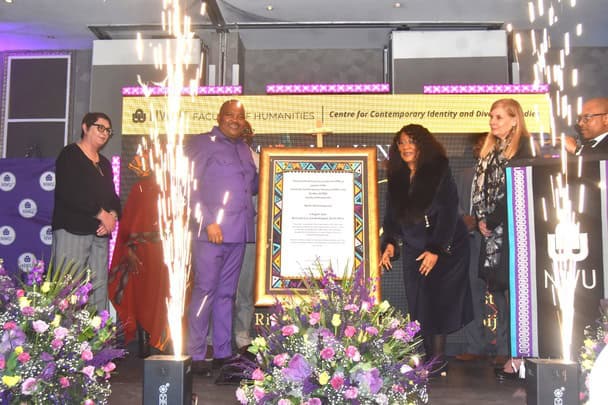
North-West University’s (NWU) Prof Anna Mokgokong, together with the principal and vice-chancellor, Prof Bismark Tyobeka, officially unveiled the Centre for Contemporary Identity and Diversity Studies (CCIDS) at a gala dinner at the Riverside Sun Hotel in Vanderbijlpark, marking the launch of the centre.
The launch, held during Women’s Month, celebrated a new chapter in the university’s commitment to advancing identity, inclusion and social justice.
Delivering the keynote address at an event attended by guests from different faculties, international and other national HEI institutions, Prof Mokgokong challenged universities to ensure that research extends beyond lecture halls and academic journals to address the realities faced by communities.
She emphasised that research should speak directly to the human condition, responding to lived experiences of people while contributing practical solutions to the most pressing challenges of society.
Universities, she noted, have a responsibility to produce knowledge and create spaces where diverse voices are heard and where scholarship contributes to a more just, inclusive and equitable society.
The official unveiling of CCIDS by Prof Mokgokong and Prof Tyobeka marked the culmination of years of planning and collaboration across the university and signalled the commitment of the NWU to becoming a leading institution for inter- and multidisciplinary scholarship on identity, diversity, inclusion and belonging.
In his address, Prof Tyobeka described the launch as a historic milestone for the university and reaffirmed the role of higher education in confronting the most complex challenges of society.
“This launch is an affirmation that universities have an obligation not only to generate knowledge, but also to illuminate the most complex questions of society, challenge prevailing assumptions, and contribute meaningfully to building a future characterised by justice, dignity and shared humanity,” he said.
He added that the centre will strengthen inter- and multidisciplinary research, expand postgraduate opportunities, foster international partnerships and contribute to evidence-informed policy and societal transformation.
The vision for the centre was introduced by Prof Mirna Nel, deputy dean for Research and Innovation in the Faculty of Humanities, who reflected on its journey from concept to reality. She explained that the idea was first proposed by former deputy vice-chancellor Prof Robert Balfour three years ago and was embraced by the Faculty of Humanities before being developed through the collective efforts of an interdisciplinary task team under the leadership of executive dean Prof Dumi Moyo.
Prof Nel said the centre is built on three strategic pillars: research excellence, capacity development and community engagement through policy and strategic partnerships. She emphasised that the centre will generate impactful research on issues such as gender-based violence, disability inclusion, migration, indigenous knowledge systems, race, social cohesion and human rights, while developing future scholars and strengthening partnerships that translate research into meaningful societal change.
The launch formed part of the inaugural CCIDS Conference under the theme “Identity, power and belonging in contemporary societies: Botho mo Setšhabeng.
” The launch brought together leading scholars from South Africa and abroad to explore questions of identity, diversity and social justice through keynote addresses, panel discussions, workshops and research presentations.”
Guided by the leadership of professor of Sociology and founding director Prof Tendayi Garutsa, the centre aims to ensure that academic knowledge does not remain confined to lecture halls but becomes a catalyst for positive change in communities across South Africa and beyond.