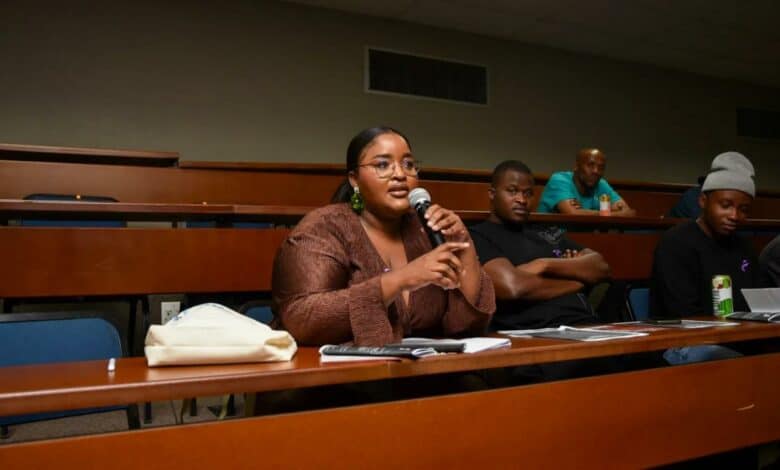
Gauteng Film Commission (GFC), VUT Community Engagement Department, and the Department of Tourism and Integrated Communication hosted a socially engaged dialogue at the VUT Conference Centre recently.
The gathering brought together filmmakers, academics, law enforcement officials, mental health practitioners, youth development organisations, municipal representatives, recovering outpatients, and the wider Vanderbijlpark community.
The programme was directed by Nthabiseng Phora, who opened by affirming GFC’s commitment to supporting both long and short film training programmes, as well as their assistance with location facilitation.
She highlighted GFC’s funding support, which ranges between R10 000 and R15 000 for local projects and starts at R40 000 for international initiatives, underscoring the Commission’s dedication to empowering communities through the creative sector.
A compelling contribution from representatives of the Vanderbijlpark SAPS: Warrant Officer Rethabile Mothepang, Warrant Officer Maria Mokoena, and Sarah Tshabalala.
They urged the community to work closely with SAPS by reporting drug dealers and criminal activities.
Mothepang emphasised that the station’s doors remain open and that law enforcement cannot win the fight alone.
She outlined the direct links between drug abuse and robberies, shop break-ins, and the rising number of people sleeping on the streets.
She reminded attendees that communities know the hotspots where drugs circulate and therefore hold real power in curbing the spread.
During the question-and-answer session, attendees asked whether SAPS supports those seeking rehabilitation.
Mothepang confirmed their commitment to working with rehabilitation centres and expressed their willingness to meet with business owners affected by drug-related crime.
Tshenolo Montsiemang added a thought-provoking perspective on how tourism can serve as a shield against drug abuse.
He noted that substance abuse affects people across Gauteng, including learners, and emphasised how tourism initiatives can offer constructive alternatives for young people. He encouraged stakeholders to view tourism development as a tool for youth empowerment and a buffer against harmful social influences.
One of the most moving moments came from Stanley Mollson of Livelihood Horizon, who spoke about the transformative power of second chances.
He outlined the organisation’s work across Gauteng, offering counselling and support to individuals battling addiction.
A staff member shared her deeply personal journey, describing how she spent more than eight years trapped in drug use after beginning as a teenager.
Her testimony moved the room and served as living proof that recovery is possible with the right support.
She expressed profound gratitude to Livelihood Horizon for helping her rebuild her life, reminding attendees that hope remains within reach even in the darkest moments.
Manila Msulwa, a therapist and social worker from SANCA (SA National Council on Alcoholism and Drug Dependence), highlighted the organisation’s work in schools, where they educate learners about the dangers of substance abuse.
She described the “We Care” programme, through which young people receive therapeutic support, and proudly noted that 24 learners were recently rehabilitated and reintegrated through this initiative.
Gladys Mkwanazi, VUT’s Security Liaison Officer, discussed the university’s ongoing efforts to address drug-related challenges on campus, explaining that progress has been achieved through collaboration between security personnel, students, and the Sedibeng Community Safety Forum.
A representative from Emfuleni Local Municipality’s Department of Tourism, Agriculture, Arts and Culture echoed earlier sentiments, stressing that drug abuse is a community issue that demands shared responsibility.
She emphasised that meaningful change in Vanderbijlpark can only emerge through partnership between institutions, law enforcement, and the public.