Have you had a visit from the stork?
The woolly-necked stork is black with a white underbelly and a woolly, white neck.
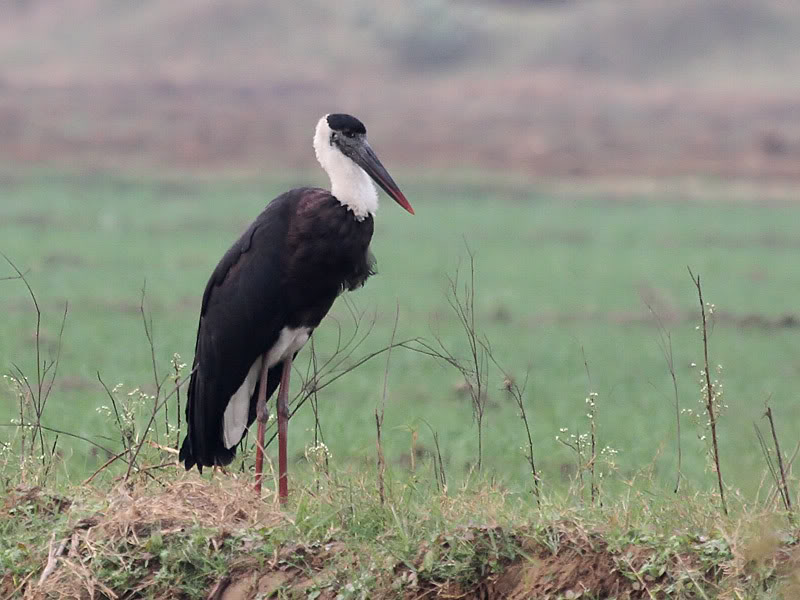
IF you are lucky enough to own a garden visited by woolly-necked storks, honours student Claire Marchant would love to hear from you.
As part of her honours project in the School of Life Sciences, University of KwaZulu-Natal, Pietermaritzburg campus, she is investigating the distributional range extension and increase in numbers of woolly-necked storks in KwaZullu-Natal. She is therefore requesting information about where they are frequently seen, where they are nesting, and where they are feeding.
“Consequently, if you know of any woolly-necked stork breeding sites in your area, or if you have these birds in your garden, at your work, school or sports club, I would really appreciate it if you could let us know. Photographs of birds seen and the geographical location (GPS points) would also be valuable,” she said.
Don’t mix them up with their cousins, the white storks. The woolly-necked stork, which goes by the Latin name of Ciconia episcopus, is generally black in colour but has a white underbelly and the woolly, white neck that gives it its name. The white stork (Ciconia ciconia) is a largely white bird with red bill and black flight feathers.
Our woolly-necked storks are residents or intra-African migrants. These birds were previously registered on the red data list for endangered species but are no longer as their numbers have increased. In KwaZulu-Natal they are becoming more common in urban areas and in the Midlands. Once they were more coastal in their distribution, but their distributional range appears to be expanding. Now they are being seen further inland, particularly around dumping sites, sports fields and in gardens.
They also appear to be less migratory and are often seen in breeding pairs or small breeding colonies of up to five pairs. Breeding sites are usually in large trees, close to water. Breeding sites have been found in increasing numbers in suburban Durban and Pietermaritzburg areas.
If you know about any of these birds contact Claire Marchant at 214580747@stu.ukzn.ac.za or Professor Colleen Downs at downs@ukzn.ac.za or at 033 260 5127.