Tent Travels: Notes from a troubled land
From a tourist point of view Zimbabwe has so much to offer
OF all our northern neighbours, Zimbabwe is the country Bill and I know best so let’s linger in this lovely but troubled land and do a little virtual travelling to some of its many attractions. As a child, Bill travelled extensively in Zimbabwe with his family and during the ten years that it was my home he did his best to show me as much of it that he possibly could.
Even after we left to settle in South Africa we frequently visited the country with our two boys and enjoyed many happy holidays at Lake Kariba and in many of the country’s wild and wonderful places. Eventually, our visits gradually dwindled as we explored other game reserves and unspoilt places in southern Africa.

Then, after a gap of some years, Bill and I visited our former home on our way back from Tanzania in 2002. Since then we have not managed a return trip, although its not for lack of trying. Last year we were planning a Zimbabwe holiday but our plans were put on hold by an important event, my son’s wedding in Australia. We spent our annual holiday down under, instead.
This year we again started planning a trip to Zimbabwe – and again a wedding intervened. Our niece is getting married in the Cape so we have again changed our plans and are doing a South African road trip. Perhaps, if no one else in our family decides to tie the knot we’ll get there next year.

There are few places in Zimbabwe that we haven’t seen. The whole country has so much to offer from a tourism point of view but there are some extra special places that I particularly long to see again. Hwange National Park is one of them. It will always have a special place in my heart. A vast wilderness in north-west Zimbabwe and one of the Africa’s greatest game reserves, it was the first major game reserve I ever visited and I owe this great national park a debt of gratitude. My first encounters with this wondrous piece of Africa sparked my passion for our continent’s wild places.
This huge chunk of conserved land really is impressive. Some 1,5-million hectares in extent, it comprises a variety of habitats, ranging from dry Kalahari woodlands and mopane stands, to extensive grasslands and dense riverine vegetation. This abundance supports a wealth of game and birds and there is something exciting around almost every corner. In the drier months, the vegetation is harsh and scratchy, but when good summer rains have fallen Hwange is transformed into a lush, green water-filled haven. There is never a bad time to visit this amazing wilderness.
A few days after I moved to Zimbabwe to make my home in Harare in 1973, Bill took my on my first foray into the wild places of Zimbabwe. We went on a five-day Eastern Highlands hiking trip, up into the Chimanimani Mountains with a group of his friends, most of them outdoorsy `Rhodies’.

I was a real townie then. I wore my flattest shoes, a trendy pair of sandals that quickly gave me blisters. As I walked, the track became steeper and steeper and my backpack seemed to grow heavier with every step. Halfway up the mountain, battling to breath in the thin air, I thought I might die. At the top, one of the girls dug a spare pair of takkies out of her rucksack and lent them to me. With thick socks, I could hardly feel the blisters. We drank sweet, icy water straight from a mountain stream. The crisp highlands air was as invigorating as a glass of champagne. I suddenly realised I would live – and what’s more, I was starting to enjoy myself.
Five exhilarating days later, after clambering down from the mountains and treating ourselves to breakfast and hot showers in the Chimanimani Hotel, I was ready for my next Zimbabwe adventure. Many of my subsequent Zimbabwe adventures involved visits to the extensive mountain region known as the Eastern Highlands and I know this incredibly scenic area very well. It is perhaps not as well known as tourist attractions like Lake Kariba and the iconic Vic Falls, but it has a mountain magic that makes it very special.
The most intriguing of all the tourist hotspots has to be Great Zimbabwe, an ancient and, to me, a rather forbidding place whose origins are steeped in mystery. Although it was built by ancestors of the modern-day Shona people, no one knows for sure exactly who built this city, why it was built, how it was sustained and why it eventually declined. It was probably part of a massive trade network that extended as far as China, although it might also have been linked to gold production. Human settlement of the area appears to go back all the way to the fourth century and the ruined city is thought to have been built between the 11th and 14th century.

Brilliantly constructed out of stone without the use of any sort of mortar, Great Zimbabwe is a beautiful edifice, all graceful curves and conical towers. It is divided into three sections – the oldest Hill Section, the Valley Section and, the most imposing, the Great Enclosure. The complex covers an area of more than 700 hectares. In its heyday, it is thought to have been home to some 18 000 citizens. We have often visited Great Zimbabwe and I always feel a little frustrated by the many unanswered questions that it poses but those ancient stones tell no secrets and Great Zimbabwe’s full story remains untold.
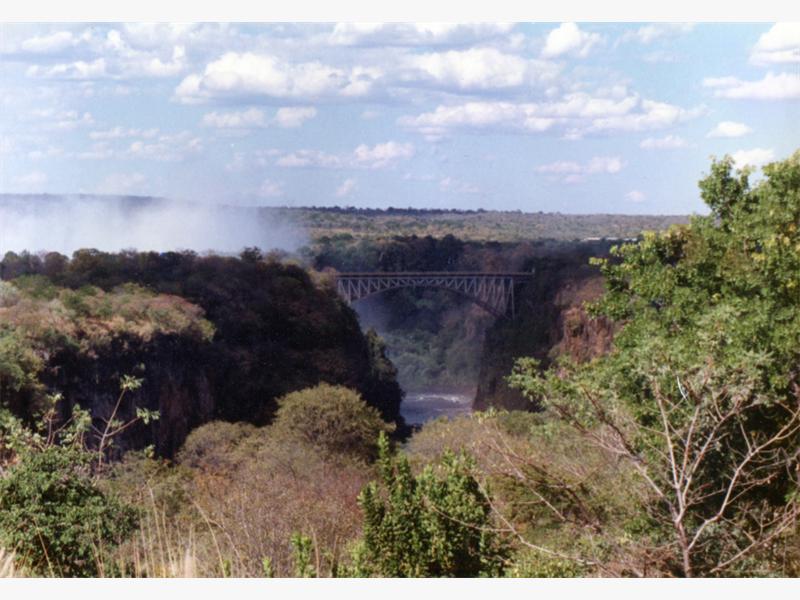
Of all the amazing sights you can see when you visit Zimbabwe there are few quite as impressive as the Zambezi River in full flood, thundering over the zigzag gorges that form world-famous Victoria Falls. At times, the spray is so dense it obscures the view. You have to wait for a breeze to waft it away so that you can glimpse the widest curtain of water in the world – 1 690 metres across and with an average drop of 92 metres.

The spray is also responsible for the famous Victoria Falls rainbows – and the beautiful setting of the world-renowned natural treasure. It transforms the surrounding dry bush into a mystical rain forest creating a scene, according to the usually pragmatic David Livingstone, so lovely that angels must have gazed upon it in their flight.
As impressive as they are in full spate, the falls are well worth visiting when there is less water and the actual formations are easier to see and appreciate. I am fortunate to have seen them in many different incarnations and they are always an awesome sight. There is never a bad time to see Victoria Falls and this iconic destination should be on the itinerary of any first time visitor to Zimbabwe, a country that offers so much to see and do.