SCIENTISTS from Canada, Britain and Norway believe they may have identified the oldest signs of life on Earth in tiny fossils found in Hudson Bay, Canada.
The fossils, if it is confirmed, show life sometime between 3.8 billion and 4.3 billion years ago.
The earth is about 4.57 billion years old and these fossils could be an indicator of life existing not long after the planet was formed.
This new discovery slots in with the recent find of 3.7 billion year old geological formations called stromatolites (bio-chemical structures) in Greenland.
Up to then the oldest stromatolites were in West Australia, dated at 3.46 billion years old.*
The really exciting thing about these remarkable discoveries is that there is increasing speculation among scientists that these are firm indications of there being life on other planets in the universe. So, we may not be alone.
YOU MIGHT ALSO BE INTERESTED IN : From my Hide: On greener gardening…
Staying in the past, many people will remember the discovery of Otzi the Iceman, a naturally mummified 5,300 year old body found in the Italian Alps in 1991.
Researchers using DNA have now analysed the hide clothing the Iceman was wearing when he died.
He was clearly a natty dresser and an opportunistic hunter at the same time. It seems that his loincloth was made out of sheepskin, his shoes and leggings goat hide, his laces cowhide, his quiver (he was carrying a bow) was roe deer hide and his very chic titfer (hat) was made from a brown bear. Indeed, a natty dresser.**
Meanwhile, a 500-year-old Portuguese shipwreck has been discovered off the Namibian coast.
She was the Bom Jesus, on her way from Lisbon to India when she disappeared in 1533.
Diamond miners have discovered the wreck and artefacts recovered so far include coins, swords, muskets and chain mail.**
From old news to new news, about the once huge hole in the Earth’s ozone layer above Antarctica.
Scientists monitoring the hole say that it has shrunk by about 2.5 million square kilometres since the year 2,000.
The main reason for this, they say, was the decision by world leaders back in 1987 to ban ozone-destroying CFCs (chlorofluorcarbons), which were used mainly in refrigerators and aerosol cans.
The scientists have predicted that the ozone hole may well close up altogether by 2050.**
YOU MIGHT ALSO BE INTERESTED IN : From my Hide: Mostly on birds
I was saddened to hear of the passing of Margaret Roberts, that great organic gardener and writer on healthy eating.
I remember interviewing her years ago about one of her many books, and ironically there is a jar of her onion and cucumber relish in the refrigerator even as I type.
She will be much missed – thank goodness we still have her recipes.
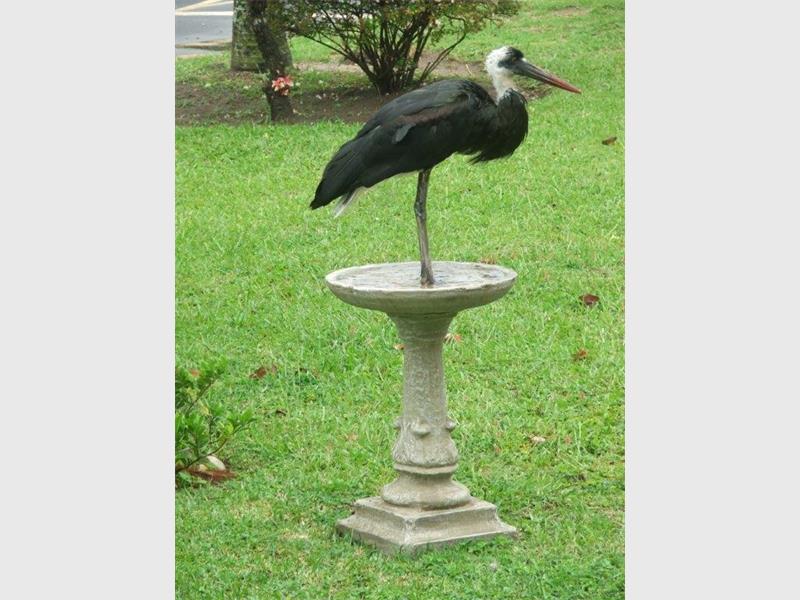
On a happier note, I’ve written about our woolly-necked storks before, but the other day we had one land in our bird bath.
Now I must point out that said bird bath was designed for normal garden birds, things like mossies and doves, so the arrival of this huge bird was somewhat unusual.
It just stood there surveying the scene, perhaps expecting a chunk of cheddar as a reward for its performance (woolly-necked storks love cheese).
*The Daily Maverick.
**The Week: The Best of the British and Foreign Media.
HAVE YOUR SAY
Like our Facebook page, follow us on Twitter and Instagram
For news straight to your phone, add us on BBM 58F3D7A7 or WhatsApp 082 421 6033