Daily spending? Why make a big deal of daily spending? Look at the balance below.
SALARY = COMPANY DEDUCTIONS + BANK & OTHER FIXED SPENDING + VARIABLE SPENDING
The amount we spend daily will all add up, and will be included in VARIABLE SPENDING. Because the daily amount may be small, we may be tempted to ignore the effect of daily spending.
YOU MIGHT ALSO BE INTERESTED IN : My Money, My Business, My Life: Other fixed spending – bank and other spending
Let’s assume we buy a loaf of bread, a litre of milk, a packet of chips, and a fizzy drink every day for seven days a week. We pay only about R60 each time. That’s a monthly total of 31 times R60. This total comes to R1,860. And over a year? That’s R22,320. I hope you can see where I am going with this. (Moreover, we are going to create a budget later – and to do this, we must know all our spending.)
Often, we don’t know how much we spend daily. This could get us into serious trouble: unmanageable debt often starts with very little overspending. To regain control of our monthly money, we may need to record daily spending. The table below would enable us to do this for a week. (The first row is just an example.)
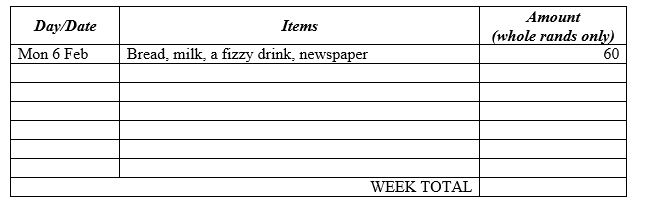
If you do this for four weeks and add the totals, you’d have a good idea of how much you need to budget for this. If you can’t afford what you see, then you need to cut back on what you buy.
Did I say, cut back on what you buy? Yes. Responsible money management may include some hard truths. And you have the most control over your variable spending.
It’s possible that you know already exactly what you spend daily (cash or card) each month, on those purchases you ‘pick up on your way home.’ You don’t need to bother with lists. Then that’s great. You may skip this blog – but keep that information for the detailed budget still to come.

Jay Pillay’s first two critical decades were spent where his first decade began – in Pietermaritzburg. After studying at ML Sultan Technikon in Durban (anyone remember that place?), he then joined the sugar industry, working in Tongaat, Durban, and Xinavane – a sugar mill village 120km north of Maputo. Oh yes – there was a brief period of unfaithfulness, when he flirted with aluminium in Richard’s Bay. Upon retirement, he and his wife Dorothy – settled in Southport.
Jay began writing about salary management (for ordinary people living on a salary) in the early 2000s. Many of his articles were published by The Ripple Effect, a Durban-based corporate newsletter. In all his writing, Jay says he attempts to emphasise the big picture in salary management: it’s not just about making it to your next payday – it’s about making it to the end of your working life. It’s not just about your working life – it’s about your retirement too. It’s not just about the cost of living – it’s about the cost of dying too. It’s not just about you as a salary manager – it’s about your dependants too.
HAVE YOUR SAY
Like our Facebook page, follow us on Twitter and Instagram
For news straight to your phone, add us on WhatsApp 082 421 6033