Very often, most of our spending is done per month. This makes it quite easy to add up all the monthly payments (for example: shop account + cell phone contract + funeral insurance premium + loan repayment).
ALSO READ : My Money, My Business, My Life: Daily spending – cash or card?
But some expenses arise annually. Think about the money spent during holidays, especially around December and January. Think about school fees and uniforms. Motor car and TV licences are also paid annually. House rates may be included here. If our budget does NOT cover annual expenses, we’d come fatally short several times during the year. A nightmare we could fall into, is creating huge debt during December and January, and spending the rest of the year paying it off. This is seriously stressful! It makes someone else richer.
Here’s a way we can solve this. We add ALL our annual expenses, and divide the total by 10. (It’s easier to divide by 10).
We now know how much we need to save monthly, to cover annual expenses in just 10 months. (For my annual expenses, I use an account that becomes available in November each year).
The table below shows how you may convert your annual expenses to a monthly expense.
A confession now. I’ve imagined that you want to get a new microwave oven, in December, and I’ve hidden that in this table too. Saving first, and then buying for cash, is an idea with unlimited potential.
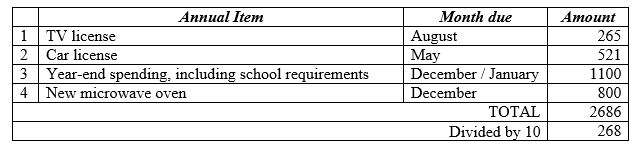
In this example, you can see that if you save R270 per month (slightly above R268), then you have a ‘bank’ from which you can draw money for your annual expenses (and your TV). All these payments don’t become due at the same time – this makes the system a little more difficult. But the basic idea is to save monthly for annual expenses. Once you’ve decided how much you need to save monthly for this, your bank may be able to help you.

If you have to place the cash in a coffee jar, or let Mom keep it for you, that’s okay. Think about the peace of mind you’d enjoy, if you could welcome the holiday season each year, knowing that the money you need is waiting for you! And it’s all your own!
Saving for annual expenses will appear on the monthly budget we will create soon. But before we get there, let’s take a short break, and rest our heads (until the next blog) on a ‘salary cushion’.

Jay Pillay’s first two critical decades were spent where his first decade began – in Pietermaritzburg. After studying at ML Sultan Technikon in Durban (anyone remember that place?), he then joined the sugar industry, working in Tongaat, Durban, and Xinavane – a sugar mill village 120km north of Maputo. Oh yes – there was a brief period of unfaithfulness, when he flirted with aluminium in Richard’s Bay. Upon retirement, he and his wife Dorothy – settled in Southport.
Jay began writing about salary management (for ordinary people living on a salary) in the early 2000s. Many of his articles were published by The Ripple Effect, a Durban-based corporate newsletter. In all his writing, Jay says he attempts to emphasise the big picture in salary management: it’s not just about making it to your next payday – it’s about making it to the end of your working life. It’s not just about your working life – it’s about your retirement too. It’s not just about the cost of living – it’s about the cost of dying too. It’s not just about you as a salary manager – it’s about your dependants too.
HAVE YOUR SAY
Like our Facebook page, follow us on Twitter and Instagram
For news straight to your phone, add us on WhatsApp 082 421 6033