Say you use your working budget every month for over 500 months (that’s 42 years – see the table/calendar above). That’s great, because you know where your money is going. But it could be that your spending is not distributed in the best possible way? Are all the spending categories covered? You need to work out a troubleshooting (or diagnostic) budget for your financial situation now. Then, when your situation changes (say you go from single to married), you need to look at this budget again.
ALSO READ : My Money, My Business, My Life: Ribbon/Bucket/Tap: The light comes on!
Think about the word MASTER. That’s what I call this diagnostic budget. Each letter of MASTER represents a category in spending money. This means there are just 6 categories. (This is a lot shorter than a working budget, which has to be more detailed.)
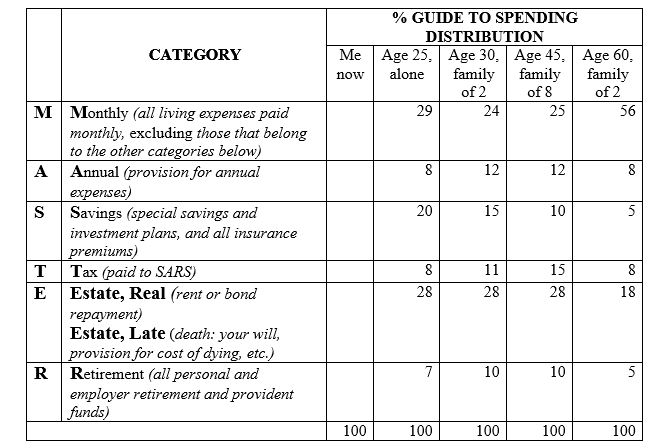
I think that the MASTER budget is brilliant – because of the dual purpose that E serves. Firstly, E is for Real Estate – and the cost of accommodation (rent or bond repayment) is easily the highest (or second highest) spending category. Then E for Estate Late is a constant reminder of something we’d rather not plan for. But now, you know. Finally, the MASTER budget is not absolute truth – it’s a gentle guide. It’s more about quality (what am I spending money on?) than it is about quantity (how much am I spending?)
Doing a MASTER analysis of how you spend money involves work. You’d need to look at your working budget, and then move each item to the correct category of MASTER.
Then you can calculate the subtotals and the percentages. (Use the Me now column in the table.) Only after this can you look at the big picture, and ask, am I spending my monthly money in the best way for me? You don’t want to be spending money for over 40 years, and then have regrets.
This troubleshooting budget may be the most difficult part of this series of blogs. If you need help, speak to your HR department, a financial advisor, or anyone you trust. If you have a child or nephew/niece in grade 10-12, they could help too. And they’d get some vital money management training at the same time.
We’re nearly at the end of My Money, My Business, My Life now. How to keep out of debt, and how to build wealth – these two topics are coming.

Jay Pillay’s first two critical decades were spent where his first decade began – in Pietermaritzburg. After studying at ML Sultan Technikon in Durban (anyone remember that place?), he then joined the sugar industry, working in Tongaat, Durban, and Xinavane – a sugar mill village 120km north of Maputo. Oh yes – there was a brief period of unfaithfulness, when he flirted with aluminium in Richard’s Bay. Upon retirement, he and his wife Dorothy – settled in Southport.
Jay began writing about salary management (for ordinary people living on a salary) in the early 2000s. Many of his articles were published by The Ripple Effect, a Durban-based corporate newsletter. In all his writing, Jay says he attempts to emphasise the big picture in salary management: it’s not just about making it to your next payday – it’s about making it to the end of your working life. It’s not just about your working life – it’s about your retirement too. It’s not just about the cost of living – it’s about the cost of dying too. It’s not just about you as a salary manager – it’s about your dependants too.
This 16-part series is being published here for the first time. It would be invaluable for salary managers in the early years of their lives – who realize that salary management is a lifetime business. Finally, it’s not just about reading stuff on salary management – it’s about careful thought (that means time, well invested), and then taking appropriate action.
HAVE YOUR SAY
Like our Facebook page, follow us on Twitter and Instagram
For news straight to your phone, add us on WhatsApp 082 421 6033